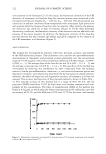
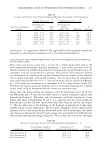
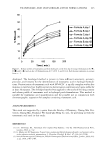
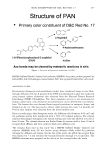
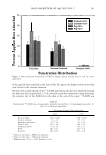
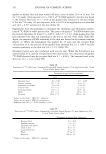
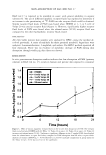
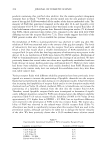
264 JOURNAL OF COSMETIC SCIENCE products contammg this certified color additive. For the suntan product (oleaginous ointment base in which 14 C-PAN was directly mixed into the oily product) studied, most of the applied PAN was washed off the surface of the skin as unabsorbed color. The majority of PAN that penetrated remained in the skin after 24 h, and typically a very small amount (0.02-0.33% of the applied dose) was found in the receptor fluid after 24 h for both human cadaver and porcine skin. Extended absorption studies (7 2 h) showed that PAN, which penetrated skin within 24 h, remained in the skin with little PAN diffusing out into the receptor fluid over 72 h. These results suggest that little of the PAN present in skin after 24 h is available for systemic absorption. No metabolism of PAN to 4-aminoazobenzene was observed in viable pig skin. Me tabolism of PAN was examined only in the extracts of the pig skin samples. The levels of radioactivity that were absorbed into the receptor fluid were extremely small and below a level that would allow a reliable determination of PAN metabolites in the receptor fluid. In spite of the fact that large amounts of radioactivity were present in the skin at 24 h, no metabolites of PAN were detected by HPLC analysis. Metabolism of PAN to 4-aminoazobenzene in skin would require the cleavage of an azo bond. We have previously shown that several other azo colors were significantly metabolized with azo bond cleavage in mouse, hairless guinea pig, and human skin (7). However, these colors had better water solubility and were more readily absorbed than PAN. Human skin samples in the current study were not analyzed for metabolism since they were from non-viable cadaver skin. Various receptor fluids with different solubility properties have been previously inves tigated as a means to increase the partitioning of lipophilic chemicals into the receptor fluids that have penetrated into skin during in vitro absorption studies. It has been shown that increasing the lipophilicity of receptor fluids used in in vitro absorption studies with chemicals such as Volpo 20, ethanol, methanol, BSA or cyclomethicone can increase the partitioning of a lipophilic chemical from the skin into the receptor fluid (5,8,9). Therefore, several lipophilic receptor fluids were investigated to determine if signifi cantly different absorption values for PAN were obtained given the different solubility properties (Table V) of various receptor fluids. Solubility of PAN in 6% Volpo 20 was approximately 37% higher than in HHBSS + 4% BSA, but no significant differences were observed in the penetration of PAN in the two receptor fluids. The lowest solu bility of PAN was observed in the ethanol-water (50:50) receptor fluid (Table V). Absorption was found to significantly increase when this receptor fluid was used in the penetration studies, although care had to be taken not to damage the barrier integrity of the skin. We have previously shown that a 50:50 methanol-water solution caused Table V Experimentally Determined Solubility of PAN in Lipophilic Receptor Fluids Lipophilic receptor fluid 6 wt% Volpo 20 3 wt% Volpo 20 1 wt% Volpo 20 HHBSS + 4% BSA Ethanol-water (50:50) Solubility of PAN (mg/ml) 0.26 0.23 0.12 0.19 0.04

SKIN ABSORPTION OF D&C RED NO. 1 7 265 damage to rat skin during an in vitro absorption study (8). This is likely the reason for the enhanced absorption of PAN with the ethanol-water receptor fluid in the current study, particularly since PAN had low solubility in this solution. The fate of chemicals left remaining in the skin at the termination of an in vitro study is a controversial area that requires additional study to determine how best to use data generated from in vitro absorption studies. Therefore, it is useful to determine the fate of chemicals retained in skin at the end of a 24-h in vitro absorption study. An extended (72-h) absorption study demonstrated that PAN retained in skin did not substantially move into the receptor fluid beyond the levels measured after 24 h. Often the skin reservoir is considered as a portion of the chemical available for systemic absorption. However, when the skin reservoir is significant compared to levels in receptor fluid, the contribution of the skin reservoir to systemic absorption should be examined. Under standing the fate of the skin reservoir will provide for a more realistic estimate of exposure. The exposure estimate is determined in part by the extent of the systemic availability of a chemical. The fate of chemicals that penetrate into skin after dermal application can greatly affect how systemic availability is calculated. Lipophilic chemi cals may be artificially retained in skin during in vitro diffusion cell absorption studies due to the inability of these chemicals to freely partition from skin into an aqueous receptor fluid. Other chemicals may be retained in skin due to processes such as binding that occur in both in vitro and in vivo studies (10). Our survey of cosmetic products finds that D&C red no. 17 is used in a very limited number of products (i.e., suntan products, shampoos, hair relaxers, nail enamels, and skin care products). It was found in only extremely small levels in the commercially available suntan product used in this study as dosing vehicles. Since a potential health concern was raised by the EU for this color additive, and the fact that color additives in the US require premarket approval and safety verification under the authority of the Federal Food, Drug and Cosmetic Act, the FDA will continue to monitor and evaluate all available data to assure that D&C red no. 1 7 use and levels in cosmetic products are not a health concern. Based on the current data, the agency has concluded that there is no basis upon which to take any regulatory action at this time. If the FDA determines that a health hazard exists, the agency will advise the public and will consider its regulatory options. REFERENCES (1) Code of Federal Regulations, Food and Drugs, April 2002 §74.1317 D&C Red No. 17. (2) T. E. Gottschalck and G. N. McEwen, International Cosmetic Ingredient Dictionary and Handbook, 11th Ed. (CTFA, Washington, DC, 2006), pp. 2054-2055. (3) SCCNFP (Scientific Committee on Consumer Products and Non-Food Products Intended for Consumers SCCNFP/0495101, final), Opinion of the SCCNFP concerning the safety review of the use of certain azo-dyes in cosmetic products adopted by the SCCNFP during the 19th plenary meeting, February 2002. (4) R. L. Bronaugh and R. F. Stewart, Methods for in vitro percutaneous absorption studies. IV. The flow-through diffusion cell,]. Pharm. Sci. 74, 64-67 (1985). (5) R. L. Bronaugh, R. F. Stewart, and M. Simon, Methods for in vitro percutaneous absorption studies. VII. Use of excised human skin,]. Phann. Sci., 75, 1094-1097 (1986). (6) SCCP (Scientific Committee on Consumer Products SCCP/0902/05), Opinion on the use of CI 26100 (CI
Purchased for the exclusive use of nofirst nolast (unknown)
From: SCC Media Library & Resource Center (library.scconline.org)