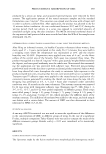
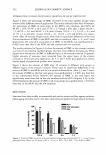
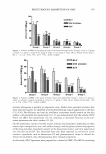
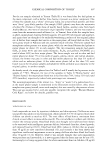
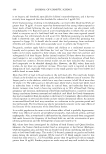
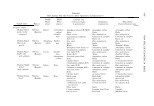
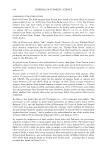
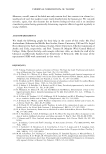
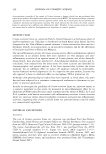
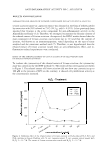
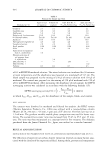
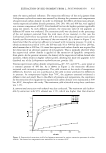
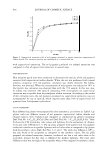
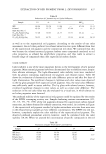
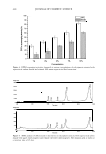
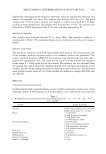
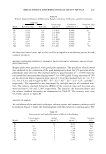
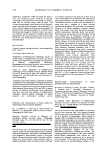
394 40 ..:I- 30 'o 20 'E ! 10 0 JOURNAL OF COSMETIC SCIENCE *- Group 1 Group2 Group 3 c:::JM..V OWenulsion -SLN Group4 Group5 Figure 5. Amount of OMC in the group of strips 5 hours after application. Group 1: strips 1-2 group 2: strips 3-7 group 3: strips 8-12 group 4: strips 13-17 group 5: strips 18-22. Values are the mean ± SD, n = 6 **p 0.01, ***p 0.001 vs MLV. Group 1 Group 2 Group 3 CJM..V OWemJsia, -SU/ Group 4 Group 5 Figure 6. Amount of OMC in the group of strips 7 hours after application. Group 1: strips 1-2 group 2: strips 3-7 group 3: strips 8-12 group 4: strips 13-17 group 5: strips 18-22. Values are the mean ± SD, n = 6 ns p 0.05, **p 0.01, ***p 0.001 vs MLV. OMC were converted to SUVs by probe sonication. The permeation of these two OMC containing formulations and a conventional o/w emulsion into the skin was investigated by tape stripping. The SPF of the OMC formulations was determined by an in vivo method in human volunteers. The results strongly indicate that MLVs are superior vehicles for OMC as a sunscreen due to their higher retention in the stratum corneum, limiting penetration to the deeper layers and providing appropriate SPF. To prepare MLV liposomes containing OMC (28), the fusion method, one of the suitable preparation methods for topical liposomes that provides homogenous MLV liposomes, was used. The presence of homogenous ML V liposomes containing OMC was confirmed by microscopic studies of the ML Vs and also size determination of ML Vs by particle-size analyzer. The fusion method is simple, efficient, reproducible, devoid of organic solvents like chloroform, and yields homogenous liposomes with high encapsulation efficiency. The encapsulation efficiencies for ML V and SUV liposomes containing OMC were 89.66 ± 2.0.8 and 89.7 ± 0.7 (n = 3), respectively, and no crystallization was observed in either formulation. The location of OMC in a liposome is probably associated in the

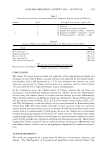
PERCUTANEOUS ABSORPTION OF OMC 395 hydrophobic interior of the liposome bilayer due to OMC's hydrophobic characteristics. This could be yet another reason for the high encapsulation efficiency of OMC in liposomes, since hydrophobic material in the right liposomal formulation could poten tially have encapsulation efficiency nearing 100 percent. Soybean PC was used for liposome preparations. Soybean PC contains polyunsaturated fatty acids like linoleic acid, which are beneficial for healthy skin. Furthermore, formu lations prepared by soybean PC increase the skin's humidity (40). In the liposome formulation cholesterol was included to stabilize the lipid bilayer and decrease the leakage of encapsulated drugs and vesicle aggregation (21,29). In this study, the SPF of the homosalate reference, the CO LIP A standard, ML Vs con taining OMC, and the o/w emulsion were analyzed. The results indicated that the SPF of the liposomes containing OMC was a little bit greater than that of OMC lotion at the same concentration. Ramon et al. (41) have also shown that liposomes could be regarded as alternatives to conventional o/w emulsions in the formulation of lipidic sun filters. They showed that when liposomes with a composition and structural organization similar to that of the stratum corneum lipids are used, skin penetration is retarded. There are different in vitro and in vivo techniques for the evaluation of skin permeation (16,17,42). In this study, the amount of OMC was investigated by a tape stripping method that is frequently used to investigate the penetration of topically applied sub stances into the skin (6,7 ,13,36). This method is a practical technique to selectively remove the stratum corneum of the skin and allows direct quantification of UV filters in the skin surface (15). Rougier et al. (43) established a linear relationship between stratum corneum reservoir content and percutaneous absorption using the standard urinary excretion method. The data obtained from this in vivo penetration study show that the ML V formulations delivered significantly higher amounts of OMC to the stratum corneum (total number of tape strips removed) than conventional lotion and SUVs. Since the intercellular lipids are important in controlling the percutaneous absorption, MLVs may mix with the intercellular lipids and cause their swelling without altering the multiple bilayer struc ture of the stratum corneum, and can produce an extra lipid barrier in the skin (8). Thus, MLV liposomes are able to provide a sustained release carrier system and act as a reservoir for OMC therefore, the sunscreen remains longer on the outermost layers of the skin. This property is important for sunscreens because the amount of the sunscreen agent inside the stratum corneum has a direct relationship with its sun protection value (7, 12), which has been confirmed by several other studies (10,18,19,23). In these studies, in vivo experiments have shown that liposomal encapsulation of drugs produces several-fold higher concentrations in the epidermis and dermis, with lower systemic concentrations compared to those in the conventional dosage forms (gel, lotion, and ointment) (10,18,19,23). The results support the possibility of developing products utilizing the liposomal dosage form that are superior to products utilizing the existing dosage forms for topical therapy (44). From the results obtained in our study, it was also demonstrated that higher amounts of OMC were recovered from the upper layers of the stratum corneum than from the deeper layers, with all formulations. It may be concluded that cutaneously applied free OMC is able to penetrate into the skin, but that with ML Vs the initial penetration into the upper layers improves OMC's permanence on the skin and the amount remaining in
Purchased for the exclusive use of nofirst nolast (unknown)
From: SCC Media Library & Resource Center (library.scconline.org)