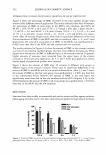
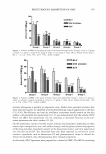
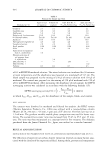
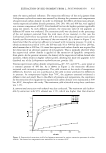
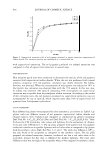
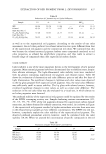
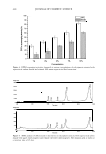
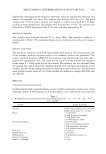
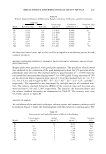
396 JOURNAL OF COSMETIC SCIENCE the upper surface of the skin. Other studies also confirm our observation that the concentration of the drugs is higher in the external layers and lower in the deeper layers of the stratum corneum when used in liposomal formulations (6,38). It is very interesting to note that the results obtained show that after 3 hours, the amount of OMC in the first strip group (strips 1-2) in the ML V formulation was lower than in the second strip group however, the total amount of OMC in the ML V for mulation was greater than in the other formulations. This could be explained by the fact that phospholipids in liposomes may mix with the intercellular lipids in the stratum corneum. Thus the intact liposomes are reduced in the first group of strips. However, in the subsequent groups of strips, the liposome size can affect skin penetration. This can cause liposome penetration to the surface of the skin and the accumulation effect in the stratum corneum, while conventional lotion may remain on the surface without pen etration to the skin. Although a higher amount of OMC is available in the first strip group in the o/w emulsion, this is not desirable, as it can easily be washed off from the skin surface. Our findings show that the SUVs penetrated into the skin significantly more than the OMC entrapped in the ML Vs and the conventional o/w emulsion, which could be due to the small sizes of these liposomes (mostly less than 100 nm). There are some studies that demonstrate that liposomes with small sizes can penetrate better into the skin (8,10,26), but conversely, there are some other reports that also claim a lack of this effect (39,43). Verma et al. (8) indicated that liposomes with a 120-nm diameter showed statistically enhanced penetration of carboxyfluoresein into the skin as compared to larger ones. It was observed in the Michel et al. (26) study that for tocopheryl nicotinate, there is a 1.5-fold greater amount of drug penetration with the small SUVs as compared to the larger Ml Vs. In contrast, in the same study they demonstrated that there is no difference in the penetration for SUV and MLV formulations containing an anti inflammatory substance (1440) (26). Du Plessis et al. (45) compared the skin penetration of three liposomal sizes of cyclosporine as a lipophilic drug. They observed the highest amount of cyclosporine in the surface of the stratum corneum and the lowest amount in the deeper portion of the stratum corneum of pig skin with 60-nm particle size, as compared to two other liposome sizes with an average of 300 nm and 600 nm. Sentjurc et al. (39) have proven that for some of their vesicular systems some transport into the deeper skin layers is observed. This penetration did not depend on vesicle size signifi cantly until the vesicle diameter of approximately 200 nm was reached. However, for small vesicles (with diameter less than 200 nm), the transport was significantly de creased. These studies show that the influence of liposome size on skin penetration depends on lipid composition, the nature of the drug, and also on the nature of the skin. Therefore, the penetration of liposomes to and through human skin can vary with composition and particle size, which furthers the need to investigate the effect of particle size for each specific drug incorporated in liposomes. This is an important aspect to optimize the topical formulation and to reduce the absorption into the skin. CONCLUSIONS The results of this study indicate that ML Vs prepared by the fusion method could be a better vehicle for OMC as a sunscreen since the MLV formulation has a slightly better SPF compared to conventional formulation and remains more in the stratum corneum,

PERCUTANEOUS ABSORPTION OF OMC 397 reducing its penetration to the deeper layers. Our study also clearly confirms that the vehicle and the vesicle's size affect the penetration of OMC and that penetration is enhanced significant! y in SUV s in contrast to ML Vs and a conventional o/w emulsion. ACKNOWLEDGMENTS The financial support of the Biotechnology Research Center and Pharmaceutical Re search Center, Mashhad University of Medical Sciences (MUMS), is gratefully acknowl edged. REFERENCES (1) M. R. M. Santoro, G.D. A. Oliveira, E. R. M. Kedor-Hackmann, and A. K. Singh, The effect of packaging materials on the stability of sunscreen emulsions, Int.]. Pharm., 297, 197-203 (2005). (2) J. B. Wilkinson and R. J. Moore, in Harry's Cosmeticology (Longman Scientific & Technical, Singapore, 1996), pp. 222-260. (3) G. J. Clydesdale, G. W. Dandie, and H.K. Muller, Ultraviolet light induced injury: Immunological and inflammatory effects, Immunol. Cell Biol., 79, 547-568 (2001). (4) W. Ting, C. D. Vest, and R. Sontheimer, Practical and experimental consideration of sun protection in dermatology, Int.]. Dermatol., 42, 505-513 (2003). (5) D. A. Godvin, N. H. Kim, and L.A. Felton, Influence of transcutol CG on the skin accumulation and transdermal permeation of ultraviolet absorbers, Eur.]. Pharm. Biopharm., 53, 23-27 (2002). (6) C. Couteau, N. P. Cullel, A. E. Cannan, and L. J.M., Coiffard, Stripping method to quantify absorp tion of two sunscreens in humans, Int.]. Pharm., 222, 153-157 (2001). (7) P. Treffel and B. Gabard, Skin penetration and sun protection factor of ultra-violet filters from two vehicles, Pharm. Res., 13, 770-774 (1996). (8) D. D. Verma, S. Verma, G. Blume, and A. Fahr, Particle size of liposomes influences dermal delivery of substances into skin, Int.]. Pharm., 258, 141-151 (2003). (9) M. Foldvari, Effect of vehicle on topical liposomal drug delivery, petrolatum bases,]. Microencapsul., 13, 589-600 (1996). (10) M. Mezei, "Liposomes and the Skin," in Liposomes in Drug Delivery, G. Gregoriadis, A. T. Florence, and H. M. Patel., Eds. (Harwood Academic Publishers GmbH, Switzerland, 1993), Vol. 2, pp. 125-135. (11) G. Potard, C. Laugel, A. Baillet, H. Schaefer, and J. P. Marty, Quantitative HPLC analysis of sun screens and caffeine during in vitro percutaneous penetration studies, Int.]. Pharm., 189, 249-260 (1999). (12) E. Chatelain, B. Gabard, and C. Surber, Skin penetration and sun protection factor of five UV filters: Effect of the vehicle, Skin Pharmacol. Appl. Skin Physiol., 16, 28-35 (2003). (13) C. Fernandez, G. Marti-Mestres, J. Ramos, and H. Maillols, LC analysis of benzophenone-3: II application to determination of "in vitro" and "in vivo" skin penetration from solvents, coarse and submicron emulsions,]. Pharm. Biomed. Anal., 24, 155-165 (2000). (14) H. Gustavsson, A. Farbrot, and 0. Larko, Percutaneous absorption of benzophenone-3, a common component of topical sunscreens, Clin. Exp. Dermatol., 27, 691-694 (2002). (15) M. M. Jimenez, J. Pelletier, M. F. Babin, and M. C. Martini, Influence of encapsulation on the in vitro percutaneous absorption of octyl methoxycinnamate, Int.]. Pharm., 272, 45-55 (2004). (16) L. Brinon, S. Geiger, V. Alard, J. Doucet, J. Tranchant, and G. Couarraze, Percutaneous absorption of sunscreens from liquid crystalline phases,]. Control. Release, 60, 67-7 6 (1999). (17) S. A. Wissing and R.H. Muller, Solid lipid nanoparticles as carrier for sunscreens: In vitro release and in vivo skin penetration,]. Control. Release, 81, 225-233 (2002). (18) M. Mezei and V. Gulasekharam, Liposomes-a selective drug delivery system for the topical route of administration: A gel dosage form,]. Pharm. Pharmacol., 34, 473-474 (1982). (19) M. Foldvari, A. Gesztes, and M. Mezei, Dermal drug delivery by liposome encapsulation: Clinical and electron microscopic studies,]. Microencapsul., 7, 479-482 (1990). (20) M. Mezei, Multiphase liposomal drug delivery system, US Patent. No. 4,761,288 (1988). (21) G. Gregoriadis, C. Kirby, P. Large, A. Meehan, and J. Senior, "Targeting of Liposomes: Study of Influence Factors," in Targeting of Drugs, G. Gregoriadis and J. Senior, Eds. (Plenium Press, New York, 1981), pp. 155-184.
Purchased for the exclusive use of nofirst nolast (unknown)
From: SCC Media Library & Resource Center (library.scconline.org)