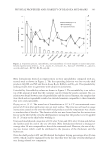
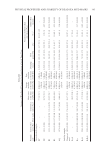
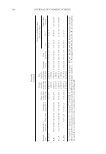
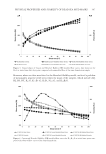
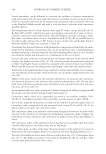
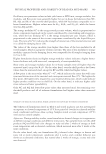
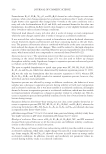
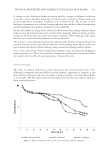
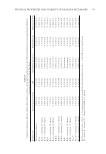
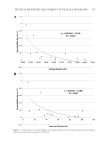
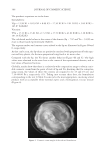
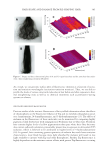
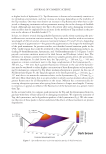
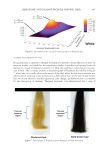
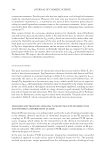
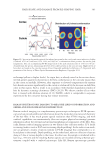
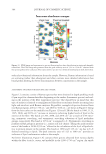
PHYSICAL PROPERTIES AND STABILITY OF DEAD SEA MUD MASKS 349 Oscillatory test parameter values include yield stress at LVE limit, storage modulus, loss modulus, and fl ow point were generally higher for our in-house formulations than NC, BS, AQ, and BL of the over-the-shelf products, while RV had values comparable to in- house formulations. Highest values were for K10, K5B5, and N0.05G, while the lowest were for AQ and NC. The storage modulus (G′) is the energy stored per unit volume, which is proportional to elastic component magnitude in the system contributed by cross-linking and/or aggrega- tion, while the loss modulus (G″) is the energy dissipated per unit volume, which is proportional to the extent of the viscous component contributed by the liquid-like por- tions. The ratio of G″/G′ indicates the strength of interaction of the internal structure and it is called the damping factor (20). The values of the storage modulus were higher than those of the loss modulus for all tested samples, which is a property of elastic systems. The ratio of loss modulus to storage modulus, expressed as the damping factor, was comparable for all samples (ranging from 0.21 to 0.29). Higher formulation elasticity (higher storage modulus values) indicates a higher formu- lation thickness and yield stress and, consequently, a lower spreadability. Shear stress and storage modulus values for in-house samples were all higher than the untreated mud, except for B10G. On the other hand, over-the-shelf products had lower values than the untreated mud, except for RV and BL, which had higher values. A fl ow point is the stress value when G′ = G″, which indicates the stress that will cause structural destruction of the material and consequent material fl ow (15). The higher the fl ow point, the higher stress required to cause material destruction, which could indicate higher product stability over its shelf life. On the other hand, it indicates higher yield stress values and lower spreadability. Only NC and AQ had lower fl ow point values than untreated mud, the remaining over- the-shelf products and all of in-house formulations had higher values than untreated mud. STABILITY OF DEAD SEA MUD MASK FORMULATIONS ON EXPOSURE TO STRESS CONDITIONS The behavior of formulations listed in Table I and stored in plastic jars was investigated on exposure to elevated temperature of 45°C for a period of 4 weeks (accelerated stability study conditions) and freeze–thaw cycling. Samples stored at room temperature (25°C) were used as control samples. Appearance. During stability studies, some formulations showed changes in its appearance at different storage conditions and different time points. Two samples from over-the-shelf products (AQ and BL) had color changes to rusty red after 2 weeks of storage at both room temperature and accelerated conditions, which increased more after 4 weeks at the same conditions. On the other hand, only one formulation (K10) showed color changes to brown and rusty red at room temperature conditions after 4 weeks, and a similar behavior was shown at accelerated conditions, but started after 2 weeks of storage, a rusty red color was observed.

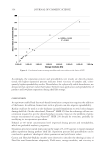
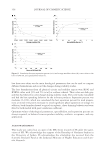
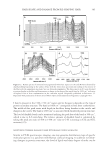
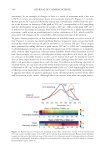
JOURNAL OF COSMETIC SCIENCE 350 Formulations K15G, K5B5, N0.05G, and K10B2G showed no color changes at room tem- perature, while color changes appeared at accelerated conditions after 2 weeks of storage slight brown color appeared that changed after 4 weeks at the same conditions into a rusty red color for formulations K15G and K5B5 and remained brown for the other two formulations. In addition, K5B5G started color changes to a very slightly brownish color after 4 weeks at only accelerated storage conditions. Untreated mud showed a rusty red color after 4 weeks of storage at room temperature while the same changes started after 2 weeks of storage at accelerated conditions. It was noticed that color changes occurred in formulations without hydrated aluminum silicate thickeners (kaolin and bentonite) and those containing kaolin as the sole thick- ener. The presence of bentonite alone or combined with kaolin at the same concentration level reduced the degree of color changes. This could be related to the high adsorption capacity of these materials that could bind whatever species responsible for color develop- ment, which may include iron compounds or carotenoids from Dunaliella (22). Separation percent (w/w). The separation percent test that was used as a tool in formulation screening at the initial development stages (13) was also used to follow up changes throughout stability study. Signifi cant changes in separation percent indicate early prod- uct failure on the shelf after marketing. The most acceptable formulations at initial time point were NC, BS, BL, B10G, K5B5G, K7.5B7.5G, and N0.05G, which were characterized by moderate separation percent (5–10%). AQ was the only one formulation that has extensive separation (10%), whereas RV, K15G, K10, K5B5, and K10B2G resulted in minimal separation percent however, they were thick and not easily spreadable. Separation percent was affected by storage at different conditions, the behavior of most samples was a decrease in separation percent during stability at both room temperature and accelerated conditions, but it was more notable at accelerated conditions all samples showed a decrease in separation percent at accelerated conditions, which was also notable in visual assessment of samples as a change in product texture to a thicker one. The de- crease in separation percent most probably attributed to the loss of water from the formu- lations during storage. Separation behavior after freeze–thaw testing was not clear some samples showed an in- crease in separation percent (RV, NC, BL, K15G, K10, K5B5G, and K10B2G), whereas the remaining formulations (BS, AQ, B10G, K7.5B7.5G, K5B5, and N0.05G) showed a decrease in separation after freeze–thaw cycles. pH values ranged from 7.93 to 8.32 at initial time point and during stability study there was slight variation in pH values (maximum pH change was 0.3 units). Rheological evaluation. Flow curves of K15G, K7.5B7.5G, K10B2G, NC, and RV remained deviated from typical behavior at all the time points and different stability conditions, similar to their behavior at initial time point. The main change in Casson yield stress values during stability was the notable increase at accelerated conditions, while only a slight change was noticed at room temperature stor- age. Some samples, BL and N0.05G, showed a decrease in yield stress on storage under accelerated conditions. In addition, viscosity and oscillatory test parameter values in- creased during stability study at accelerated conditions.
Purchased for the exclusive use of nofirst nolast (unknown)
From: SCC Media Library & Resource Center (library.scconline.org)