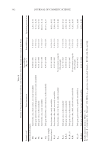
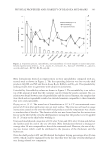
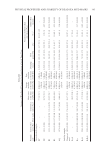
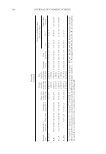
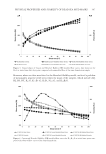
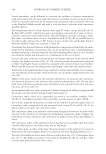
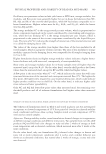
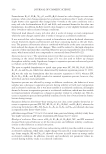
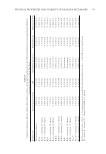
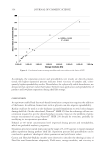
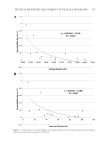
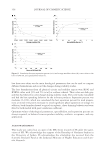
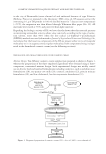
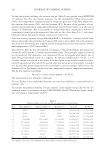
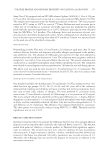
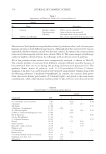
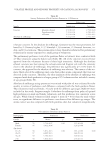
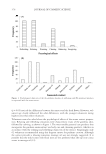
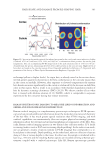
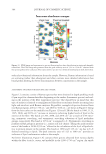
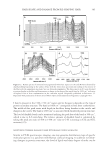
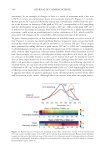
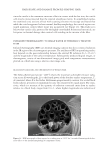
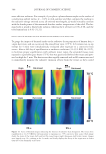
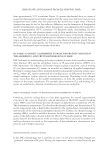
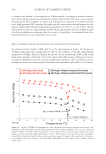
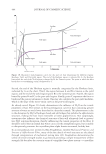
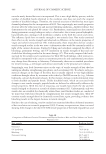
PHYSICAL PROPERTIES AND STABILITY OF DEAD SEA MUD MASKS 341 —Yield stress (Pa) at the limit of LVE —Storage modulus (G′, Pa) at the limit of LVE —Loss modulus (G″, Pa) at the limit of LVE —Flow point (Pa): the stress value when (G′ = G″). —Damping factor: the ratio of loss modulus to elastic modulus (G″/G′) Data analysis. Data were summarized as mean ± SD the mean value and SD values were calculated for a duplicate or triplicate measurements according to the methodology used. Coeffi cient of determination (R2) was used to evaluate the parameters (regression coeffi - cients) calculated from both rheological models (Casson and Herschel–Bulkley models). RESULTS AND DISCUSSION PREPARATION OF DEAD SEA MUD MASK FORMULATIONS Thickeners can change plasticity and alter the application characteristics of the fi nished product and are useful in stabilizing the dispersion of solids and preventing gradual phase separation, which is occasionally observed during the shelf life of clay masks (9). Dead Sea mud mask formulations were prepared using three different thickeners (bentonite, kaolin, and Natrosol® 250 HHX), which were added to the mud in powdered form. This mode of addition was used as a way to disperse the thickener within the mud without having to increase its water content. CHARACTERIZATION OF DEAD SEA MUD MASK FORMULATIONS Visual assessment. Visual assessment results are described in Table II samples varied in color from brown to dark gray and their consistency and thickness varied according to composition from easily extrudable formulations to thick formulations that were not easily extrudable. Natrosol® 250 HHX produced samples with a gritty texture, which may be attributed to the incorporation technique used for slow addition and mixing of Natrosol® as dry powder to the mud, which may have been inadequate to cause effi cient hydration and gelling of polymeric thickener. Separation percent (w/w). Separation percent decreased for all prepared formulas as com- pared with the untreated mud except for B10G and N0.05G, which showed separation values comparable to the untreated mud (Figure 2). Separation percent for over-the-shelf formulations was generally higher than that of the in-house formulations. In comparison to the untreated mud, separation percent of over- the-shelf products was lower in the case of BL and RV only, while AQ, BS, and NC showed higher separation percent than the untreated mud. Spreadability. Glycerin has been shown by our results (Figure 2) to be essential for formu- lation spreadability formulations prepared without glycerin, K10, and K5B5 were not spreadable using the spreadability testing procedure used in this study (no movement using the 0.1 kg weight) as can be seen from the results in Figure 2.

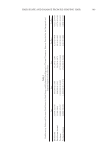
Table II Results of Visual Assessment, Spreadability, and Separation Tests for Formulations at Initial Time Point Formula code a Visual assessment Spreadability (Kg cm·s-1 ) Extrudability (g) Separation percent (w/w) Over-the-shelf samples RV Faint brown color, thick texture, not easily extrudable 0.008 ± 0.001 4.10 ± 0.17 4.20 ± 0.35 BL Dark gray and brown (nonhomogenous color), not easily extrudable 0.082 ± 0.011 3.45 ± 0.12 6.31 ± 0.29 NC Dark gray color, easily extrudable 0.181 ± 0.006 6.02 ± 0.33 9.84 ± 0.45 BS Faint brown color, easily extrudable 0.679 ± 0.186 4.75 ± 0.30 10.13 ± 0.11 AQ Dark gray and brown (color variation), easily extrudable 0.963 ± 0.064 7.94 ± 0.54 13.57 ± 0.27 Stability samples Untreated mud Gray-brown color, easily extrudable 0.053 ± 0.008 6.63 ± 0.12 8.85 ± 0.02 K 15 G Gray-brown color, thick, not easily extrudable 0.025 ± 0.003 5.40 ± 0.16 2.98 ± 0.41 K10 Gray-brown color, very thick, not easily extrudable No movement using the 100 g weight 6.61 ± 0.23 2.45 ± 0.49 B 10 G Dark gray color, easily extrudable 0.217 ± 0.043 9.17 ± 0.38 8.02 ± 0.52 K5BG5 Dark gray color, easily extrudable 0.099 ± 0.010 5.61 ± 0.27 4.99 ± 0.36 K7.5B 7.5 G Dark gray color, easily extrudable 0.054 ± 0.007 14.25 ± 0.53 5.34 ± 0.47 K5B5 Gray-brown color, thick, and not easily extrudable No movement using the 100 g weight 6.52 ± 0.21 4.26 ± 0.95 N 0.05 G Dark gray, gritty texture, acceptable extrudability 0.180 ± 0.022 7.66 ± 0.34 7.03 ± 0.88 K10B2G Dark gray color, thick, and not easily extrudable 0.041 ± 0.004 5.63 ± 0.21 4.05 ± 0.45 Results represent mean ± SD (n = 3). a K = kaolin, B = bentonite, N = Natrosol250 ® HHX, G = glycerin, over-the-shelf brands = RV, NC, BL, BS, and AQ. JOURNAL OF COSMETIC SCIENCE 342
Purchased for the exclusive use of nofirst nolast (unknown)
From: SCC Media Library & Resource Center (library.scconline.org)