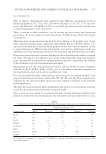
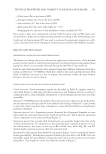
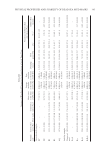
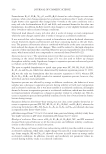
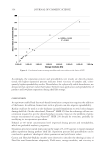
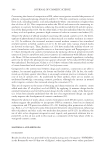
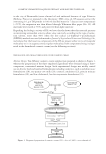
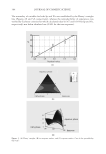
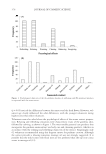
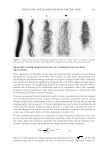
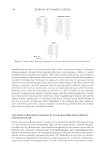
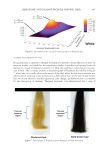
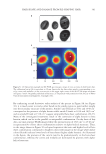
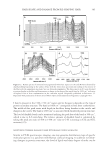
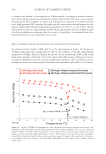
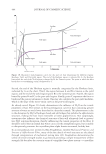
HAIR SHAPE AND DAMAGE FROM RE-SHAPING HAIR 381 MEASURING FIBER ORIENTATION BY TWO-DIMENSIONAL FOURIER TRANSFORM Fiber alignment is a desirable trait for characterizing hair fi ber assemblies since it defi nes the geometric arrangement of the fi bers. For example, one may wish to quantify hair that has undergone permanent waving treatment to monitor changes in hair shape. Similarly, hair relaxer treatments are employed to eliminate the curl of hair. Thus, one may seek to quantify the degree of straightening induced by relaxer treatment. We may also wish to measure the de-frizzing or de-volumizing capacity of a treatment. These fi ber assembly properties may be quantifi ed using image processing techniques in combination with two-dimensional Fourier transform analysis. In image processing, Fourier transform is used to remove repeating patterns from images, such as halftones from scanned images or periodic noise that can present itself in images obtained with certain instruments—these include transmission electron microscopy and scanning probe microscopies (11). Fourier transform may also be used to perform fractal analysis and to examine texture in images. Finally, it is also used to measure the orienta- tion and alignment in images. Specifi cally, image transform techniques have found par- ticular use in the quantifi cation of fi ber alignment of textiles (12). Fourier transform decomposes an image from its spatial domain of intensities into a fre- quency domain with appropriate magnitude and phase values. In the frequency form of the image, gray scale intensities represent the magnitude of the various frequency com- ponents. Analysis is typically performed by using discrete Fourier transform: -1 1 ( )= ( )e-i2 N uxN/ x=0 F f x N π (1) where N is the number of sampled points along the function f(x), i is 1, and F(u) the transform function. It determines the rate at which an intensity transition occurs in a Figure 1. Images of various types of hair illustrating their diversity in shape. Type I is classifi ed as straight European hair, Type II as wavy hair, Types III and IV as mulatto hair, and Type V as African-type hair.

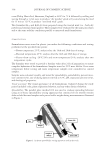
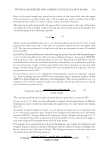
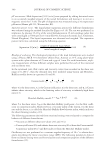
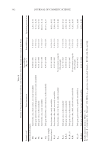
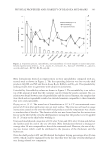
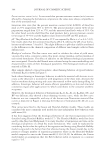
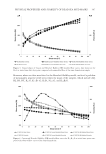
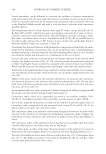
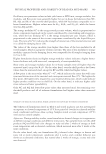
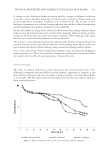
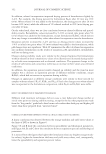
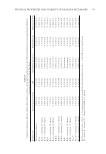
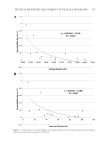
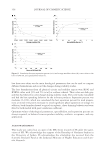
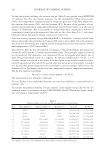
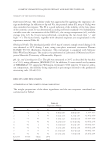
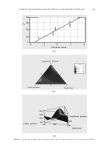
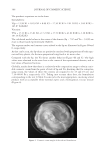
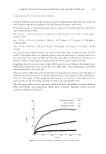
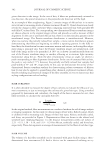
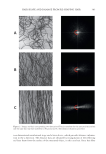
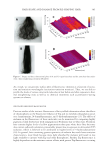
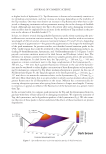
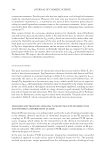
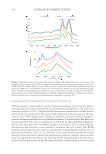
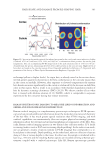
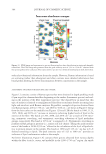
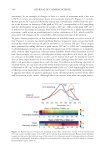
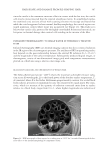
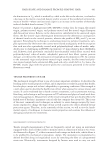
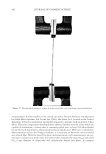
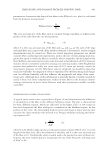
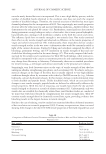
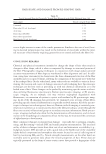
JOURNAL OF COSMETIC SCIENCE 382 given direction in the image. In the case of hair, if fi bers are predominantly oriented in one direction, the spatial intensities in the perpendicular direction will be high. As an example of fi ber straightening, Figure 2 contains images of African hair in its native state (A) and at increasing levels of relaxer treatment (B and C). Visual observation clearly reveals the change in fi ber curvature when comparing untreated hair with partially (B) and fully (C) relaxed hair. The corresponding two-dimensional Fourier transform images are shown adjacent to the original images of hair and provide us with a measure of fi ber alignment. In the case of untreated African hair, there is no directionality apparent in the transformed image. The Fourier transform distribution is omnidirectional. However, when we examine the partially relaxed hair sample, a more narrow distribution appears demonstrating that fi bers are beginning to exhibit a repeating pattern. In the fully re- laxed hair, the distribution becomes even more narrow and intense, indicating fi ber align- ment along a principle axis. Since the Fourier transform images are symmetrical, only half of the image needs to be quantifi ed. A 180° arc is drawn circumferentially from one axis of the Fourier transform image to another, allowing us to measure light intensity (luminosity) along the arc. From the plot of luminosity versus arc angle, we observe a peak corresponding to fi ber alignment distribution. In the case of untreated African hair, the peak is very wide (177°) however, the partially and fully relaxed hair samples had peak widths of 35° and 18°, respectively. In this case, we demonstrate the utility of two- dimensional Fourier transform analysis for characterizing relaxer treatments of African hair. It may also be applied to quantifying other chemical or physical treatments of hair, thereby resulting in geometrical changes of the fi ber assembly, or even to characterize hair styling confi gurations such as brading. HAIR CURLINESS It is often desirable to measure the degree of hair curliness to evaluate the effi cacy of cos- metic treatments, or just to investigate the curliness of a given hair type. Using a method proposed by Loussouarn and coworkers, the length of the hair is measured at rest, then fully stretched, to calculate the curl index (CI) (13): rest stretched Length CI= Length (2) In the original method, fi ber measurements are conducted without the aid of image analysis or imaging equipment. In this study, we obtain images of hair with a fl atbed scanner, which is calibrated with a measuring scale. Images of three hair types, African, artifi cially curled, and frizzy, are provided in Figure 3. Representative fi bers are shown in the relaxed and stretched state. Applying Equation 1 to the distance measurements yields curl indices of 2.25 ± 0.15, 1.58 ± 0.16, and 1.19 ± 0.24 for African, artifi cially curled, and frizzy hair, respectively. These data represent an average of measurements for fi ve fi bers of each hair type. HAIR VOLUME The volume of a hair fi ber assembly can be measured with great facility using a three- dimensional laser stereometer (14). Such a device can be constructed utilizing an x-y
Purchased for the exclusive use of nofirst nolast (unknown)
From: SCC Media Library & Resource Center (library.scconline.org)