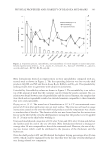
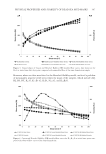
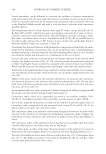
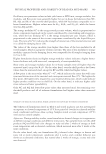
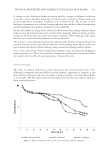
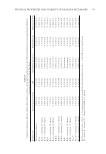
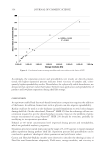
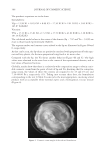
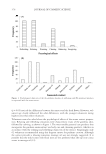
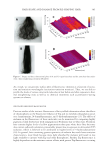
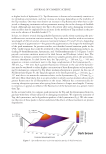
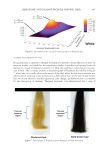
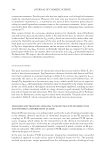
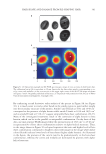
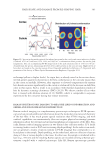
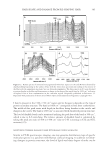
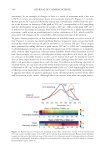
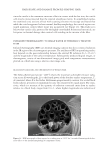
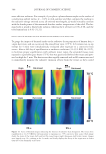
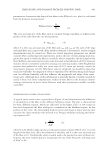
HAIR SHAPE AND DAMAGE FROM RE-SHAPING HAIR 399 from approximately 70°C to ambient. Figure 15 captures the thermal decay as a series of sequential thermograms and clearly suggests that the virgin tress (left tress) cools to room temperature more slowly than the previously fl at-ironed tress (right tress). Chemical changes that may be tied to the radiative differences are the formation of diisopeptide (amide) or lanthionine cross-links, where diisopeptide cross-linking has been reported to occur at approximately 165°C in keratin (33). Extensive amide cross-linking, via reac- tions between lysine and glutamic/aspartic acid (or their amides) may lead to a reduction in swell volume, thereby limiting the maximum water regain of thermally damaged fi - bers (29). Hence, one possible explanation for differences in the radiative decay rates for virgin and thermally damaged hair is that excessive thermal treatments rework the core fi ber structure and, subsequently, the kinetics of the essential water-binding, hydrogen bonding, and thermal capacity systems of the hair. DYNAMIC SCANNING CALORIMETRY TO MONITOR PROTEIN CHANGES IN THE AMORPHOUS AND CRYSTALLINE REGIONS OF HAIR DSC facilitates an understanding of the physicochemical states of the crystalline interme- diate fi laments (IFs) and the amorphous matrix, or IF-associated proteins (IFAPs). In a DSC experiment, the infl uence of thermal energy on phase transitions, such as melting (Tm) or glass transition (Tg) events, is recorded as a function of applied temperature. Heating or cooling characteristic materials facilitates measurable variations in heat capac- ity (Cp), where ΔCp may be monitored by recording excess, or differential, heat fl ow as a sample undergoes a phase, physical, or chemical transition. Depending on the thermal event, excess heat fl ows to the sample (endothermic), or from the sample (exothermic), relative to the empty sample pan. For example, glass transition (Tg) and melting (Tm) events are endothermic, whereas crystallization processes are exothermic. EFFECT OF THERMAL STYLING ON THE DENATURATION TEMPERATURE OF THE IFS Conveying excessive styling heat to a hair fi ber aggravates the natural organizational structure of the cortex as thermally induced alterations in IFs-IFAPs covalent bonding and/or IFAPs cross-link density decrease the degree of alpha keratin crystallinity (34,35). The denaturation temperature (TD) describes the thermal stability, and the position of TD on the temperature scale is kinetically controlled by the cystine-based cross-link density and viscosity of the non-helical amorphous matrix (36). Further, the thermal energy, or enthalpy (ΔHD), needed to unfold or denature the helix correlates with the structural ri- gidity of the alpha helices bound within the IFs (37). Physically speaking, DSC thermo- grams describe the denaturation of the secondary alpha-helical structure to random coils and beta domains via trends in the magnitudes of the endothermic denaturation tem- perature and enthalpy transitions. HIGH-PRESSURE DSC ANALYSIS OF HAIR In dry DSC methodology, hair is carefully cut into 1–2 mm pieces and then charged into “pinholed” aluminum DSC pans. During the experiment, water is evolved from the pan

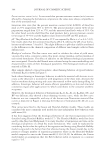
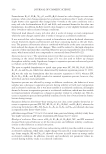
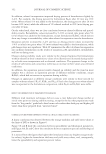
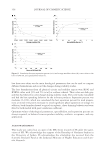
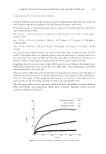
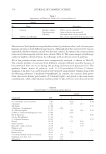
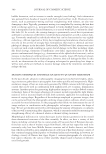
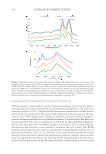
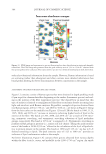
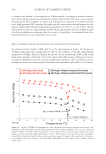
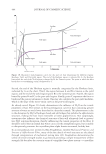
JOURNAL OF COSMETIC SCIENCE 400 as samples are heated to decomposition. Unfortunately, overlapping protein denatur- ation (TD) and decomposition endotherms confound the results. The issue is overcome by presoaking the fi ber snippets in water and subsequently charging into sealed stainless steel, high-pressure DSC capsules. By exploiting the water-plasticization behavior of the matrix, which shifts the hair denaturation peak from 230–250°C to 120–150°C, the TD and pyrolysis events are opportunely resolved. More importantly, the area of ΔHD is unaf- fected by prehydration, meaning that the extent of crystallinity is measurable since the helical structures are not tainted by excess water. EFFECT OF THERMAL HISTORY ON THE EXTENT OF ALPHA KERATIN CRYSTALLINITY As indicated in the trends in ΔHD and TD in the thermogram in Figure 16, the process of high-temperature fl at ironing (232°C) affects the stability of the IFs. Diminishing magnitudes of ΔHD, which is defi ned by the area of the endothermic DSC peak, result from prior exposure of the hair tress to the rigors of hot fl at ironing. Changes in the de- naturation enthalpy reveal that excessive temperatures infl uence the viscoelasticity of the amorphous matrix and subsequently destabilize the embedded alpha helices. In addition, Figure 16. Overlay of HPDSC thermograms for virgin, thermally styled virgin, polymer-treated virgin, and thermally styled and polymer-treated virgin European dark brown hair assemblies. The top curve (open red squares) shows a very faint endothermic peak at ~115°C, whereas the untreated virgin sample (red circles) displays a characteristically sharp endotherm at 140°C. The bottom curves show the results of polymer- treated fi bers, demonstrating that the protective polymer appears to preserve the endotherm for the heat- treated fi bers (open black squares). The individual endotherms have been offset on the ordinate axis for visual clarity.
Purchased for the exclusive use of nofirst nolast (unknown)
From: SCC Media Library & Resource Center (library.scconline.org)