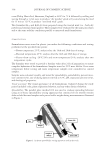
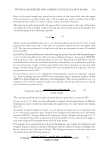
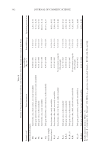
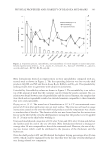
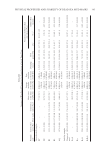
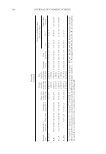
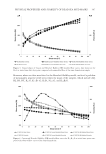
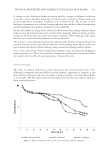
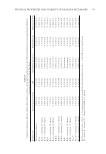
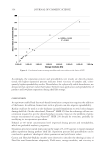
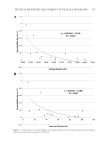
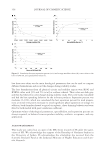
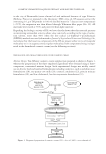
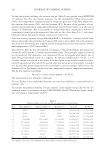
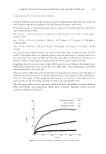
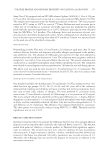
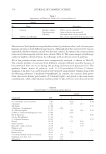
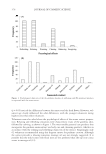
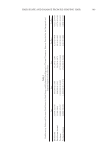
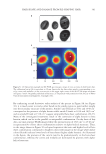
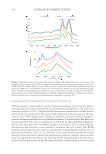
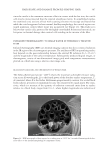
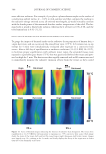
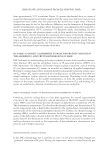
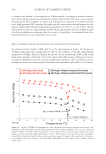
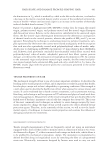
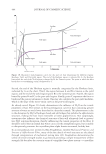
COSMETIC CREAM WITH AQUEOUS EXTRACT AND DATE FRUIT SEED OIL 367 CHARACTERIZATION OF THE SELECTED COSMETIC Stability. Table II represents the experience matrix, summarizing experimental conditions and obtained responses according to the full factorial design at two levels. From these results are then deduced the effects of the factors as represented by the follow- ing corresponding models: PI = 62.32 − 1.45 x1 + 1.93 x2 – 0.01 x3 + 1.102 x1x2 + 1.157 x1x3 − 0.425 x2x3 − 0.605 x1x2x3 Sp = 74.51 – 0.47 x1 + 0.20 x2 + 0.28 x3 − 0.533 x1x2 – 0.733 x1x3 + 0.358 x2x3 − 0.466 x1x2x3 Vis = 31.58 + 0.40 x1 – 2.66 x2 +0.18 x3 − 0.69 x1x2 – 0.74 x1x3 – 0.14 x2x3 – 10.66 x1x2x3 As it can be seen, different factors do not have the same effect on the responses. For Vis and PI, the highest effect (in absolute values) concerns the factor x2 (storage time). It is also clear that the content of DSO (x1) has the same effect on PI and Vis, tending to (i) protect cosmetic cream against oxidation and (ii) reduce the cosmetic viscosity. Regarding the interactions, some of their effects greatly exceed those of the main factors: DSO/time/temperature (case of the Vis) and DSO/time, time/temperature, and DSO/ time/temperature (case of the Sp). Rheological Profi le. Rheological measurements are important not only to assess the physical stability (36), but they are at the same time indicators of the quality of the analyzed sys- tem (37). The study of these properties has become a crucial tool in the analysis of cos- metic products, the aim being to produce stable structural profi les (38). The rheograms related to the enriched (added with DSO and DSAE), standard (without DSO and DSAE), and commercial (Mark Dove Unilever, Mumbai, India) cosmetic creams are displayed in Figure 5. Figure 5. Flow curves related to different cosmetic creams tested.

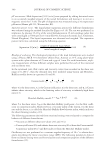
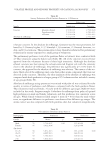
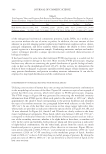
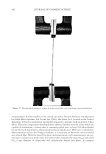
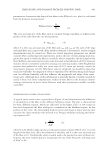
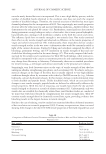
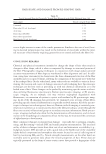
JOURNAL OF COSMETIC SCIENCE 368 Table III pH and Sp Values of the Three Compared Cosmetic Creams Parameter DSO/DSAE cosmetic Standard cosmetic Commercial cosmetic pH 6.33 ± 0.72b 3.71 ± 0.02c 7.92 ± 0.01a Sp (cm2) 14.78 ± 1.92a 14.99 ± 1.55a 15.97 ± 2.82a Ct (%) 100 100 100 a,b,c Same letters on the same line indicate the absence of signifi cant difference (p ≤ 0.05) between values. The rheological behavior of the elaborated cosmetic is similar to those of certain formula- tions studied by Djuris et al. (22), who have used cetearyl glucoside as a natural emulsifi er and a mixture of lipophilic coemulsifi ers as a stabilizer of the emulsion. The power model of Ostwald-de Wealk (37) was applied for modeling rheological behav- ior of the obtained cosmetic cream. τ = kγη where, τ is the sheer strain, k the uniformity index, γ the sheer rate, and η the fl ow index. The fl ow index for the three cosmetics is below 1: standard cosmetic (n = 0.2995), cos- metic added with date seed derivatives (n = 0.4151), and commercial cosmetic (n = 0.4669). The similar values between the last products must be noticed. From point of view of rheological behavior, the obtained cosmetic is of pseudoplastic type. This fi nding is concordant with that of Guaratini et al. (37) about a cosmetic cream added with vitamins A and E. Moreover, the same authors postulated that such confi gura- tion is suitable for cosmetics. Comparative Values of pH, Sp, and Ct. Table III shows that the pH values of the three com- pared cosmetics are statistically different (p ≤ 0.05), but those of the commercial and elaborated cosmetic are similar to the required pH. In opposite, the corresponding Sp and Ct values (Table III) are not statistically different (p ≤ 0.05) and are in the suitable range. CONCLUSION Globally, results show that there is a relatively wide range of ingredient proportions that allows one to obtain a suitable moisturizing cosmetic cream, according to the Sp and Vis. In opposite to the storage time, the DSO was found to act positively on the both Vis and PI. From point of view of rheological behavior, the obtained cosmetic cream is of pseudoplas- tic type. Since the results confi rm the feasibility of the studied cosmetic, it would be interesting to deepen certain analysis (statistics, stability, and dermatological testing). Considering the potential health of natural ingredients contained in the elaborated cos- metic cream, the latter has promising prospects. In particular, it may generate interest
Purchased for the exclusive use of nofirst nolast (unknown)
From: SCC Media Library & Resource Center (library.scconline.org)