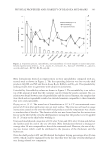
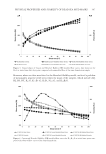
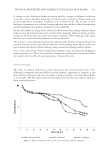
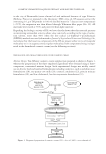
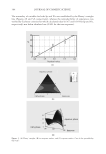
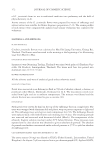
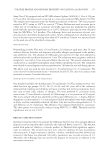
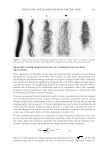
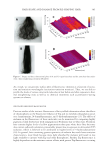
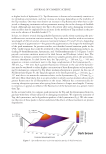
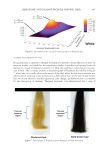
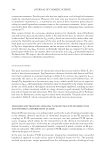
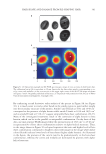
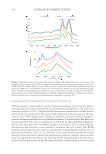
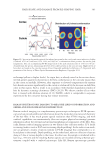
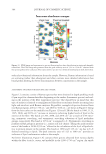
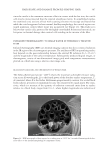
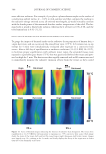
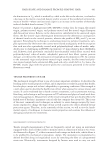
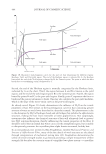
HAIR SHAPE AND DAMAGE FROM RE-SHAPING HAIR 393 red/orange/yellow to higher levels). In virgin hair, as already noted in the section above, we fi nd greater quantities of proteins in the beta conformation in the cuticular region than in the cortex or medulla. However, after exposure to elevated temperatures the amount beta keratin increases signifi cantly in the cortex as evidenced by the decrease in dark blue color in this region. Such a result is in accordance with thermal degradation studies of hair by dynamic scanning calorimetry (DSC) (28,29). We observe similar effects when hair is treated with alkaline solution (0.1% NaOH), which is comparable to exposure experienced by the consumer during hair relaxer treatment. RAMAN SPECTROSCOPIC IMAGING TO MEASURE LIPID CONFORMATION AND ORDER AND DISULFIDE BOND DISTRIBUTION Raman confocal imaging is a complementary spectroscopic technique to FT-IR spectros- copy and can provide additional information about the molecular structure and chemistry of the hair fi ber. It has much greater spatial resolution than FT-IR imaging, and with confocal capabilities can noninvasively (does not require physical sectioning) generate information about the external and internal morphological components of the fi ber. Typ- ically, Raman confocal imaging operates in two distinct data collection modes: X-Y lateral sectioning (surface scan) or X-Z cross sectioning (depth profi ling). In the surface scan mode, one can generate a matrix of spectra (similar to FT-IR imaging) that corresponds to a se- lected plane in the sample. Depth profi ling, on the other hand, refers to collection of spectra along a Z-line at various depths in the tissue. In either case, the sample is irradiated with a laser (e.g., 785 nm) and the resulting Raman spectra are recorded utilizing a Raman spec- trometer coupled with a confocal microscope. Like IR, Raman spectroscopy provides Figure 10. Spectra in the amide region of the infrared spectrum for the cuticle and cortex indicative of alpha (1548 and 1652 cm-1) and beta (1516, 1630, and 1695 cm-1) conformation of hair proteins. See text for peak assignments. Also, an accompanying FT-IR image based on the peak intensity ratio of 1516 to 1548 cm-1 obtained from the spectra, illustrating the level of beta sheet present in the cross sections. Higher levels of beta sheet are found in the cuticular region of hair. Originally published in Reference 25. Reprinted with permission of the Society of Photo Optical Instrumentation Engineers, Copyright 2011.

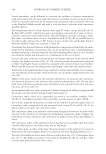
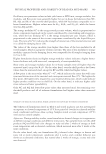
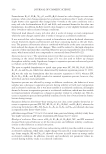
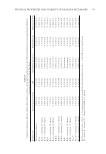
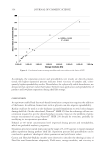
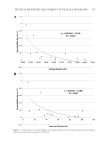
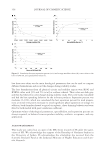
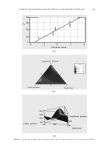
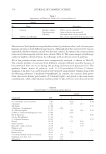
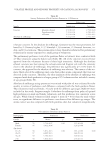
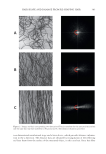
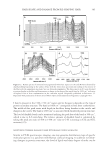
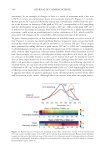
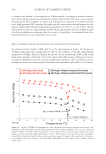
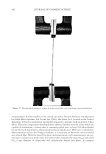
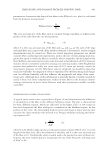
JOURNAL OF COSMETIC SCIENCE 394 molecular vibrational information about the sample. However, Raman information is based on scattering (rather than absorption) and often contains more detailed information (less broad peaks) allowing for better discrimination between constituents in the sample. ASSIGNMENT OF BANDS IN RAMAN SPECTRA OF HAIR Figure 12 contains a series of Raman spectra that were obtained in depth profi ling mode (2 μm steps) for a human hair fi ber beginning at the surface (lowermost spectra) and end- ing in the interior of the fi ber (uppermost spectra). One should bear in mind that this type of analysis is limited to nonpigmented hair fi bers as melanin absorbs incoming laser light and interferes with Raman emission. Regardless, examples of spectra obtained from two Raman regions, 400 to 1750 cm-1 and 2800 to 3020 cm-1, are shown in Figure 8. Going from the hair surface to the medulla (see Figures 12A and 12B) the bands at 1080, 1125, 1295, 2848, and 2878 cm-1 increase in intensity indicating higher levels of lipid in the interior of the fi ber. The bands at 1295, 2848, and 2878 cm-1 are a result of C–H twist- ing, symmetric stretching, and asymmetric stretching vibrations of lipid methylene groups, respectively. The band at 2934 cm-1 is assigned to C–H symmetric stretching in pendant methyl groups in proteins (i.e., amino acid side chains). Taking the peak intensity ratio of the bands at 2848–2934 cm-1 allows for the calculation of the level of lipid rela- tive to protein present in the sample. The bands at 1080 and 1125 cm-1 are due to C–C skeletal stretching in lipids. The peak intensity ratio of 1125 to 1080 cm-1 provides an indicator of lipid conformation order in the sample. For better illustration, Figure 12C contains three spectra obtained from various depths within the fi ber (cuticle, cortex, and medulla) in the 1200–1750 cm-1 region. An amide Figure 11. FT-IR image and representative spectra illustrating beta sheet distribution in virgin and thermally treated hair. The FTIR image was generated from the peak intensity ratio of 1516 to 1548 cm-1 obtained from the spectra gathered for each pixel. The representative spectra were obtained from European dark brown hair.
Purchased for the exclusive use of nofirst nolast (unknown)
From: SCC Media Library & Resource Center (library.scconline.org)