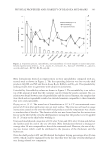
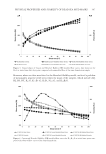
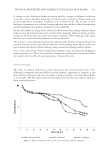
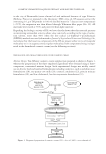
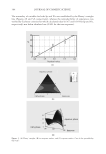
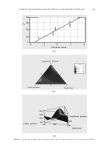
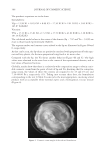
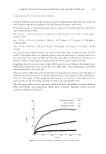
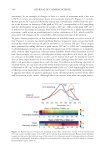
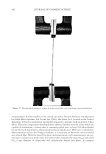
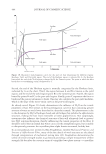
HAIR SHAPE AND DAMAGE FROM RE-SHAPING HAIR 405 component composed of IFs embedded in an amorphous matrix of disulfi de-rich globular proteins. During the extension of a keratin fi ber, reversible and irreversible changes occur throughout the various phases of the stress–strain curve. For example, alpha keratin structure is conserved throughout the Hookean region. This means that the fi ber can be extended up to the end of the Hookean region without infl icting permanent damage to the alpha keratin structure. Once we extend the fi ber beyond the Hookean limit (A), conformational changes are introduced and alpha keratin is converted to beta keratin. Fortunately, this process is reversible throughout the yield region. Therefore, stretching a fi ber up until the turnover point (B) will not lead to permanent changes in the crystal structure. It should be noted that approximately 30% of the alpha helix is converted to beta sheet in the yield region (42). When the alpha helix opens up, this changes the water management properties of hair—now, water can penetrate into the crystalline phase ma- terial. In the post-yield region, the fi ber stiffens with increasing elongation. It is believed that disulfi de cross-linking provides the major opposition force to extension in this re- gion of the load–elongation curve. By this point, changes in protein secondary structure (conversion of alpha keratin to beta keratin) are permanent along with other major irre- versible changes. One should also bear in mind that tensile measurements performed on a virgin, undam- aged fi ber are much different than those completed on hair with a rich history of abuse. Further, conducting one load–elongation procedure (through the break point) is distinc- tive from a series of cycles carried out in the Hookean or yield regions (extension followed by returning to the state of origin). Such repetitive insult studies may offer a more realis- tic approach to mimicking hair’s daily experience with brushing or combing. Alterna- tives to tensile strength measurements include mechanical fatigue and cyclical extension testing, which probably more accurately describe the forces encountered in daily groom- ing (41,43,44). Moreover, the forces generally encountered in tensile testing can often exceed that required to pull a fi ber, including the follicle, from the scalp (45). Neverthe- less, tensile testing provides us with greatly needed information on the overall physical condition of the fi ber. EFFECT OF DAMAGING TREATMENTS ON HAIR MECHANICAL PROPERTIES A great deal of work has been conducted on the effects of bleaching and its infl uence on the tensile properties of hair. Robbins gives a review of this material where he outlines several important concepts (41). Findings suggest that wet tensile strength is more sus- ceptible to bleaching than dry tensile strength. Bleaching damages disulfi de bonds, con- verting cystine (disulfi de bonds) to cysteic acid. More than likely, the hair fi ber is more accessible by H2O (especially in the matrix), in the absence of disulfi de bonds, thereby disrupting hydrogen bonds and making the fi ber more extensible (weaker tensile strength). We should also expect that the porous structure of bleached hair, due to de- composition of surface and internal lipids, might also play a role in facilitating H2O ac- cess to the interior of the fi ber. Likewise, a considerable amount of work has been completed to better understand the mechanical properties of permanently waved hair. Similar to the case of bleaching, permanent waving affects the dry tensile properties of hair less than the wet tensile properties. During the permanent waving process, disulfi de bonds (cystine) in hair are reduced (cleaved), and then reformed by oxidative treatment

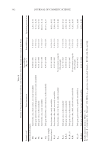
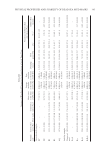
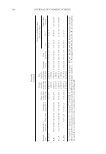
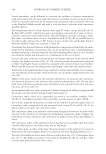
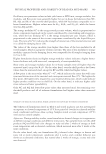
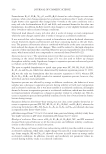
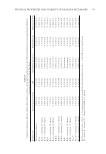
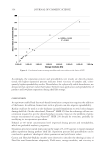
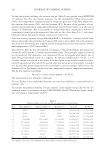
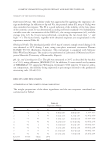
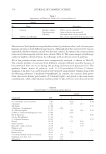
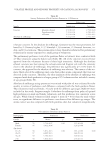
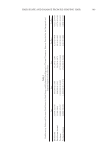
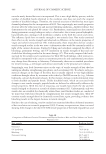
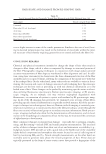
JOURNAL OF COSMETIC SCIENCE 406 once the newly desired hair set is incorporated. This is not a high fi delity process, and the number of disulfi de bonds reformed in the oxidation step does not reach the original number of disulfi de linkages. Therefore, the internal structure of the fi ber has more open channels/pathways for the incorporation of H2O. Not surprisingly, wet tensile properties decrease after the reduction step and increase following oxidation—further evidence that demonstrates the role played by cystine (41). Furthermore, many lipids are also removed during permanent waving leading not only to a hair surface that is more porous/hydrophilic, but probably also a damaged cell membrane complex in the both the cuticle and cortex. The infl uence lipids have on tensile strength is not entirely clear. One study examined their effect on dry tensile strength and observed no difference in the tensile properties of virgin and solvent extracted hair (46). Unfortunately, these researchers did not conduct tensile strength studies in the wet state—information that would be extremely useful in light of the current discussion. Studies by Cheng and coworkers compared the effects of bleaching, permanent waving, and UV irradiation on tensile strength of hair and con- cluded that bleaching resulted in the most damage (47). This study compared the break- ing load for the samples and is summarized in Table III. Such fi ndings, while instructive, should be interpreted with caution as treatment protocols and experimental procedures may change from laboratory to laboratory. Unfortunately, there are no standard procedures for tensile testing—a technique used almost universally in the personal care industry. Surprisingly, very little literature exists on the topic of tensile strength of hair that has undergone alkaline straightening procedures, such as relaxing (48). To achieve such geo- metrical changes in the shape of the fi ber, hair is usually exposed to very high alkaline conditions brought about by treatment with either lye (NaOH) or non-lye (e.g., lithium hydroxide, calcium hydroxide) relaxers. In this manner, damage is indiscriminately done to both disulfi de and peptide bonds. Unlike disulfi de bonds, which are associated with changes in wet tensile strength, peptide bonds are believed to additionally infl uence dry tensile properties. With this line of reasoning, one would expect both the dry and wet tensile strength to decrease as a result of relaxer treatment (41). Unfortunately, only wet tensile data are available for chemically relaxed hair until further studies are conducted we must wait with bated breath for complimentary dry tensile strength data. Table IV contains tensile strength data for chemically treated hair again, providing evidence that bleaching results in the largest decrease in tensile strength. Similar to the case of relaxing, very few studies have examined the effects of thermal treatment of hair in relation to its tensile properties (8,49). Contrary to expectations, there is a trend showing little change in the dry (65% RH) tensile properties of thermally exposed hair and Table III Comparison of Different Chemical Treatments and Physical Insults to Hair and Their Infl uence on Tensile Properties (47) Hair sample Breaking load (N) Untreated 94.13 UV irradiation 76.95 (96 h) Bleaching 75.22 (12% H2O2) Permanent waving 89.25 (pH 7) 78.53 (pH 9) 76.28 (pH 10)
Purchased for the exclusive use of nofirst nolast (unknown)
From: SCC Media Library & Resource Center (library.scconline.org)