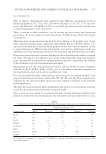
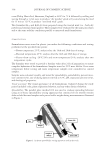
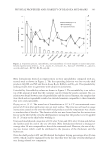
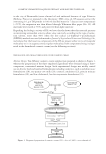
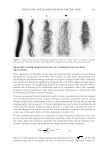
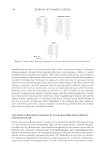
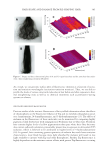
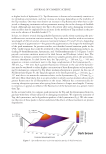
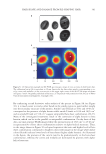
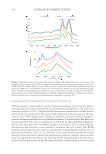
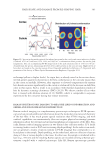
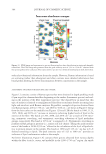
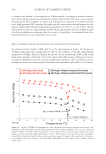
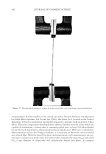
JOURNAL OF COSMETIC SCIENCE 380 bubble formation, and an increase in tensile strength (cross-linking). Such information was garnered from decades of research with both wool and hair (4–8). Chemicals treat- ments, such as permanent waving and hair straightening with relaxers, are also very damaging to hair. Typically, permanent waving is accomplished by treating the hair fi rst with a reducing agent (e.g., mercaptoethanol) to break disulfi de bonds, and then once hair is manipulated in the desired formation, it is treated with H2O2 to reform the disul- fi de links (9). As a result, the ensuing damage to permanently waved hair is paramount and leads to a reduction of the fi ber’s overall mechanical properties as well as surface dam- age. Commonly employed by individuals whose hair can be characterized as very tightly curled (e.g., African-type hair) or frizzy, hair straightening formulations (chemical relax- ers) rely on the activity of strongly basic formulations that result in chemical and mor- phological changes in the hair shaft. Traditionally, NaOH-based (lye) relaxers were used to carry out such a task, resulting in a great deal of damage to the fi ber including: disul- fi de bond cleavage, formation of lanthionine cross-links, supercontraction of the fi ber, protein conformational changes (e.g., denaturation of the alpha-helical structure), and an increase in mechanical combing forces (10). More recently, lower pH chemical relaxers have been introduced into the market place however, they still damage the fi ber. In this article, we demonstrate the utility of imaging techniques for quantifying hair shape as well as state-of-the-art methods to monitor damage induced by treatments intended to reshape the hair. IMAGING TECHINQUES AND IMAGE ANALYSIS TO QUANTIFY HAIR SHAPE In the past decade, advances in photographic imaging have reached new heights, allow- ing scientists to gather data in pictographic form rather quickly and inexpensively. High- resolution images of hair are now easily generated by DSLR cameras with full exposure control that can be used in combination with sophisticated, yet economic, illumination systems. Another option for generating high-quality images is to utilize fl atbed scanner technology. Some of the major advantages of scanners include reproducible light illumi- nation as well as increased depth of fi eld, both extremely applicable for examining hair tresses of varying shape. Regardless of the technique employed to generate images, data can be extracted from the photographs utilizing image analysis software, which is easily accessible for most laboratories. In the paragraphs that follow, we demonstrate the use of image analysis in combination with photographic techniques to measure the shape of hair. We are specifi cally interested in determining the amount of frizziness or curliness of hair as well as monitoring fi ber alignment, which is extremely useful for measuring the straightening effi cacy of a chemical relaxer or thermal styling treatment. Morphological differences in various hair types lead to distinct geometries in the overall three-dimensional structure of the fi ber assembly. In effect, we have a variety of hair shapes including: extremely fi ne to coarser grades of Caucasian hair of European descent, frizzy hair such as that of mulatto origin from Brazil, African hair types that tend to be extremely curly, hair from Middle Eastern countries and of Arabic descent, and Asian hair, which is probably a gross simplifi cation of a selection of hair from distinct corners of this continent ranging from Japanese to Southern Indian and everything in between in- cluding a variety of Chinese hair types. Figure 1 contains photographs of a selection of hair types to illustrate the variety of fi ber assembly shapes found in humans of different racial backgrounds.

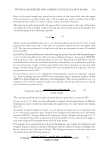
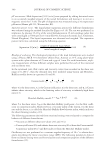
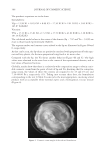
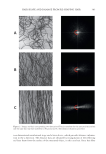
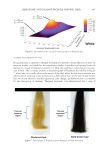
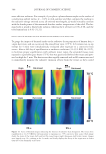
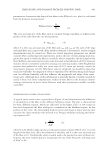
HAIR SHAPE AND DAMAGE FROM RE-SHAPING HAIR 381 MEASURING FIBER ORIENTATION BY TWO-DIMENSIONAL FOURIER TRANSFORM Fiber alignment is a desirable trait for characterizing hair fi ber assemblies since it defi nes the geometric arrangement of the fi bers. For example, one may wish to quantify hair that has undergone permanent waving treatment to monitor changes in hair shape. Similarly, hair relaxer treatments are employed to eliminate the curl of hair. Thus, one may seek to quantify the degree of straightening induced by relaxer treatment. We may also wish to measure the de-frizzing or de-volumizing capacity of a treatment. These fi ber assembly properties may be quantifi ed using image processing techniques in combination with two-dimensional Fourier transform analysis. In image processing, Fourier transform is used to remove repeating patterns from images, such as halftones from scanned images or periodic noise that can present itself in images obtained with certain instruments—these include transmission electron microscopy and scanning probe microscopies (11). Fourier transform may also be used to perform fractal analysis and to examine texture in images. Finally, it is also used to measure the orienta- tion and alignment in images. Specifi cally, image transform techniques have found par- ticular use in the quantifi cation of fi ber alignment of textiles (12). Fourier transform decomposes an image from its spatial domain of intensities into a fre- quency domain with appropriate magnitude and phase values. In the frequency form of the image, gray scale intensities represent the magnitude of the various frequency com- ponents. Analysis is typically performed by using discrete Fourier transform: -1 1 ( )= ( )e-i2 N uxN/ x=0 F f x N π (1) where N is the number of sampled points along the function f(x), i is 1, and F(u) the transform function. It determines the rate at which an intensity transition occurs in a Figure 1. Images of various types of hair illustrating their diversity in shape. Type I is classifi ed as straight European hair, Type II as wavy hair, Types III and IV as mulatto hair, and Type V as African-type hair.
Purchased for the exclusive use of nofirst nolast (unknown)
From: SCC Media Library & Resource Center (library.scconline.org)