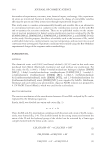
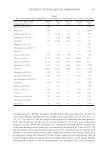
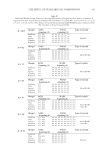
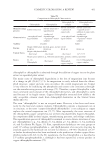
384 JOURNAL OF COSMETIC SCIENCE humidity, and PM and VOC concentration inside the simulation chamber were con- tinuously monitored during all the experiments. Receptor solutions were continuously stirred using Teflon-coated magnetic stirrers. Strat-M® membranes (14 mm diameter, being the exposed surface of 0.7 cm2) were used in the modified vertical diffusion cells as skin simulants (26). Effectiveness of the antipollution cosmetics was evaluated by homogeneously applying 2 mg product per cm2 exposed membrane, being this side of the membrane in contact to the contaminated atmosphere. Control experiments were performed with the Strat-M® membrane at the same conditions without cosmetic application. The amount of hazard- ous organic compounds present in the membrane and receptor solutions were determined after different exposure times. DETERMINATION OF HAZARDOUS ORGANIC COMPOUNDS FROM CIGARETTES IN THE SIMULATION CHAMBER The concentration of hazardous organic compounds inside the chamber was measured by active sampling using a low-volume personal air sampling TUFF Standard from Casella measurements (Bedford, UK), operating with a low flow adaptor at a flow rate of 40 mL min−1 for 5 min. Glass thermal desorber (TD) tubes, capped with perfluoroalkoxy-polytet- rafluoroethylene (PFA-PTFE) ferrules, were obtained from Perkin Elmer (Waltham, MA). TD tubes were filled with 150 mg of Tenax TA (35–60 mesh) provided by Alltech (Selms- dorf, Germany). Tenax was conditioned prior to sampling at 300°C during 2 h. Active sampling pump flow was regulated using an ADM calibrated flowmeter (Agilent Technologies, Palo Alto, CA) before each sampling. After sampling, tubes were capped with PFA-PTFE ferrules and stored at −20°C until analysis. TD tubes were thermally desorbed using a Turbo Matrix series TD from Perkin Elmer coupled to a Trace GC-Polaris Q gas chromatography-mass spectrometry (GC-MS) detector from Finnigan (Waltham, MA), equipped with an Agilent HP-5MS capillary column (30 m, 0.25 mm, 0.25 μm). Thermal desorption was carried out at 260°C for 20 min using a 75 mL min−1 helium flow rate and desorbed analytes were transferred to a Tenax cold trap at −10°C. A quick trap desorption was carried out at 270°C at 99°C s−1 and the analytes were desorbed and directly transferred to the chromatographic column, using a transfer line set at 275°C, with a helium constant flow of 0.8 mL min−1 and a split flow of 1:15. GC temperature program was 40°C, held for 8 min, increased at rate of 20°C min−1 up to 200°C, and held for 2 min. MS ion source and transfer line temperatures were set at 300°C and 250°C, respectively. Full scan acquisitions were performed using a mass range from 50 to 200 m/z. Calibration curve was prepared in Tenax packed TD tubes spiked with 10 μL target ana- lytes standard prepared in acetone, with a final added amount from 0.1 to 4.0 μg. Addi- tionally, 10 µL toluene-d 8 internal standard solution (10 mg L−1 in acetone) was added inside the Tenax tube. Table II shows m/z ions, retention time, and analytical features of studied compounds. For the analysis of hazardous organic compounds absorbed in the synthetic membrane, a similar procedure was used introducing in TD tubes 25 mg of Strat-M® membrane. Calibration curves were prepared in TD tubes loaded with 25 mg of Strat-M® membrane and spiked with 10 μL target analytes standard prepared in acetone, with a final added amount from 0.1 to 4.0 μg. Additionally, 10 µL toluene-d 8 internal standard solution (10 mg L−1 in acetone) was added.

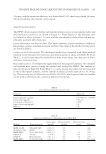
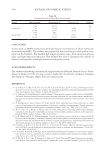
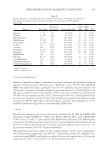
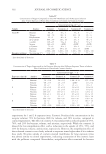
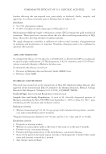
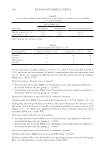
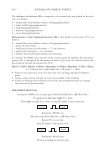
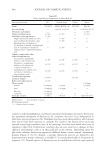
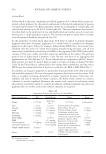
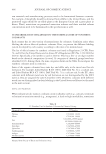
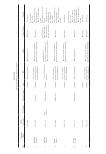
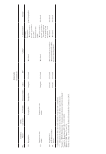
385 SKIN PERMEATION OF HAZARDOUS COMPOUNDS HS-GC-MS DETERMINATION Analysis of hazardous organic compounds in receptor solutions was performed using an Agilent 7697A head space (HS) injector, a 7890A GC, and a 53975C inert XL EI/CI MSD with triple-axis single quadrupole detector. Five milliliter receptor solution and 200 ng mL−1 of internal standard (toluene-d 8 ) were introduced in a 10-mL HS glass vial. HS vial was hermetically closed, heated at 60°C for 20 min, and HS was measured by GC-MS. Injector temperature was 250°C, employing 0.8 mL min−1 constant flow helium as carrier gas. Capillary column and GC oven temperature program were that previously described in TD-GC-MS analysis. Electron-impact ionization was performed at 70 eV and MS acquisitions using selected ion monitoring (SIM) mode. LC-MS-MS Nicotine determination in receptor solution was performed by LC-MS. An UHPLC-MS instrument model ACQUITY ® TQD, from Waters (Milford, MA), with a KINETEX C18 evo (50 x 2.1 mm, 1.7 µm) column, from Phenomenex (Torrance, CA). Mobile phase consisted of 50 mM ammonium acetate in water (A) and methanol (B). Gradient elution from 5% to 95% mobile phase B in 2 min was used with a flow rate of 0.4 mL min−1, a 5 µL injection volume, and 30°C column temperature. MS acquisitions were done using 3.5 kV capillary voltage, 120°C source temperature, 300°C desolvation temperature, and 690 L h−1 desolvation gas flow rate. Multiple reac- tion monitoring (MRM) conditions were adjusted for nicotine and nicotine-d 4 , being the transitions m/z 163 → 130 and 167 → 136, respectively selected. Table II Analytical Features, Including Selected Ions and Retention Time, of the Organic Compounds Determined in Cigarette Smoke by Active Sampling and Analyzed by TD-GC-MS and HS-GC-MS Analyte Ions (m/z) Retention time (min) Lineal range (ng) LODa (ng) LOQb (ng) R2 Benzene 77, 78 2.50 20–4,000 6 20 0.995 Toluene 91, 106 4.43 20–4,000 6 20 0.998 Chlorobenzene 112 7.63 200–4,000 50 170 0.978 Ethylbenzene 91, 106 8.57 100–4,000 30 100 0.997 m+p-xylene 91, 106 9.27 200–4,000 60 200 0.992 Styrene 116 10.62 500–4,000 150 500 0.984 o-xylene 104 10.65 200–4,000 50 170 0.994 p-Cymene 91, 117 13.40 350–4,000 100 330 0.985 Limonene 67, 93 13.47 200–4,000 60 200 0.999 Naphthalene 128 15.10 20–4,000 5 17 0.994 Nicotine 84, 133 16.30 200–4,000 50 170 0.989 Acenaphthylene 152 17.00 20–4,000 5 17 0.979 2-methylanthracene 192 18.32 100–4,000 25 83 0.996 1-methylphenanthrene 192 19.60 100–4,000 25 83 0.996 a Limit of detection b Limit of quantification
Purchased for the exclusive use of nofirst nolast (unknown)
From: SCC Media Library & Resource Center (library.scconline.org)