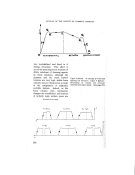
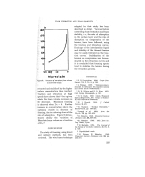
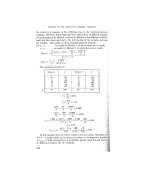
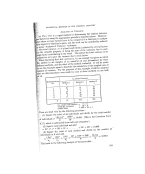
JOURNAL OF THE SOCIETY OF COSMETIC CHEMISTS Should a sample give sufficient rejects to lie outside the outer limits, a further sample of fifty should be examined and the result added to that of the first sample taken from the delivery. The complete sample examined now being made up of one hundred, would normally be expected to contain two rejects (2 per cent of 100). Calculation of the expectation of rejects for this size of sample places the outer limits now at 9 reject containers and the inner limits at 6 rejects. Should 9 or more rejects be found out of the hundred, the deliv.e. ry is rejected' should 7 or 8 rejects be found, a further sample is .taken and the results added to the previous ones and new limits found' should 5 or 6 rejects be found, the delivery would be accepted, but future deliveries watched carefully to see whether a deterioration in the average per cent defective has occurred. The customary levels of signiftcance for the inner limits of control charts are p --- 0.025 and for the outer limits p -• 0.001. If it is desired to put these levels exactly in the chart (there is no point as a container cannot be less than a unit), then the number of rejects is plotted on a graph against the.::: probability that it will' be exceeded, and then the exact value for the number of rejects at p = 0.025 and p--0.001 found by interpolation. In thiS: example these limits are 3.7 and 5.5 defective containers at p -- 0.025, and 5.6 and 8-8 at p --- 0.001, for samples of fifty and one hundred respectively.: FURTHER STUDY AND APP,I.I'•ATIONS .. No attempt has been made in this paper to do more than show application of statistical methods to a few typical examples which often.'! occur in the cosmetic industry. Anyone who troubles to study the technique•i:,' and their theoretical basis will find that they have acquired additionai:}i • "laboratory equipment" of similar h. tility to that of volumetric or chromi?i tographic methods. For practice, readers will find it instructive to examine any data from which they have drawn conclusions about whictf{ they have not been too confident, by making use of any analogous exampl•11!• given here. They will find the following texts appropriate for further stud•i•i and ,n, ot requiring an advanced mathematical background: Quality Control Charts," B. P. Dudding and W. J. Jennett, B.S. 6 1942. "Industrial Experimentation," K. A. Brownlee, H.M.S.O., 1949. "Facts from Figures," M. J. Moroney, a Pelican Book. "Statistical l•lethods," G. W. Snedecor, Iowa State College Press. "Rank Correlation Methods," •. G. Kendall, Charles Griffin & C Ltd. "Statistical Tables for Biological, Agricultural and Medical Research?•Jl R. A. Fisher and F. Yates. Oliver & Boyd, Ltd. A continuation of this article is planned, in which--among other thin gi 254

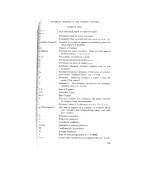
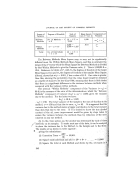
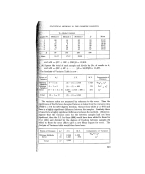
STATISTICAL METF. ODS IN THE COSMETIC INDUSTRY tCh testing and market research techniques will be analysed and the ign of experiments dealt with simply. , easy reference, the examples--together with the statistical procedure analysis--are listed below: an Content of bottles' and its fiducial limits. of Methods of analysis: Two methods carried out on the same sample. See Section ß Standard Deviation. p. 235 t-test (a). p. 238 More than two methods carried out on one sample, with replication. Two methods carried out on different samples. More than two methods, each carried out on several samples. Analysis of Variance (a). •,p. 241 t-test (b). p. 239 Analysis of Variance (b). p. 242 : ective assessment of preference for one of a pair :of 'products. of cap• supplied by different manufac- Binomial Distribu- tion, and X• Test. ß p. 255 Test. p. 247 • between cooling time and vessel size. ective Evaluation of Jasmin Absolute. xpert judgment of consumer acceptability. •'•! Lipstick Containers--control of defectives before ß •,3• :• .., •:• •:'.': factor use ' .?.• •}•:•'•::•: AMENDED CONSTITUTION AND RULES •:•'5•Britain Correlation Coeffici- ent, and Line of Best Fit. p: 248 Ranking Methods. p. 250 •'' Ranking Methods. ß p. 25r • :. ß Quality Control.' p. 252 special general meeting of the So9iety of Cosmetic Chemists of Great was held on October 23rd, 1952, when general acceptance was '•i?btained for the Society's amended Constitution and Rules. The main i• ffference between the old and new rules lies in the introduction of an •i/associateship for those not fully qualified as cosmetic chemists. The new rules ::•?lso change the titles of chairman and vice-chairman to president and vice- ?:Presideny respectively--Dr. R. H. Marriott being now the president and ??Mr. F. \'. Wells vice-president. ::'•':- 255
Purchased for the exclusive use of nofirst nolast (unknown)
From: SCC Media Library & Resource Center (library.scconline.org)