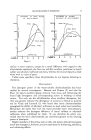
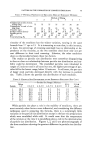
48 JOURNAL OF THE SOCIETY OF COSMETIC CHEMISTS pears to be a regular pattern of distribution of particle sizes in all emulsions and those having a higher percentage of particles under $ microns seem more stable. At present, we are unable to present any positive correlation between particle size distribution and stability, but it would appear that the speeds and methods of mixing do not materially affect or change the particle size distributions. This would indicate that still other factors affect emulsion stability and we believe that the emulsifying agent may be a chief consideration in this phase of production. This study indicates that there can be considerable variability in the preparation of emulsions and shows the need for process control as well as chemical control. The slight fluctuations in time and speed of stirring that may go unnoticed dur- ing manufacture may make a difference in batch variability. Although the studies of particle size distribution were inconclusive, this phase may still hold the answer to stability questions. However, the factors we have studied do not completely answer the question of the variability of the appearance of the emulsions. Apparently, there are other factors that are present that have not been considered and complete control of emulsion formulation cannot be attained at the present time. (1) Dotts, W. M., "Measuring the Distribution of Particle Size in Dispersed Systems," Ind. Eng. Chem., dnal. Ed., 18, 326(1946). DISCUSSION MR. CONR^D: Since the rate of mixing affects the heat transfer rate, is anything done to control the rate of cooling? DR. SVER^NDIO: Nothing was done to control the rate of cooling, but we did take the temperature at the time of the start of emulsification and at the end of the stirring. We stirred for one minute in every case, and we found in practically every case that the drop in temperature was within reasonable limits. For example, No. 1 started at 75 ø and at the end of stirring the tempera- ture was 63 ø. It was identically the same for No. 2 and No. 4 No. 5 was 65 ø while No. 3 was $8 ø at the end of that minute. The other two emulsions were made at room temperature and there was no temperature change. MR. DEN^V^RRE: You say that you stir for one minute only, and that is for all emulsions? DR. SVER^NDIO: Yes. MR. DEN^v^RRE: Why did you select the one m•nute, not longer? DR. S•ER^NDIO: We took an arbitrary time of one minute because pre- liminary work with this technical formula indicated that we could get what we considered complete emulsification at that time, and we did not want to stir any longer than was necessary.

FACTORS ON THE FORMATION OF COSMETIC EMULSIONS 49 MR. DENAVARRE: How large was the batch? DR. SPr. RAND•O: The batch we used was 1000 gm. lots. MR. KLApp: I would like to know if you placed the Span 80 and Tween 80 in the water phase or the oil phase. DR. SPr. RANDIO: Each emulsifying agent was placed in its selective phase. MR. DF.N^v^RRE: You mentioned one batch in which you threw every- thing in together, heated it, and then put it under the mixer. How did it come out ? DR. SPERANDIOi That was interesting. On that particular formula I was surprised at how it did come out, because it came out, as I said earlier with a viscosity midway between the two extremes. On over-all particle size distribution it came out practically to the identical pattern as those which we mentioned that had been mixed in the conventional way. In over-all stability on all of the factors which we studied, it came out third or fourth, out of the seven. And I believe--I am quite sure--by modifying it we could have gotten it better. MR. ALEXANDER: Was any work done in order to determine whether the emulsion, on standing, became more or less hydrophilic, assuming it was a water-in-oil emulsion ? DR. SPERANDIO: More or less. MR.. ALEX^NDEP,: Did the hydrophilic nature change? DR. SPERANDIO-' I might say that we made sure it was an oil-in-water emulsion at the beginning, by using selective soluble dyes but after the first test we did not make any further determinations on that particular factor. In fact, we didn't touch them, just let them stand and observed them. MP,. MINTON: What was the quantitative formula of the emulsion ? DR. SPERANDIOi I'll be glad to read that to you. CI•^IRM^N S^G^RIN: That will be in the printed paper, and it would have been on a chart, had the charts been available on slides. DR. SP•.R^Nmo: The formula, briefly, calls for heavy mineral oil, 350-- and, this is all by weight in grams--lanolin anhydrous, 10 cetyl alcohol, 10 Span 80, 21 Tween 80, 49 and distilled water, 560. I might say that when we made this formula we did not want to have a perfect emulsion, assuming we could have made one. We wanted to be able to study improvements as well as degradations. MR. S^G^RIN: If there are no other questions, Dr. Sperandio, to what extent, from other work that you have done, are you willing or ready to generalize with the results that you have obtained from this emulsion, on emulsions generally? On other oil-in-water emulsions which contain dif- ferent emulsifying agents? And so on. DR. SPEtt^sDIO: To generalize, about the most positive statement I could make is that to me there is nothing positive about the emulsions. I believe
Purchased for the exclusive use of nofirst nolast (unknown)
From: SCC Media Library & Resource Center (library.scconline.org)