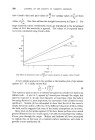
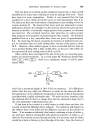
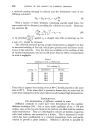
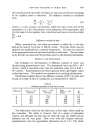
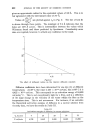
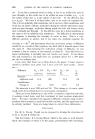
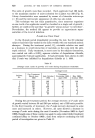
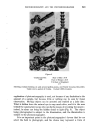
604 JOURNAL OF THE SOCIETY OF COSMETIC CHEMISTS ar z. If one has a molecule which is finite, it has to be within this area to pass through, so the centre has to be within an area of radius rh-r d. r d is the radius of the dye, r h is the radius of the hole. So the effective area is a (rd-rh) 2. We have n of these holes, and so we arrive at equation (9). This is for an infinitely thin membrane, but if one has a thick membrane, and if one has an elastic collision, molecules hitting the outside will bounce away and not pass through molecules hitting inside the hole will bounce down and eventually get through. So the effective area for a finite membrane is the same as for an infinitely thin membrane. The difficulty in determining the number, is knowing the viscosity of water in hair. This is a very difficult question to answer, but if one takes the Andrade equation for b viscosity v ---: Be g and determines what the activation energy of diffusion should be as a result of this equation, one finds that it depends upon b but not upon B. Thus knowing the activation energy of diffusion, we can evaluate b, but we cannot, at the moment, evaluate B. Since the latter is a linear relationship, it probably does not matter very much. If one allows this and evaluates b, one finds there are probably about 2.3 x 10 xz holes per cm • for ordinary hair. I was sorry that there was so little data in the paper it takes about a month to produce each point, but I have now two more points. These are :-- Diffusant Benzene sulphonic acid Naphthalene Orange G D w X 10 6 D h X 10 *z D h X 10 6 r d (cm•/sec) (cm•/sec) D w (A) 11-8 920 77.4 2.0 4.4 51.6 11.7 5.5 The intercept is now 7.9A and not 7.4. This change is, of course, quite small, and I do not think that it is of any great consequence. There are severe limitations to this work it assumes a spherical molecule, it assumes round holes, and this treatment at least assumes single-sized holes. We have calculated the apparent diffusion constant using Crank's equation which assumes a rapid irreversible reaction, and this again may not be entirely justified. Steps are being taken to correct these deficiencies. DISCUSSION DR. H. G. TROTH : Would you be prepared to divulge the structures of A, B, C, D and E (Table II). THE LECTURER: B is Neolan Black, which is the same as Acid Alizarin black, the formula of which is in the paper, premetalized with chromium,

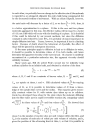
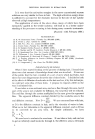
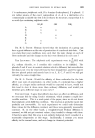
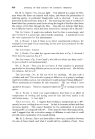
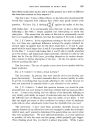
DIFFUSION PROCESSES IN HUMAN HAIR C is azobenzene psulphonic acid, D is 4-amino-2-nitrophenol, E is phenol. I am rather unsure of the exact composition of A--it is a derivative of a commercially available dye but I do not know its structure, except that it is an acid dye containing sulphonic acids. A B C D E F G SO3H OH x x x x NH2 DR. H. G. TROTU: Herman showed that the ionization of a group can have a great influence on the rate of penetration of a molecule into hair. Can you state that your conditions were such that the ionic charge on each of these molecules and the charge on the hair were identical in each case ? N THE LECTURER' The sulphonic acid experiments were in ]-• HC1 with 2% sodium chloride, so I consider this condition to be fulfilled. The phenols D and E were in neutral solution which is different, but nevertheless the data is not very far removed from the best straight line, and if we ignore the two phenol points and merely base it on .4, B, C, F and G we still get virtually the same straight line. DR. H. G. TROTH: Would the affinity of these molecules for the hair affect your rates of penetration in other words, if a molecule has a higher affinity, as a larger radius molecule would be expected to have, would not this tend to slow it down more than ordinary diffusion, and would you therefore get a different slope on your curve ? THE LECTURER: I agree that affinity does have an effect on diffusion, and we overcame this by using Crank's treatment, which assumes a rapid irre- versible reaction. This is a weak point of the paper, since we do not know that sulphonic acids fulfil this condition. The reaction is probably rapid, but probably not irreversible. In each experiment we could only determine three values for the diffusion constant, and these were generally reasonably constant. If, on the other hand, a straightforward Fickian diffusion is assumed, we did not get constant values they tended to change with time. I therefore agree that this area is not entirely foolproof, but I consider it a reasonable compromise at this stage. Incidentally, I assume you mean affinity in the normal sense, and not change in chemical potential.
Purchased for the exclusive use of nofirst nolast (unknown)
From: SCC Media Library & Resource Center (library.scconline.org)