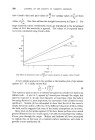
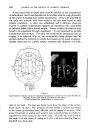
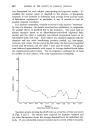
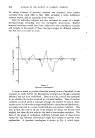
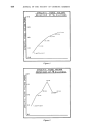
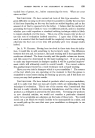
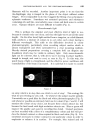
598 JOURNAL OF THE SOCIETY OF COSMETIC CHEMISTS pt take Crank's data and plot values of a•-for varying values of at three values of C•' One then obtains the straight lines shown in Figure 1. For large reactivity ratios, considerable errors are introduced in the determined values of D if the reactivity is ignored. The values of D reported below have been calculated using Crank's data. 1.2- 1'¸ 04- Figure 1 Dt The effect of reactivity ratio on•-/- at various degrees of uptake (after Crank) A more simple approach to the problem is the familiar plot of dye uptake against (t)( It is easily shown that Ct (_.•)• 2 (s) This equation again assumes an infinite homogeneous cylinder (or slab) in an infinite bath. A plot of C t against (t) • should pass through the origin, but must be expected to deviate from linearity at long times when the bath is becoming depleted or, more important, the curvature of the cylinder becomes significant. Skinkle (5) has attempted to show that the fit of the curve is simply fortuitous and is a reflection of the different behaviour of fibres within the bath, and he suggests that some of the initial assumptions are incorrect. Many plots of dye uptake against (t) • do have linear portions over a much greater distance than one would expect, but with wool and hair they seldom, if ever, pass through the origin. Medley and Andrews (6) have attempted to explain this on the basis of a resistant surface membrane, and claim to provide a more satisfactory fit.

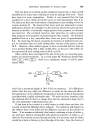
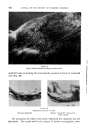
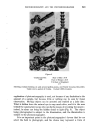
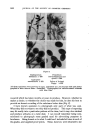
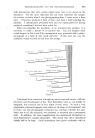
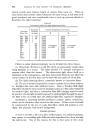
DIFFUSION PROCESSES IN HUMAN HAIR 599 Very few data are available on dye uptake by human hair, so that we find ourselves in the usual state of having to work by analogy with wool. There have been two main assumptions. Firstly, it was assumed that the hair consisted of a sieve which prevented access of molecules greater than 6 A. The idea arose from the observations of Speakman on the swelling of wool in various alcohols (7). He observed that when wool was immersed in water, methanol or ethanol, the strength was decreased by almost the same amount, whereas in alcohols of molecular weight greater than propanol, no decrease was observed. He concluded, therefore, that molecules of a radius greater than propanol were incapable of penetrating the fibre rapidly. He therefore predicted that in a dry, unswollen fibre, there are pores of approximately 6 A. By observing the elastic properties in mixtures of methanol and octa- nol, he calculated that in a fully swollen fibre, the size of the pores is about 35 A. However, other authors appear to have overlooked the fact that we are in general dealing with a fully swollen fibre, so the pore with which we are concerned (if such a thing exists) is 35 A, not 6 A. Other authors have investigated the size of the pore by observing pene- tration of coloured molecules. In a recent paper (8), Wilsmann showed that H•N••fiNHx/--•, which has a maximum length of 12.5 A, pene- trated, while CI- H,C • Ctta /JCHa • NH 2 which has a maximum length of 13.0 A did not penetrate. It is difficult to believe that the very slight size difference accounts for the observed effects. The appearance of the published photographs is typical of that of ring dyeing associated with a highly substantive dye. We may conclude, therefore, that the observed effect is due to a change from the less substantive basic dye to the very substantive triphenylmethane dye. If hair does in fact consist of a solid barrier in which there are holes, the amount of material diffusing will be reduced. The reduction will depend on the relative sizes of the holes and the diffusant, and also on the number of holes. If we assume an infinitely thin barrier containing n holes of radius r h per unit area, which is bombarded with spherical molecules of radius r d, in order for the molecule to pass through the hole, it is necessary that its centre should be at least a distance r d from the edge of the hole thus, the chance of
Purchased for the exclusive use of nofirst nolast (unknown)
From: SCC Media Library & Resource Center (library.scconline.org)