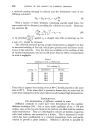
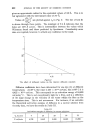
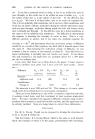
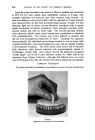
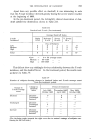
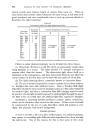
600 JOURNAL OF THE SOCIETY OF COSMETIC CHEMISTS a molecule passing through is reduced and the determined value of the diffusion constant is D H: D w n = (r h -- rd) 2 •w With a barrier of finite thickness containing parallel sided holes, the same result will be obtained, providing the collisions are elastic. Rearrang- ing equation (9), (DH _•H_ • • • •w n =2 = rh-- rd (10) so by plotting (D•)i against rs, a straight line with an intercept on the x axis of r h should be obtained. The observed increased dyeing at high temperatures is alleged to be due to increased swelling of the hair, which gives greater pores and hence easier access of the molecule. Very few data are available on the swelling of hair at various temperatures, but one set (9) shows that the effect of temperature in wool is negligible. Table I Swelling of wool at 100% R.H. Temp. o C 20 30 4O 5O 6O Vol. swelling % Southdown 35'7 33'1 32'5 33 '6 34 '8 Merinos 36.0 34.5 34.3 34-7 35.4 From this it appears that dyeing wool at 60 ø C should proceed at the same rate as 20 ø C. If the same effect is present in human hair, we must look for some other explanation of the observed increased dyeing at high temperatures. EXPERIMENTAL The determination of diffusion constant in water Diffusion constants in water have been determined by the capillary diffusion technique (10). One or more small capillaries (3 cm x 0.5 mm radius), open at the top and closed at the bottom, are filled with the solution under examination. They are centrifuged to remove air bubbles, topped up with fresh solution, and mounted in a holder. This is immersed in water which has been equihbriated in a constant-temperature bath, and gently rotated to provide a plane interface. Diffusion is allowed to proceed for

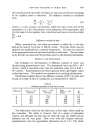
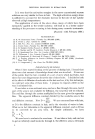
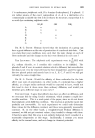
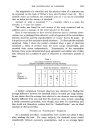
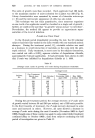
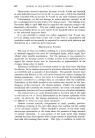
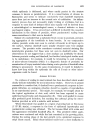
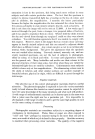
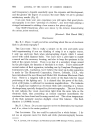
DIFFUSION PROCESSES IN HUMAN HAIR 601 the requisite period, the holder and tubes are removed, and the dye remaining in the capillary tubes is estimated. The diffusion constant is calculated from Dt _• (1- Cav'• 2 (11) h 2 4 C O ,/ where Cav is the average concentration within the tube at the end of the experiment, C O is the concentration at the beginning of the experiment, and h is the height of the capillary tube, which has been shown to hold provided Dt -- 0.2. Diffusion constant in hair White, untreated hair, was either pre-treated or added dry to the dye bath in the ratio of 1 g of hair to 100 ml of bath. The bath, which was not agitated, was maintained at a constant temperature. The hair was removed at the appropriate intervals and rinsed quickly in cold water. The dye taken up by the hair was extracted with pyridine-water or with dimethyl formamide. RESULTS AND DISCUSSION The technique for determination of diffusion constant in water was checked using paminobenzoic acid. The determined value was 6.57 X 10 -6 cm•/sec, which is somewhat lower than the published value (11) of 8.42 X 10 -6 cm'/sec. Experimental errors will, in general, tend to give higher values rather than lower. The method was assumed to be working satisfactorily. The limited available data on the diffusion constant at 25 ø C in water and in hair, of a range of dyes of varying size, are summarised in Table II. Table II Diffusion constants in hair and in water Diffusant Dwater X 10 6 Dhair X 10 •2 Dhair (cm2/sec) (cm•/sec) Dwate--• X 10 6 (•) A 4.0 12-0 3-0 5.3 B 3.3 9-0 2.6 6-4 C 12-0 260 20.8 1 '8 D 8.6 480 55.9 2.6 E 10.0 316 31.6 2.1 The determined values for the radii seem, at first sight, rather small for dye molecules. The radius is, however, that of a sphere of equivalent volume, and although the dyes may be relatively long, the width and the thickness are not very great. Thus, even with the compact molecule, paminobenzoic acid, the approximate dimensions are 9 X 6 X 2 A, which
Purchased for the exclusive use of nofirst nolast (unknown)
From: SCC Media Library & Resource Center (library.scconline.org)