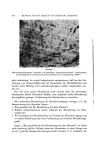
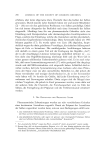
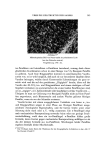
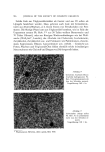
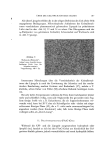
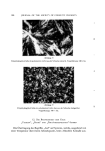
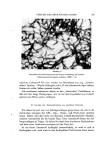
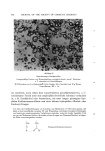
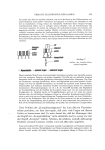
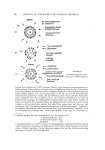
OBER DIE GELSTRUKTUR DER SALBEN 335 Bei der Herstellung der Crfime dutch Erwiirmen mit Wasser auf 70-80øC wird dieset f3ber- schuB, der bei dieset Temperatur fiiissig ist, unter Rtihren emulgiert. Gleichzeitig bildet sich der Komplex, der teils an der Grenzfifiche den sehr stabilen Komplexemulgatorfilm, teils beim Abktihlen in der Wasserphase die steifen Mizellen entstehen lfiBt, welche das Gelgerast auf- bauen. Ist die Temperatur unter den Erstarrungspunkt des lipophilen Anteils gefallen, so er- starten auch die bis anhin fiassigen Tr6pfchen und wetden fest. Ob sie feindispers sind und ob sie eher sphfiroid oder unregelmfiBig geformt sind, hfingt davon ab, wie intensiv wfihrend der Emulgierung und beim Abktihlen dispergiert wird. Aus der ursprtinglichen Emulsion, d. h. aus dem fitissig-in-fitissig-System, entsteht dabei eines Suspension, d. h. ein System fest-in-halbfest oder, da die fiuBere Phase aus Wasset als Dispersionsmittel besteht, ein Suspensions-Hydro- gel. Das Geigerfist wird jedoch nicht nut von einem Stoff aufgebaut, sondern aus einer wasser- 16slichen und einer fett16slichen amphophilen Substanz, welche Komplexmizellen bilden. Abwaschbare O/W-Salben oder -Cr•mes enthalten somit Typen dieset weitverbreiteten st6chio- metrischen Komplexe wie sie auch im lebenden Organismus vorkommen. Diese eher hypothetischen Vorstellungen finden eine gewisse Unter- sttitzung in einer neueren britischen Arbeit (93). Die Autoten schreiben darin: "For such interaction ... the temperature ... must be at or above a certain critical temperature which, for the aqueous sodium dodecyl sulphate solution at a concentration of 1% w/w, is approximately 46 ø. To prepare the systems, the cetyl alcohol at 65 ø is poured into the sodium dodecyl sulphate solution, maintained at the same temperature, and the mixture agitated. The molten alcohol disperses into droplets and the sulphate and water penetrate these to produce a highly viscous liquid crystal phase. This phase will tend to be drawn out along the complex flow lines in the mix, and some of it may finally dissolve to form an isotropic mixed micellar solution. Thus, individual globules of molten cetyl alcohol stream through the hot mix and pro- duce elongated threads of liquid crystals, whilst they themselves diminish in bulk as they form this smectic phase. The fluidity of the liquid crystal phase increases as more water enters the structure, surface tension forces act, and spherulites are formed. When the temperature is rapidly lowered by forced cooling to below 46 ø , the alcohol solidifies and further interaction with sodium dodecyl sulphate solution is prevented ... The liquid crystal phase is frozen and a meta- stable system is formed in which the intimate mixture of alcohol, sulphate and water present in the smectic phase is maintained, ... For systems of low alcohol content ... the result is a mobile suspension containing solid alcohol and frozen spherulites. The latter are somewhat deformed due to flow forces and partial crystallization, and often contain unreacted alcohol at their centres. Any frozen smectic threads have effect on the consistency of the system. As the percentage of alcohol in the system rises ... two effects become important: The effective disperse phase volume of the system rises. In a simple dispersion of a long chain alcohol in water, the disperse phase is the alcohol, but in the present systems this phase is increased in volume due to the incorporation of a small amount of alkyl sulphate and a relatively large amount of water. Even if the water is not bound, a honeycomb structure will result which will entrap continuous phase and the effective disperse phase volume will be increased. b) It is postulated that the threads of frozen liquid crystal are now abundant enough to form a submicroscopic network which entraps both solid alcohol and frozen spherulites. The result will be a typical gel-like structure exhibiting solid properties. ... Indications of a network structure, ..., were obtained by introducing air bubbles into the mobile systems ... and examining them microscopically. The bubbles were allowed to traverse the field of view when a striated effect was seen in the flow lines surrounding them: this is strongly suggestive of a fibrillar structure.

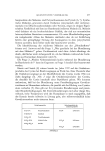
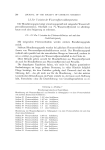
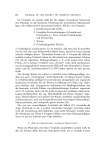
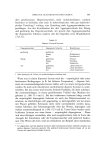
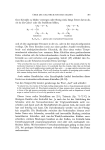
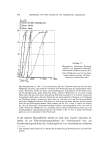
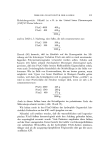
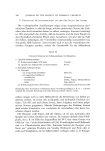
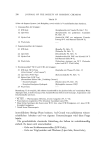
336 JOURNAL OF THE SOCIETY OF COSMETIC CHEMISTS 17. PRAKTISCHE NUTZANWENDUNGEN AUS DER GEL-NATUR DER SALBEN Die vorhergehenden Ausftihrungen zeigen einen ausgesprochenen theo- retischen Charakter, so dab die Frage, welchen praktischen Nutzen der Gale- hiker oder der Kosmetiker daraus zu ziehen verm6gen, durchaus berechtigt ist. Wit sind jedoch der Ansicht, dab die Kenntnis und die klare Einsicht in das physikalisch-chemische Wesen einer Arzneiform, wie jetzt hier im Falle der Salben, demjenigen, der Vorschriften rezepturm2Big auszuarbeiten hat, eine groBe Hilfe bedeutet. Zuerst einm•d muB er sich die wesentlichen che- mischen Gruppen metken, welche die Grundstoffe ftir die Salbenbasen Tabelle III Chemische Einteilung der Salbengrundlagen (mit Beispielen). 1. Lipophile Salbengrundlagen 1.1 Kohlenwasserstoffgele (KW-Gele) (Vaselin) 1.2 Lipogele (aus Triglyzeriden und Esterwachsen) (Fette) 2. Hydrophile Salbengmndlagen 2.1 Hydrogele - mit anorganischen Gelbildern (Bentonit) - mit organischen Gelbildnern - eiweiBiihnlich (Gelatine) - Kohlehydrate (Stiirke, Tragant, Methylzellulose) - Seifen (Sapo kalinus) 2.2 Polyiithylenglykol-Gele (PAeG-Gele) (Polyethylene glycolointment USP) Bemerkung: Beim Vermischen verschiedener Typen yon Salbengrundlagen (z. B. 1.1 d- 1.2) kann natiirlich die chemische Einteilung nicht mehr eindeutig aufrecht erhalten wetden. stellen m6gen noch so viele Hilfsstoffe ftir die Herstellung von Salben an- geboten wetden, sie lassen sich in lipophile und hydrophile Produkte ein- teilen (Tab. III) und nach ihrem Zweck, ihren Aufgaben und ihrem pr2pa- rativen Nutzen gruppieren. Manche Behauptungen der Reklame k6nnen dank solchef Kenntnisse yon vornherein als unzutreffend oder leeres Ge- schwittz erkannt wetden. Der Rezeptar weiB ferner, dab die Salben, ob sie nun hydrophil oder lipophil sein sollen, formlest sein mtissen. Sie besitzen deshalb einen FlieB- punkt, der z. B. im Falle der Augensalben bei 30 øC eine obere Grenze yon 1000 dyn ß cm _9. nicht tiberschreiten soll (16). Formfestigkeit und FlieBpunkt sind u. a. Charakteristika eines Gels. Entweder bentitzt der Rezeptar ,,yon Natur aus" gelartige Produkte wie Vaselin, Wollwachs und Fette oder er stellt aus Fltissigkeiten, die im Salbenvehikel vorliegen sollen (z. B. fltissiges
Purchased for the exclusive use of nofirst nolast (unknown)
From: SCC Media Library & Resource Center (library.scconline.org)