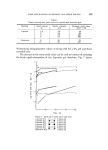
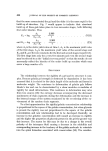
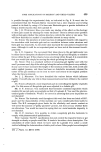
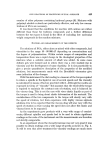
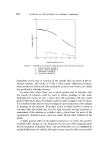
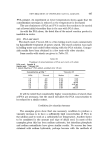
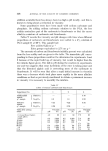
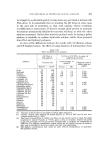
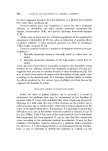
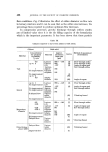
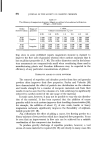
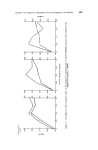
448 JOURNAL OF THE SOCIETY OF COSMETIC CHEMISTS addition available there has always been too high a pH locally, and this is known to bring about a reduction in viscosity. Some quantitative tests have been made with sodium carbonate and phosphate. On adding sodium carbonate solution to the PGA, the free acidity neutralises part of the carbonate to bicarbonate so that the excess alkali is a mixture of carbonate and bicarbonate. Table IV records the viscosity and pH changes with time when different proportions of carbonate and bicarbonate were added to a 49/0 solution of PGA sample D at 20øC. This sample had Free acidity 0.22 me g-1 Ester groups equivalent to 2.71 me g-1 The amounts of carbon and bicarbonate initially present were calculated from the free acidity and are given in the table. The immediate pH corres- ponding to these proportions could not be determined in experiments 1 and 2 because of the rapid build up of viscosity, but would be higher than the five minute figure given. The fall in pH during the reaction in experiments one and two suggests that some hydrolysis of the ester is taking place and that the liberated alginic acid is converting more of the carbonate to bicarbonate. It will be seen that after a rapid initial increase in viscosity there •vas a decrease which took place more rapidly in the more alkaline conditions so that as previously mentioned to obtain a permanent increase in viscosity it is necessary to reacidify the mixture. Table IV Effect of sodium-carbonate and bicarbonatc Experiment No. 1 2 3 Alkali added } NaHCO 3 -- -- 3.10 mmole g-• sample Na2CO 3 0.5 1.0 0.22 Effective } NaHCO3 0.22 0.22 3.32 mmole g- • sample Na 2CO 3 0.28 0.78 -- .... Time after adding Viscosity Viscosity Viscosity alkali pH (P) pH (P) pH (P) 0 (1 and 2 just before 4.0 30 4.0 30 7.9 18 3 just after) 5 min 9.2 3 600 9.5 2 240 7.9 28 15 min 8.4 3 920 8.7 216 7.9 30 30 min 8.0 2 960 8.2 120 ..... 45 min ...... 7.9 140 90 min 8.0 2 320 8.1 96 7.9 180 3 h 8.0 1 440 8.1 80 7.8 124 24 h 7.8 248 7.8 12 7.8 18

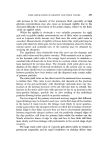
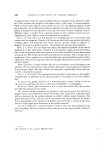
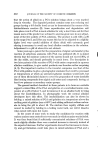
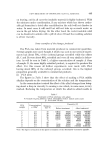
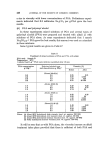
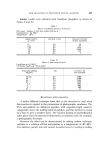
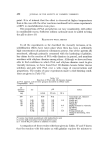
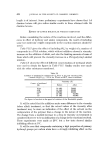
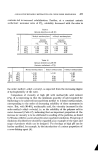
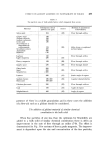
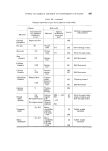
NEW REACTIONS OF PROPYLENE GLYCOL ALGINATE 449 Similar results were obtained with trisodium phosphate as shown in Tables V and VI. PGA used: Concentration: 4g 100g -• Temperature: 20øC Table V Effects of different amounts of Na3PO4 Sample D with free acidity 0.22 me g-1 mmole Na•PO4 g- 1 PGA o o.31 0.75 1.o 1.5 2.0 pH after 1 min 4.0 8.6 8.7 8.8 9.8 10.4 Viscosity (P) after 15 min (acidified) 32 127 3 700 3 500 112 9 Table VI Effect of time using Na3PO4 Conditions as in Table V 1.0 mmole NasPO4 g-' PGA added Time after adding Na sPO 4 10 min 15 ,, 30 ,, 2 h 4 ,, 6 ,, 21 ,, pH 8.3 8.0 7.9 7.6 7.5 7.3 7.0 7.0 Viscosity (P) (not acidified) 3 680 2 480 2 000 2 000 1 920 1 280 680 44 REACTIONS WITH GELATINE A rather different technique from that so far described is used when this reaction is applied to the preparation of photographic emulsions. The PGA and gelatine are dissolved together, with suspended light sensitive compounds, above the melting point of gelatine, and this mixture is coated on a base to give a sensitive layer. The reaction leading to insolubilization takes place when the material is immersed in an alkaline bath, for example, a photographic developer. However the effect can be demonstrated by adding sodium carbonate solution to a solution of PGA and gelatine at a temperature of 40ø-50øC. The mixture quickly sets and cannot be melted even by heating to boiling
Purchased for the exclusive use of nofirst nolast (unknown)
From: SCC Media Library & Resource Center (library.scconline.org)