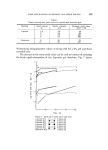
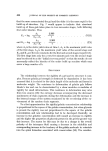
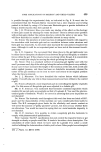
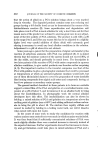
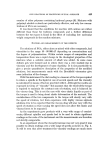
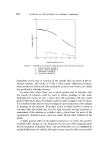
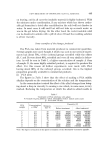
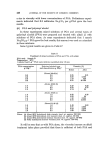
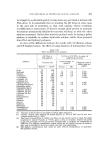
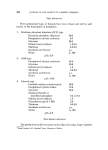
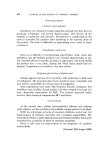
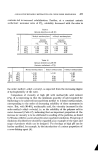
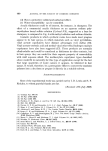
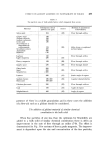
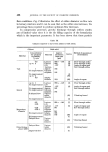
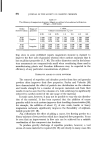
450 JOURNAL OF THE SOCIETY OF COSMETIC CHEMISTS point. It is of interest that the effect is observed at higher temperatures than is the case with the other reactions mentioned but in some experiments at 60øC no insolubilization took place. The proportions of PGA and gelatine can vary considerably, with either in considerable excess. Sufficient sodium carbonate must be added to bring the pH to above 10. REACTIONS WITH AMINES In all the experiments so far described the viscosity increases, or in- solubilization effects have taken place when there has been a sufficiently high concentration of polymeric substances present. One of the patents (4) mentioned, although primarily concerned with the hardening of gelatine, has claims for the reaction of PGA with diamines in general, and mentions reactions with ethylene diamine among others. Although we have not been able to find conditions in which PGA and ethylene diamine react to give viscosity increases, we have found that 1:6 diamino hexane forms viscous solutions and gels with PGA over a w/de range of concentrations and proportions. The results of some experiments made to find limiting condi- tions are given in Table VII. Table Vii Reaction of PGA with 1:6 diamino hexane lg PGA (approx. 2.6 me ester groups) dissolved in 100ml water. Temperature: 20øC 1:6 diamino hexane mg 150 107 86 54 43 me 2.6 1.85 1.49 0.93 0.74 2.6* 2.6i 0.74:[: initial 10.8 10.5 10.2 9.9 9.7 9.8 10.0 10.3 pH 15 min 10.2 8.8 8.5 7.3 7.0 7.0 8.2 9.4 18 h 6.4 4.9 Effect Immediate gel, thinned within 15 min Stable gel Stable gel Weak gel Slight increase in viscosity No effect Weak gel Strong initial gel, strength decreasing, then stable. (*) amine two thirds neutralized with hydrochloric acid (t) amine half neutralized with hydrochloric acid (•t) 1 mmole Na2CO3 added in addition to amine. A comparison of these results with those given in Tables I V and V shows that the reaction with this amine as with gelatine requires the mixture to

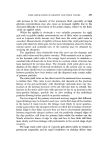
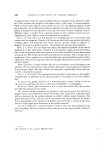
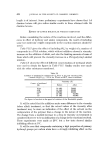
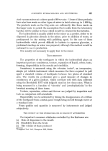
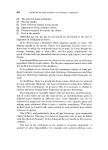
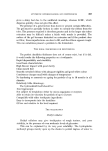
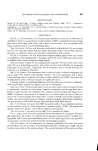
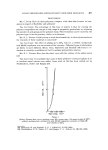
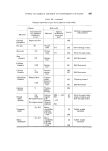
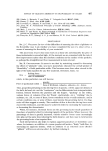
NEW REACTIONS OF PROPYLENE GLYCOL ALGINATE 451 be brought to a pH which quickly breaks down any gel which is formed with PGA alone. It is remarkable that on standing the pH drops in some cases to the acid side of neutrality, so that with suitably chosen conditions reacidification is unnecessary. If there is enough alkali present to maintain the mixture permanently alkaline the viscosity will drop, as with the other mixtures examined. On the other hand the product made by drying a gelled mixture is insoluble in sodium hydroxide solution, unlike those prepared from PGA and hydroxy polymers. In view of the differences between the results with 1:2 diamino ethane and 1:6 diamino hexane, the effect of using diamines of intermediate chain Table VIII Effect of additives on reaction 4 •o PGA q- % PGA q- 2 % PVA q- concn. of 8 •o additive additive given below Additive Lowest concn. to Viscosity (P) inhibits Highest concn.$ which does not Before* Afterr (wt •o) (M) inhibit None 75 450 -- -- -- Methanol 100 $ 1.6 0.5 0.375 Ethanol 85 310 7.8 1.7 0.950 n-Propanol 75 250 12.8 2.0 1.750 iso-Propanol 80 1 200 -- -- 4.000 õ n-Butane 1-ol 80 460 n-Butane 2-ol 120 1 000 Ethylene glycol 70 15 2.9 0.5 0.300 1:2 Propylene glycol 95 12 3.8 0.5 0.400 Diethylene glycol 70 60 Dipropylene glycol 80 700 n-Butane 1:3 dio1. 75 200 11.7 1.3 1.250 n-Butane 1:4 dio1. 62 80 5.4 0.6 0.500 n-Butane 2:3 diol. 67 800 -- -- 3.000õ Glycerol 54 24 Pentaerithritol 30 10 Sorbitol 50 20 Dextrose 70 32 Sucrose 70 40 Raffinose 65 26 Rhamnose 53 53 Formaldehyde 0.12 0.04 0.020 Acetaldehyde 2.60 0.60 0.500 (*) Viscosity of PGA solution and additive before alkali treatment. (t) Vicosity reading after adding 0.5 mmole Na,CO, g-• PGA at 20øC and 15 min later 1 mmole acetic acid g-1 PGA. (:•) The lowest concentration to inhibit was taken as the lowest tested in which the alkali treatment (1 mmole Na2CO3 g-1 PGA) gave a drop in viscosity. Figures are given in per cent of weight (cf. 8 •o in previous columns) and in molartry for comparison of additives. The highest concentration tested which did not inhibit is given in molartry only, and is included to show how nearly the limit was approached. (õ) The highest concentration that could be used without precipitation of polymers. No inhibition found.
Purchased for the exclusive use of nofirst nolast (unknown)
From: SCC Media Library & Resource Center (library.scconline.org)