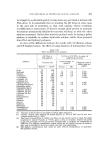
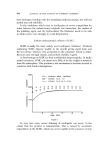
SYNTHETIC HYDROCOLLOIDS AND DENTIFRICES 461 steel vacuum mixers at a stirrer speed of 60 rev min- 1. Some of these products have also been made on other types of mixer in batch sizes up to 1 500 kg. The products made on the 3 kg scale are sufficiently like those made on the larger scale to permit the assumption that results from the laboratory batches will be similar to those which would be obtained in the factories. The hydrocolloid is usually added to the mixer as a powder, either to be dispersed in glycerine already in the mixer, prior to addition of water, or predispersed by dry mixing with polishing agent. In the case of those hydrocolloids which proved difficult to hydrate in aqueous glycerine, a preformed mucilage in water was prepared, although this method would be awkward to use in production. It is usually not necessary to apply heat to the mixer. TEST METHODS The properties of the toothpaste in which the hydrocolloid plays an important part are: consistency, texture, separation of liquid, colour, taste, foaming, dispersibility in the mouth and rinsibility. Consistency is measured using the cohesion tester*, an inexpensive, simple yet reliable instrument which measures the force required to pull apart a standard volume of toothpaste between two plates of standard area. The results (in g cohesion) give a good measure of changes in consistency of a given product, which correlate well with data collected using the Brookfield RVT with helipath stand at low shear rates. What is being measured is a function of 'viscosity' and 'pseudoplasticity' in the broadest meaning of those terms. Texture, separation, colour and flavour are judged by inspection and taste as comparison with standards. Dispersibility can be estimated by timing the disappearance of a ribbon of the toothpaste from a metal gauze trough being moved through water at a standard rate. Foam quality and quantity is measured by instruments and judged subjectively. THE EFFECT OF THE HYDROCOLLOID ON PRODUCT ATTRIBUTES The important consumer attributes controlled by the thickener are: (a) Rate of dispersion in the mouth (b) Rinsibility from the brush (c) The volume of foam produced *Longford Tool Ltd., Hampton Hill, Middx.

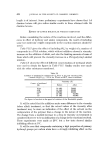
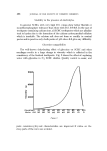
JOURNAL OF THE SOCIETY OF COSMETIC CHEMISTS (d) The speed of foam production (e) Flavour clarity (f) Rate of flavour release in the mouth (g) Appearance of the extruded ribbon (h) Pressure required to extrude the ribbon (i) Feel in the mouth. Attributes (a), (b), (c), (d), (e), (f) and (i) are all related to the rate of dispersion of toothpaste in water. It is obvious that a dentifrice which disperses rapidly in water, will disperse rapidly in the mouth. This is very important because of the very short time in which the toothpaste must do its work. In Great Britain the average brushing time is about 30 s, and the prime requirements are speed of foam build up, immediate flavour release, high impact and rapid rinsing. Fast dispersibility must also be a factor in the contact time of anti-caries ingredient with the tooth surface. The fluorine compound cannot react with the tooth if it is locked in the dentifrice. It is perhaps not so obvious that the maximum volume of foam pro- duced is greater, in general, when high thixotropy thickeners are used than when low thixotropy materials, giving viscous liquids rather than gels, are used. In dentifrices, there is a maximum foam volume which can be achieved for any particular thickener, the type of thickener having more influence than the level of detergent. To go above this, it is necessary to change to another thickener having faster dispersion and greater thixotropy. Fast dispersion is normally linked with gel structure and thixotropy, but of course these are not the only factors, as non-thixotropic gums of different types disperse at different rates. Good dispersion can also be achieved by using very low levels of thickener in the aqueous phase and relying upon absorbent fillers to give a suitable consistency. This latter method must be treated with some caution as such products may exhibit syneresis on ageing. The SCMCs, and particularly those of high thixotropy, give remarkable clarity of flavour. This may be related to dispersion rate, or may be linked with the physical chemistry of the detergent/flavour micelie in the presence of SCMC. The feel of the toothpaste in the mouth is obviously important. A product of slow dispersibility, for example with polyoxyethylene resin,
Purchased for the exclusive use of nofirst nolast (unknown)
From: SCC Media Library & Resource Center (library.scconline.org)