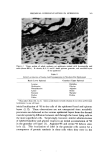
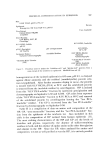
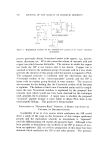
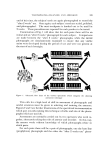
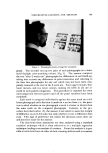
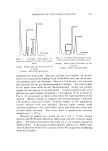
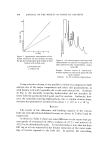
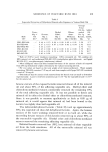
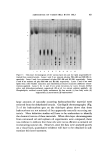
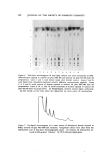
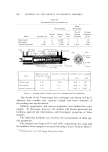
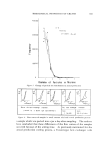
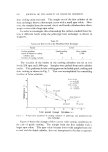
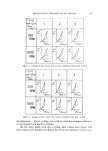
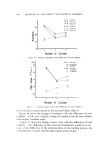
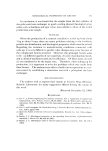
TOOTHPASTES--CLEANING AND 4_BRASION 603 ties seen in Table II is in exact agreement with the exception of Paste E which, contrary to its relatively low enamel abrasivity, is ranked as a high cleaner. On the other hand, there is a much stronger correlation between cleaning and dentine abrasion. Alongside this method, a second technique was developed. This was because we recognized that the "photographic" technique described is largely subjective in nature and that greater reliability may be achieved by instrumentation, particularly of the assessment of tooth cleanliness. For this reason, a "photometric" technique was developed. In this paper only its salient features will be illustrated (Fig. 5). Figure 5. Photometric device which quantitatively measures the presence of tooth soil Esssentially, the instrument looks at an area of the lower anterior teeth and detects changes in optical brightness with the presence of tooth soils. Such changes are monitored by an optical system coupled to a sensitive photomultiplier. The photographic stages of the test previously outlined are replaced by photometric readings. Thus, instead of the initial photograph, an ini- tial reading of the clean state is taken. This is followed up a fortnight later by a second photometric reading. As before, each panel member uses each toothpaste for a fortnightly period. A typical result is illus- trated in Table III.

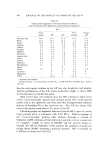
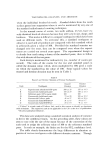
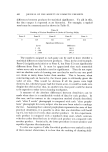
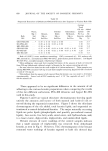
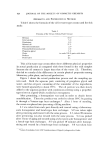
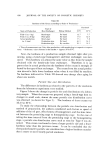
604 JOURNAL OF THE SOCIETY OF COSMETIC CHEMISTS Table III Brightness Changes for Various Toothpastes % Change in Brightncss Paste after 2 Weeks' Use A 3.1 B 3.4 E 3.5 D 10.9 G 13.2 H (based on PVC) • 18.6 This is a polyvinyl chloride powder manufactured by ICI as "Corvic" P65/50. It will be noted that the lowest change in brightness occurs with the highest cleaner. This is because the subjects' teeth start in the dean state, i.e., with a dental prophylaxis, and therefore the best cleaners will show least tendency for the teeth to become stained. Toothpastes such as H, containing PVC as the main abrasive, and normally con- sidered to be ineffective cleaners, will show the greatest change because the teeth build up considerable stain and hence move further from the initial clean state. For any one test using a selected panel of people, the results are con- sistent and reproducible. Similarly, the ranking order is the same with different panels. However, experience has shown it to be dangerous to place too much emphasis on the magnitude of the brightness changes be- cause these are dependent to a degree on the composition of the panel. For example, the brightness changes for a panel of very heavy stainers would be greater than for a panel of medium-heavy stainers though, of course, the overall ranking of products would be unchanged. Agreement between the techniques is excellent in fact, the rankings are identical. Also, the sensitivity of the photometric technique is of the same order as for the photographic, i.e., products can be categorized as high, medium, or low cleaners. CONCLUSIONS Heavy stainers can readily differentiate between the cleaning proper- ties of dentifrices. While those dentifrices containing chalk, anhydrous DGP, or aluminum oxide trihydrate are likely to have satisfactory clean~ ing properties, it is doubtful whether products based on hydrated DCP or PVC would. On the other hand, individuals who have virtually no
Purchased for the exclusive use of nofirst nolast (unknown)
From: SCC Media Library & Resource Center (library.scconline.org)