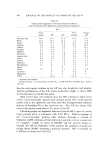
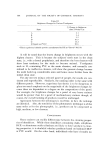
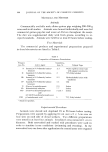
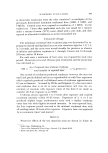
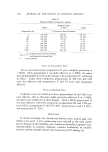
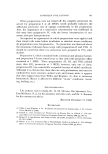
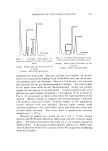
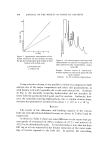
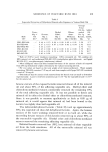
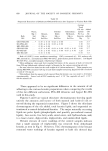
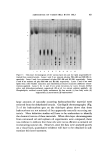
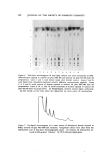
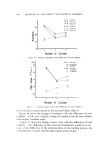
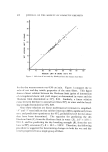
ADHERENCE OF VEGETABLE BATH OILS 623 DISCUSSION The results of this investigation indicate that slightly more vegetable oil adhered to keratin than did mineral oil when the bath oil preparation was at the 0.02% level. Under the conditions of this investigation, ap- proximately 0.80 mg more of vegetable oil than mineral oil adhered to 1 g of dehydrated keratin, and 0.50 mg more of vegetable oil than mineral oil adhered to 1 g of defatted keratin. The greater adherence of vegetable oil to keratin than of mineral oil at the concentrations used appeared to be the result of a greater affinity of vegetable oil for keratin and a greater binding capacity of vegetable oil to keratin. Knox and Ogura (3) found that when much higher bath oil concentrations of 0.5 and 1% mineral oil or vegetable oil were used, a much larger amount (two or three times more) of mineral oil adhered to normal keratin than vegetable oil. The sequential extractions used in this study indicate that mineral oil adherence is primarily a surface addition or coalescence of mineral oil droplets (layering) to the surface of the keratin. Vegetable oil, on the other hand, probably does not coalesce onto the surface of keratin as readily, but, rather binds in a limited way to specific protein sites. Whether vegetable oil is clinically more effective than mineral oil in the retention of water by the skin through the retardation of the water evaporation from the stratum corneum remains to be determined. (Received January 12, 1970) REFERENCES (1) Johnston, V. D., and Porcaro, P. J., Cosmetic oils on the skin, some quantitative measure- ments, Givaudanian, 7 (March, 1962). (2) Haensch, R., Therapeutic oil application in the form of a bath additive, Z. Haut- Geschlechts-Kr., •4, 211 (1963). (3) Knox, J. M., and Ogura, R., Adherence of bath oil to keratin, Brit. Med. ]., ii, 1048 (October, 1964). (4) Owens, D. W., Ogura, R., and Knox, J. M., Adsorption of bath oil in skin diseases, Cutis, 4, 288 (March, 1968). (5) Folch, J. M. Lees, and Stanley, G. H., A simple method for the isolation and purification of total lipids from animal tissues, ]. Biol. Chem., 226, 497 (1957).

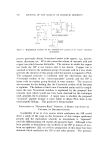
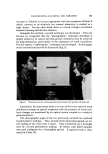
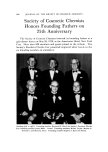
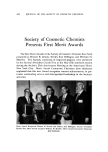
624 JOURNAL OF THE SOCIETY OF COSMETIC CHEMISTS Society of Cosmetic Chemists Literature Award to Dr. Karl Laden Dr. Karl Laden, Vice-President, Gillette Co. Research Institute (Rockville, Md.), has received the Society of Cosmetic Chemists Litera- ture Award for 1969. The award, consisting of a scroll and a $1500 honorarium, is given annually to the author or authors of a publication or series of papers on basic research which is judged to be the most outstanding contribu- tion to cosmetic science or technology published during the preceding three years. In presenting the award at the May 27th luncheon session of the Society's 25th Anniversary Meeting at the Americana Hotel, New York City, President Charles Fox read the following citation: The Society of Cosmetic Chemists presents to Dr. Karl Laden the Literature Award for 1969 in recognition of his many con- tributions to the field of skin research. His outstanding work provides a sound basis for the development of new and im- proved cosmetic compositions. Cosmetic Science and Tech- nology has benefited greatly from these research efforts. Society of Cosmetic Chemists President Mr. Charlcs Fox, Dr. Karl Laden, Eulogist Dr. John Menkart
Purchased for the exclusive use of nofirst nolast (unknown)
From: SCC Media Library & Resource Center (library.scconline.org)