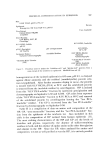
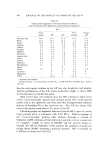
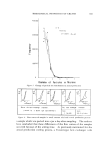
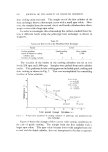
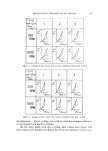
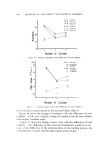
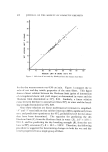
JOURNAL OF THE SOCIETY OF COSMETIC CHEMISTS 641 Prediction equations for the dry tensile properties are first deter- mined for a single keratin fiber source under a given set of experimental conditions. Fibers from this same source are then extended 20 to 30% to provide the wet tensile data. From these data, values for dry extension for the untreated fibers are calculated. The fibers are then relaxed in water, treated, and again extended in water to determine changes in the wet tensile properties. After relaxation in water and drying, the fibers are extended to break and the data are compared statistically with the predicted data for the untreated fibers for estimating changes to the dry tensile properties. Since the conditions used for dry stretching in this experiment pro- vide unsatisfactory reproducibility for elastic slope determination, a similar comparison of Young's modulus (E) for wet rs. dry stretching was not made at this time. For future study, we intend to consider means to improve precision to narrow the ranges for the statistical prediction equations, as well as to relate other parameters of the wet and dry tensile curves in a similar manner. C. R. ROBBINS G. V. SCOTT Colgate-Palmolive Research Center 909 River Road, Piscataway, N.J. 08854 REFERENCES (1) Reed, A. B., and Bronfein, I., Protein additives for hair sprays, Drug Cosmet. Ind., 101, No. 6, 44-7 (1967).

Book Reviews RODD'S CHEMISTRY OF CARBON COMPOUNDS, 2ND ED., VOL. II: ALICYCLIC COMPOUNDS, PART C, POLYCYCLIC COMPOUNDS EXCLUDING STF. ROIDS, Edited by S. Coffey. American Elsevier Publishing Co., Inc., New York, N.Y., 1969. 521 pages, indexed. Price $32.00. This book and its companion vol- umes are a must for any industrial, governmental, or academic labora- tory having an)' connection at all with organic chemistry. They serve as excellent reference sources of syn- thetic and mechanistic organic chem- istry and as sources of information on specific compounds. They can be highly recommended as one of the, if not the, standard organic chemistry references and compound indexes for a laboratory. Dr. Coffey and his contributing authors are to be commended for their massive un- dertaking and, more importantly, for the excellently organized and well presented subject matter. The purpose of this series is estab- lished by the subtitle "A Modern Comprehensive Treatise." The vol- umes are fairIx,' modern (references through 1966 in this book) and are, indeed, comprehensive which neces- sitates the issuance of a large hum- 643 ber of parts 1or each volume with prices ranging from about $16.00 to 542.00 per part. This specific book (Part C of Vol- ume II) on polycyclic compounds (excluding steroids) contains Chap- ters 9 through 14. Chapter 9 deals with carbon polycyclic compounds having two or more separated ring systems including spiro compounds. Continuing, Chapter 10 deals with fused or condensed ring systems and Chapter 11 covers bridged rings. The last three chapters concern the chemistry of the naturally occurring polycarbocyclic terpenoids. This ex- tensive group of complex com- pounds is covered in Chapter 12 on bicyclic monoterpenoids and related compounds, in Chapter 13 on sesqui- terpenoids, and in Chapter 14 on di- terpenoids, sesterterpenoids, and tri- terpenoids. The text is well written, illustra- tions and tables are clear and plenti- ful, printing quality is good, the index is very extensive, and there are few typographical errors. A minor objection ,that can be raised is the ac- tual presentation of references in the written text as opposed to the more easily followed numbering of refer- ences and a reference section at the end of each chapter. This presents
Purchased for the exclusive use of nofirst nolast (unknown)
From: SCC Media Library & Resource Center (library.scconline.org)