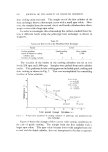
Editor, ,Journal of the Society of Cosmetic Chemists Prediction of Dry Extension Properties of Keratin Fibers from Wet Extensio,n Data Sir: Changes in dry tensile properties of keratin fibers may be estimated by comparing average parameters for sets of treated and control fibers. However, unless the sets are unusually large, normalizing the i•dividual fibers for differences in cross-sectional areas may be necessary. The purpose of this communication is to show that the dry tensile properties of keratin fibers, in a set, are proportional to, and therefore may be esti- mated from, the wet tensile properties. Fundamentally, this relation holds since both wet and dry tensile properties of a given keratin fiber type are proportional to fiber diameter. Aside from a work savings advantage, this inethod for cs6mating dry tensile properties should compensate more fully for axial irregularities than procedures dependent on the direct measurement of fiber dimen- sions. Another self-normalizing procedure using alternating segments of individual fibers as control and test samples has been suggested for dry tensile determination of human hair (1) however, this procedure did not provide satisfactory precision in our experiments. The keratin fibers used in this investigation were fro•n 12-in. dark brown hair.* This hair was purported to be chemically unaltered. Fibers, selected at random, were each mounted on tabs at a gauge length of 5 cm. After the fibers were conditioned in water for 10 mimeres, they were stretched 1 cm (20%) on an Insiron tensile tester. The rate of ex- tension was 0.25 cm/min. The fibers were then relaxed in water, equili- brated at 55% RH, 24øC, and stretched to break. The rate of extension Purchased from DeMeo Bros., New York, N.Y. 639

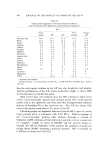
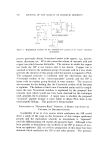
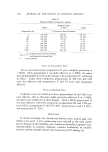
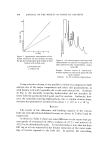
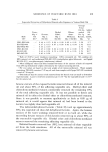
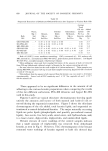
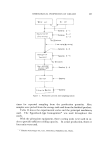
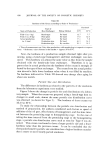
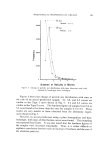
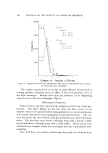
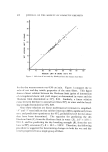
6-t0 JOURNAI, OF THE SOCIETY OF COSMETIC CHEMISTS 35 ß ß ß oo ß I õ ,• ø I•- 0 I0 20 30 40 50 60 70 HOOKEAN LIMIT IN GRAMS (55 % R H) Fig't•re /. Relalion of wet and dry Hookean limit for human hair fibers I 8O I'()r the dry measurements was 0.50 cm/min. Figure 1 compares the re- stilts o1' wet and dry tensile properties of the same fibers. This figure shows a linear relation between the Hookean limit (point of intersection ()f extrapolated elastic and yield slopes) as determined in water and the 1tookean li[nit determined at 55% RH. Similarly, a linear relation exists between the force to extend hair fibers 20% in water and the break- i•g strength determined at 55% RH. Since these relations are linear mathematical treatment is simplified. "F" :u•d "t" tests indicate that neither intercept differs significantly from veto, and prediction equations at the 95% probability level for the above data have been determined. The equation for predicting the dry 1 lookcan limit (Y), from the Hookean limit in water (X), is Y q- 3.75 -- 2.18 X, and for predicting the dry breaking strength (B), from the wet t'{u'cc to 20% extension (F), B m 10.3 = 3.92 F. Therefore, the following procedure is suggested for determining changes in both the wet and dry ! ensile properties kotn a single group of fibers.
Purchased for the exclusive use of nofirst nolast (unknown)
From: SCC Media Library & Resource Center (library.scconline.org)