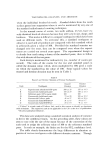
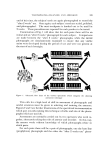
TOOTHPASTES--CLEANiNG AND ABRASION 605 staining problem do not need high cleaning dentifrices and, in fact, would not be expected to notice any differences in cleaning performances. Cleaning is, for the most part, related to the abrasiveness of the agent used. Lobene found that the stain removing property of a dentifrice was not solely related to its abrasiveness towards dentine (5), though other researchers (2-4) have shown that the largest contributory factor for cleaning performance is the abrasive and, further, that there is a relation. ship between cleaning and dentine abrasion. Enamel abrasion and cleaning are usually similarly related, but the relationship has been shown to be broken for a particular abrasive. Presumably, such a deviation oc- curs because of the properties of the abrasive (hardness, shape, size, etc.). SUMMARY Dentifrices of various formulations have been examined for their abrasivehess towards both dentine and enamel using a standardized radio- tracer technique. Cleaning data have been obtained for the same denti- frices by a precision photographic technique and also by using an instru- ment designed to detect changes in the optical brightness of teeth with varying degrees of associated stain. Cleaning and abrasion are, for the most part, directly related, and higher cleaning corresponds to greater abrasivehess. In the case of enamel abrasion, this relationship can be broken, presumably as a result of the properties of the abrasive (i.e., hardness, shape, and size). (Received December 9, 1969) REFERENCES (1) Kitchin, P. C., and Robinson, H. B. G., How abrasive need a toothpaste be? ]. Dent. Res., 27, 501-6 (1948). (2) Bull, W. H., Callender, R. M., Pugh, B. R., and l¾ood, G. D., The abrasion and cleaning properties of dentifrices, Brit. Dent. J., 125, 331-7 (1968). (3) Stookey, G. K., and Muhler, J. C., Laboratory studies concerning the enamel and dentine abrasion properties of common dentifrice polishing agents, J. Dent. Res., 47, 524-32 (1•68). (4) Wright, K. H. R., and Stevenson, J. I., The measurement and interpretation of dentifrice abrasiveness, J. Soc. Cosmet. Chem., 18, 397-411 (1967). (5) Lobene, R. R., Effect of dentifrices on tooth stains with controlled brushing, J. Amer. Dent. Ass., 77, 849-55 (1968). (6) Callender, R. M., Techniques of intra-oral photography, Photog. J., 106, 327-g2 (1966).

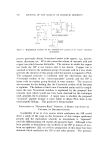
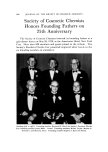
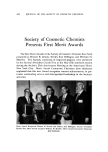
606 JOURNAL OF THE SOCIETY OF COSMETIC CHEMISTS Society of Cosmetic Chemists Honors Founding Fathers on 25th Anniversary ß The Society of Cosmetic Chemists honored its founding fathers at a gala dinner dance on May 26, 1970, at the Americana Hotel, New York City. More than 800 members and guests joined in the tribute. The Society's President Charles Fox presented engraved silver bowls to the six founding members in attendance. Standing (leJt to right): Founding member Raymond E. Reed, the Society's President Charles Fox, founding member James Baker. Seated: Founding members Walter Taylor, Maison G. deNavarre, and Marcel J. Suter. Founding member Stephen A. Karas not shown.
Purchased for the exclusive use of nofirst nolast (unknown)
From: SCC Media Library & Resource Center (library.scconline.org)