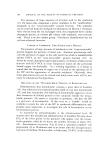
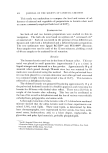
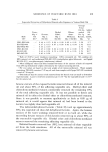
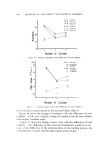
RHEOLOGICAL PROPERT[ES OF CREAMS 627 Water part I (3•1 part _ Sampling' S-- ! Sampling' S--2 ( Pre-mlx•ng ) S-- 3 • •kFo 20 minutes.
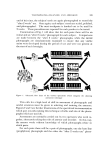
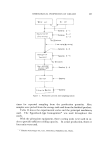
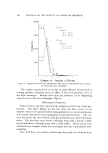
Emulsification •- ....... ] hour aging(No-m•xlng) /.--Sampling S --4 Homoge izer Sampling S Treatment I •k"For 10 minutes. Heat -exchanger ( Votator type) Samphng S Treatment Storage •-- Sampling: I Filling by Machine I. -----Sampling: Figure 1. Production process and sampling system times for repeated sampling from the production quantity. Also, samples were picked from the storage tank and from the finished product. Table II shows the experimental scales and the principal machinery used. The Eppenbach-type homogenizer * was used throughout this study. With the pilot-plant equipment, three cooling units were used in or- der to provide sufficient cooling capacity. In actual production, three or four units were used. • Tokushu Kika Kogyo Co., Ltd., 3 Ebieshita, Fukushima-ku, Osaka.

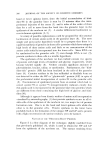
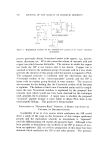
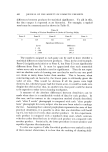
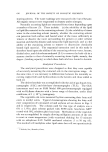
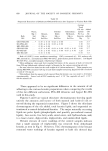
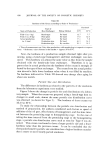
628 JOURNAL OF THE SOCIETY OF COSMETIC CHEMISTS Table II Production Scale and Machinery Scale Quantity, kg. Heat Homogenizer Exchanger Power, Speed, Time, cooling hp rpm min cylinders Cooling Capacity, kg/hr Bench scale 1 Pilot plant 20 Actual production 5,000 I/6 10,000 1 1 a/4 7,300 2 3 10 3,500 20 3 or 4 lO loo lOOO Product Beat Transler Beat Tansfer Medmm Inlet • Inlet t • • Medmm Outlet Outside Jacket Cylinder Passage for Passage {or Product Product Outlet Set Pros for Blades Revolwng Shaft Shaft Product er Blades I Insulation Effective Heat Cylinder Capacity Cylinder I. D.x Length Type Transfer Area m 2 L mm mm Bench type 0.01 0.06 30• x 120 Pilot plant 0. 03 0. 3 50 • x 250 Actual production 0. 14 3.2 96• x 1,000 -- Figure 2. Cooling unit of Votator-type heat exchanger and its mechanism The details of the Votator-type heat exchanger are shown in Fig. 2. Effective heat transfer area, capacity, length, and inner diameter of the cooling unit are also shown. Stability, appearance, and various properties were studied for every sample. In this paper, however, the authors will discuss primarily the hardness, particle size distribution, and rheological properties of these samples. The following methods were used for the measurement of these spe- cific properties: The samples were kept at 25øC and 30øC, respectively, for a day and the hardness of the samples was measured using a Curd Tension Meter.* * Iio Electric Co., I.td., 2-27 Yoyogi, Shibuya-ku, Tokyo.
Purchased for the exclusive use of nofirst nolast (unknown)
From: SCC Media Library & Resource Center (library.scconline.org)