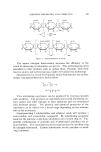
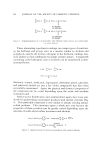
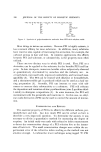
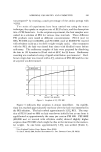
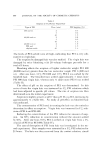
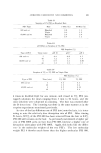
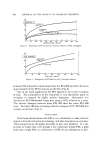
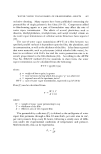
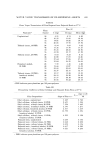
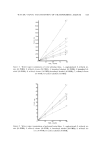
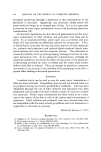
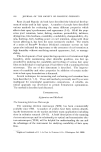
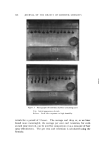
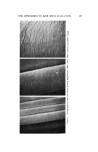
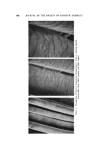
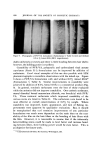
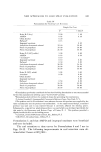
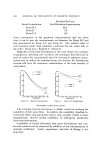
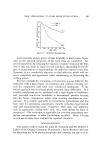
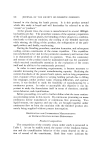
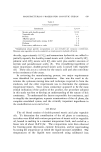
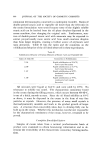
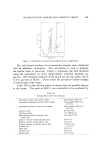
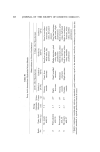
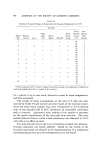
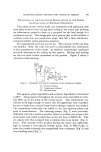
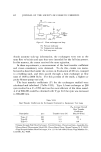
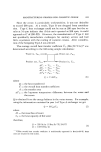
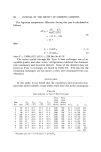
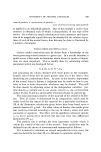
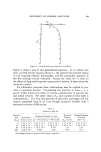
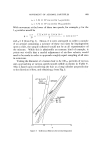
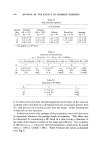
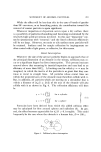
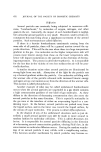
612 JOURNAL OF THE SOCIETY OF COSMETIC CHEMISTS DISCUSSION OF RESULTS Previous investigations have indicated that films of ethyl cellulose and polyamid resin were worthy of further study (9). The tlux, as well as the permeability coefficient for these films, was determined using several plasticizers at varying concentrations. In all cases a plot of flux as a func- tion of time yielded a straight line, confirniing that a steady state diffu- sion process was operative. These results are illustrated in Figs. 2 and 3. The composition and concentration of both plasticizers studied were varied in order to evaluate their effects upon the polymeric film. Figure 2 includes the values for 10 and 20• by weight of hexadecyl alcohol in ethyl cellulose films. These were obtained from a previous study (16) and are included for comparison. It was observed that ethyl cellulose films generally gave a higher per- roeability coefficient than polyamid resin films. It was noted that the water vapor transmission of ethyl cellulose films decreased with an in- crease in tributyl citrate concentration up to 10% by weight and an in- crease in permeation with an increasing plasticizer concentration beyond this point. Hexadecyl alcohol, on the other hand, did decrease the water vapor permeation oF ethyl cellulose films at a concentration of 105o by weight, but showed no change in permeability coefficient when its con- centration was increased to 20% by weight. The water vapor permeabil- ity of ethyl cellulose film was noted to nearly double with the use o[ a mixture ot: tributyl citrate and hexadecyl alcohol as the plasticizer. Ad- ditional increase in concentration of the mixture beyond 10% brought about a decrease in the water vapor' permeability as shown in Table Ill. Polyamid resin films behaved differently in that concentrations ot: tributyl citrate up to 105o by weight increased the water vapor perme- at)ility, followed by a decrease in permeability with an increase in con- centration. With hexadecyl alcohol, as well as the combination o[ this with tributyl citrate, an increase in the water vapor permeability was noted. This may be explained on the basis that the plasticizer is an in- tegral part of the free film as it is distributed between the interstices o[ the polymer. If the permeation of water vapor through the film is pri- marily accomplished by the passage of w•por through the interstices, then it. seems logical that as these spaces become filled with plasticizer, the rate (•[ water vapor transmission would decrease. This was noted to be true with ethyl cellulose and polyamid resin films plasticized with tribu.tyl citrate and hexadecyl alcohol. As previously shown, the permeability coefficient of ethyl cellulose films plasticized with tribu•-yl citrate and

¾VATER VAPOl{ TRANSMISSION OF FILM-FORMING AGENTS 613 11oo lOOO 9oo 8oo 7oo 6oo 5oo 4oo 2oo lOO o / / 24 48 72 cuB' TIME, HOURS 1,'igure 2. Water vapor transmission of ethyl cellulose films. 1, unplasticized 2, tributyl cit- rate (10 PHR) 3, tributxl citrate (20 PItR) 4, hexadecyl alcohol (10 PHR) 5 hexadecyl al- cohol (20 PHR) 6, tribtu)l citrate (10 PHR)/hexadecyl alcohol (10 PHR) 7, tributyl citrate (15 PHR)/hexadec¾1 alcohol (15 PHR) 45 40 85 [ •o • •o 15 10 5 24 48 72 96 TIME, HOURS Figure 3. Water vapor transmission of polyamid resin fihns. 1, unplasticized 2, tributyl cit- rate i10 PHR) 3, tribut)l citrate (20 PHR) 4, hexadecyl alcohol (20 PHR) 5, tributyl cit- rate (10 PHR)/hexadecyl alcohol (10 PHR)
Purchased for the exclusive use of nofirst nolast (unknown)
From: SCC Media Library & Resource Center (library.scconline.org)