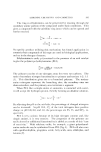
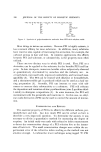
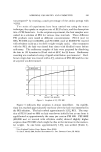
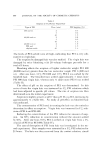
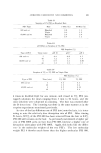
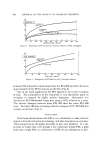
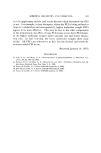
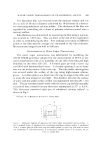
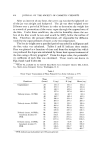
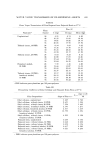
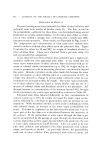
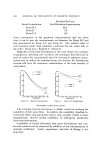
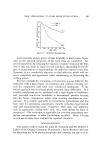
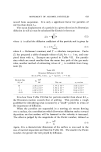
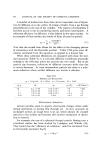
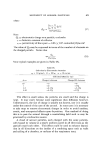
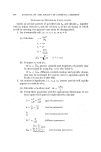
614 JOURNAL OF THE SOCIETY OF COSMETIC CHEMISTS hexadecyl alcohol go through a minimum as the concentration of the plasticizer is increased. Apparently, any plasticizer added above this point would no longer be an integral part of film. It is at this point that an increase in water vapor transmission occurs with increasing plasticizer concentration (12). An alternate explanation for this observed phenomenon for the water vapor transmission of ethyl cellulose and polyamid resin films can be given. In an unplasticized film, water vapor acts as permeant and plas- ticizer (17) and provides an additional pathway for permeation. There is dipole-dipole attraction between ,the polar portion of bo.th molecules (i.e., polymer and plasticizer) and induced dipole-induced dipole inter- action between the polar and the nonpolar portion. The plasticizer in- creases the mobility of the polymer grouping, causing an increase in water vapor permeation (18). At low plasticizer concen. tra•tions, although the segmental mobility is increased, the effect of interaction of the plasticizer in decreasing solvation by water is evident and the water vapor perme- ability of the film is reduced. Thus, an increase in plasticizer concentra- tion resul.ts in an increase in the mobility of the groupings in the film in greater effect leading to increased permeation. SUMMARY A method which can be used to vary the water vapor transmission of films has been indicated. Depending upon the end use desired, films can be prepared having the desired permeability coefficient. This has been illustrated through the use of ethyl cellulose and polyamid resin films plasticized with hexadecyl alcohol, tributyl citrate, or mixtures of these two materials. Water vapor transmission has been noted to be a func- tion of the nature of the film as well as the nature and concentration of plasticizer. Ethyl cellulose and polyamid resin were selected since they are compatible with the usual aerosol propellants and lend themselves to application to the body by spraying. (Received January 7, 1972) REFERENCES (1) Wallgren, G. R., Plastics as surgical dressing, Ann. Chir. Gynaecol. Fenn., 43, 279 (1954). (2) Fluid surgical dressing, U.S. Patent 2,804,073 (1957). (3) Miller, J. M., Grinberg, M., McElfatrick, G. E., and Shonberg, I. L., Use of plastic film as a dressing for wounds, Arch. Surg., 82, 326 (1961). (4) Anon., Aerosol spray for surgical emergencies in war and peace, Soap Chem. Spec., 43, 183 (Aug. 1967).

WATER VAPOR TRANSMISSION OF FILM-FORMING AGENTS 615 (5) Anon., More on aerosol tissuc adhesives, Aerosol Age, 12, 40 (Nov. 1967). {6) Nelson, R. A., Banitt, E. H., Kram, D.C., Harrington, J. K., Robertson, J. E., and Bue- low, J. s., A ncw ttuoroalkyl cyanoacrylatc surgical adhesive, Arch. Surg., 100• 295 (1970). .(7) Lange, W. E., and Gonet, F. R., Aqueous topical adhesive. I. Spray-on bandage, J. $oc. Cosmet. Chem., 16, 563 (1965). (8) Lange, W. E., and Fang, V. S., Aqueous topical adhesive. II. Spray-on bandage, Ibid., 17, 115 (1966). (9) Sciarra, J. J., and Gidwani, R., The release of various ingredients from aerosols contain- ing selected film-forming agents, Ibid., 21, 667 (1970). ,(10) Kanig, J. L., and Goodman, H., Evaluative procedure for film-forming materials used in pharmaceutical applications, J. Pharm. Sci., 51, 77 (1962). (1l) Munden, B. J., Dekay, H. G., and Banker, G. S., Evaluation of polymeric material. I, Ibid., 55, 395 (1964). .(12) Lachman, L., and Drubulis, A., Factors influencing the properties of fihns used for tablet coating. I, Ibid., 55, 639 (1964). (13) Patel, M., Patel, J. M., and Leto berger, A. P., Water vapor permeation of selected cellu- lose ester films, Ibid., 55, 286 (1964). (14) Barrer, R. M., Diffusion in and Through Solids, Cambridge University Press, London, 1952, p. 432. {15) Standard Methods o[ Test [or Water Vapor Transmission o[ Materials in Sheet Form, ASTM Designation E96-66, American Society for Testing of Materials, Philadelphia, Pa., 1966. (16) Sciarra, J. J., and Gidwani, R., Evaluation of selected physical constants of polymeric fihns and proposed kinetics of drug release, ]. Pharm. Sci., 61, 754 (1972). (17) Stannett, V., and Williams, J. L., The permeability of poly(ethyl methacrylate) to gases and water vapor, ]. Polym. Sci., Part C, 10, 45 (1965). (18) Kumins, C. A, Transport through polymer films, Ibid., 10, I (1965).
Purchased for the exclusive use of nofirst nolast (unknown)
From: SCC Media Library & Resource Center (library.scconline.org)