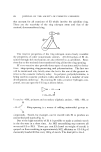
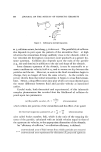
658 JOURNAL OF THE SOCIETY OF COSMETIC CHEMISTS (a) to remain suspended as long as possible in a confined space, in or- der, for example, to produce a disinfecting or deodorizing effect upon the air (b) to collide with, and be retained with maximum efficiency upon a particular surface, as, for example, surfaces of the body both exter- nal (skin, hair, eyes) and internal (respiratory tract, throat) in order to provide cosmetic or therapeutic effects, e.g., perfume, hair spray, deodorant, nasal decongestant, throat spray, etc. (c) conversely, to avoid collision with surfaces of the body as in the case of an insecticide which might cause skin irritation (d) to become impacted on the surfaces of instruments which are de- signed for the sampling and analysis of aerosols, e.g., microscope slides, impactor stages. A study of the principles which govern the movement of aerosol particles should be of value in helping to achieve any one of these objectives. The path followed by an aerosol particle, subsequent to its generation and re'_ease, depends not only upon its initial velocity and upon the ve- locity of the air stream in which it rides, but also upon the action of cer- tain external forces. These may be listed as: (a) drag, the resistance to motion offered by the air surrounding the particle (b) gravity (opposed by a negligible amount of buoyancy) (c) inertia, the resistance offered by the particle to an attempted change in speed or direction (d) diffusion, due to bombardment by air molecules or to turbulence in the air (e) electrostatic, if the particle acquires a charge. Whether the particle remains suspended in still or moving air, settles out, or impinges upon some neighboring surface depends upon its path or trajectory, as determined by the net effect of whichever of these forces may be acting. After collision upon a neighboring surface, the particle may rebound or it may remain deposited upon that surface. To predict the probability of deposition of a particle upon a surface requires an un- derstanding of how each of these forces affect its path. Each of the above forces is reviewed briefly below, in order to indicate what is known about its effect upon aerosol motion, and to indicate how the relative importance of each force may be judged in a given set of cir- cumstances. This is done basically by analyzing the equation of New- ton's Law of Motion:

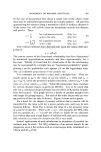
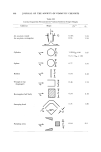
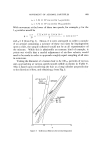
MOVEMENT OF AEROSOL PARTICLES 659 mass of particle X acceleration of particle = sum of all forces acting upon particle as applied to an individual particle. Out of this analysis a series of pa- rameters is obtained, each of which is characteristic of one type of be- havior. By a relatively simple calculation of each parameter and inspec- tion of its magxfitude a good idea may be obtained of the relative impor- tance of each of the several forces how this may be done is illustrated by a number of examples. IMPLICATIONS FOR APPLICATIONS Certain useful conclusions may be drawn from a knowledge of the forces governing aerosol motion in a given case. In a specific situation, a quick survey is first made to determine which forces (or modes of deposi- tion) are most important. This is readily done by calculating certain parameters which are developed below: G, •p, Re, dr/D, Pe -•, K•u and comparing the values obtained with those given in the examples. Usually one of these will be much greater than all of the others, thus identifying the predominant force. As soon as the relative importance of the several forces is known, a judgment may be made on how to pre- vent, or how to foster deposition, whichever may be desired. This will be done mainly by adjusting values of the independent variables: par- ticle density or, particle size d•,, air stream velocity v0, size of deposition surface D (also R and L), and possibly electrical charge on particle Qv. The most important property of the material of the aerosol is its den- sity. This, of course, is determined by its composition, which may be rather fixed by the nature of the material for a particular application. All of the illustrative calculations given below have been based upon a particle density of 1 g/cm a. For other values of density, the results given may easily be corrected according to the way in which p enters into each parameter or equation. The effect will be significant whenever gravity (•', us, G) or inertia (a,) is involved, but does not enter into diffusional phenomena (Pe, :o ). The particle size is perhaps the most important variable which is within the control of the user of the aerosol. Some guidelines may be deduced from the theory of movement and summarized as follows: If it is desired to maintain an aerosol suspended in a free space, the particles should be less than 50 t* in diameter to minimize settling
Purchased for the exclusive use of nofirst nolast (unknown)
From: SCC Media Library & Resource Center (library.scconline.org)