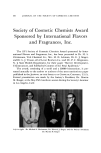
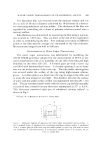
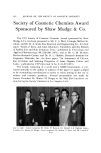
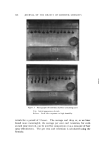
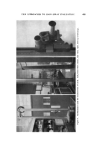
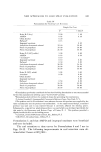
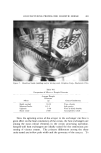
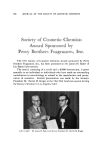
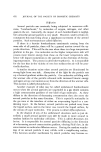
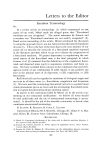
656 JOURNAL OF THE SOCIETY OF COSMETIC CHEMISTS Society of Cosmetic Chemists Award Sponsored by Perry Brothers Fragrances, Inc. The 1971 Society of Cosmetic Chemists Award sponsored by Perry Brothers Fragrances, Inc., has been presen. ted to Mr. James H. Baker of Gar-Baker Laboratories. The award, consisting of a scroll and a $1000 honorarium, is given annually to an individual or individuals who have made an outstanding contribution to microbiology as related to the manufacture and preser- vation of cosmetics. Formal presentation was made by the Society's President Dr. Martin M. Rieger at the May 25th luncheon session during the Society's Seminar in Los Angeles, Calif. LeJt to right: Mr. James H. Baker and Society President Dr. Maitin M. Rieger

J. Soc. Cosmet. Chem., 23, 657-678 (September 14, 1972) The Movement of Aerosol Particles WILLIAM LICHT, Ph.D.* Presented December 13, 1971, New York City Synopsis--The MOVEMENT of an AEROSOL PARTICLE, subsequent to the initial VE- LOCITY imparted by its source, is governed primarily by the influence of GRAVITY, DRAG, INERTIA, DIFFUSION, and ELECTROSTATIC CHARGES. The combined effect of these forces determines the path a particle follows. If this path brings it sufficiently near to a surface, it may collide with that surface and be deposited thereon. Of special interest here is the possible deposition upon surfaces of the body, the hair, and the respira- tory tract. Each of these forces may be characterized by a dimensionless parameter which is readily defined and calculated. From an examination of the numerical values of these parameters, the relative importance of each factor may be judged for a given case. The likelihood of a particle being deposited upon a given surface may also be estimated. The critical variables which control the movement are found to be the size and density of the individual particle, its initial velocity, and the velocity of the surrounding air. These may be adjusted, within limits, so as to tend to promote desired deposition of the particles, or to prevent an unwanted deposition. GENERAL CONCEPTS The widespread use of aerosol dispensers for a variety of cosmetic, pharmaceutical, and related products creates a need for an understand- ing of how aerosol particles move and what determines where they finally come to rest. Such a particle issues from the atomizer as a spherical drop- let of fixed size and density, traveling with a certain initial speed and di- rection. Depending upon the intended purpose of the product, the user may wish the particles to behave in one of several possible ways: * Department of Chemical and Nuclear Engineering, University of Cincinnati, Cincinnati, Ohio 45221. 657
Purchased for the exclusive use of nofirst nolast (unknown)
From: SCC Media Library & Resource Center (library.scconline.org)