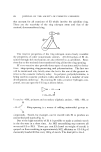
680 JOURNAL OF THE SOCIETY OF COSMETIC CHEMISTS and "locks in" flavors or scents in many formulations. In a similar man- her, to explain the action of anesthetic drugs, Ecanow et al. have pro- posed that membranes which also consist of micellar films or liquid crys- tals or coacervate structures can adsorb or "lock in" nonpolar anesthetic gas molecules. The coacervate (membrane) is then stabilized by the non- polar molecules. One effect of stabilizing the coacervate structure is that diffusion across the matrix or membrane by polar molecules or ions such as potassium or sodium is minimized and the anesthetic state results (3). A defined term in the vocabulary used to discuss hererogenous systems should incorporate within its limits all the characteristics common to all the systems. Thus, the terms coagulation and fiocculation describe two different types of aggregated states which can be present in any hereroge- nous system. These aggregated states occur in cosmetic, pharmaceutical, or biological beterogenous systems. REFERENCES (1) Ecanow, B., and Wilson, R., Powdered particle interactions: suspension flocculation and caking, II, ]. Pharnt. Sci., 52, 1031-8 (1963). (2) Ecanow, B., Gold, B., Ecanow, C., Newer aspects of suspension theory, Arner. Perrum. Cosntet., 84, 27-30 (1969). (3) Ecanow, B., and Gold, B., Application of physical-chemical principles to the study of anxiety and depression, J. Psychotherapy Psychosom. Med., 21, 125-7 (1972).

Letters to the Editor Emulsion Terminology Sir: In a review article on terminology (1) which commented on one aspect of our work, Mittal made the alleged quote that "Flocculated e•nulsions are not recognized." The actual statement by Ecanow and co-workers was "Flocculated emulsions are not readily recognized" (2). Based on his misreading of the article, Mittal reinforced his discussion by using the approach that it was not believed that fiocculated emulsions do exist (1). This in the face of the facts that in the next sentence of our article (2) we describe the networks of a fiocculated emulsion reported in the literature and after which we go on to discuss the preparation of a fiocculated emulsion. Of greater importance in emphasizing the uni- versal nature of the flocculated state is the final paragraph in which Ecanow et al. (2) comment that the definitions of the coagulated, fioccu- lated, and dispersed states apply to suspension, emulsion, and foam sys- tems. We have extended these concepts to the conclusion that any herer- ogenous system of any combination of solid, liquid, or gas particles can exist in the physical states of (I) dispersion, or (II) coagulation, or (III) fiocculation. Red blood cells can be regarded as emulsions of biological origin and can exist in all three states, i.e., fiocculation, coagulation and dispersion (3). We have used the terminology fiocculated red cells to explain blood system phenomena just as we have used the terminology fiocculated emul- sion to explain the phenomena of any emulsion system. In answer to the conclusions listed by Mittal (1) in the article com- menting on our conceptual clarifications: we believe all terms should be used judiciously and the use of unwarranted terminology is unwar- ranted. It should be the job of the scientific community to decide what constitutes unwarranted terminology. B. ECANOW, R. ]•ALAGOT, B. GOLD, C. ECANOW University of Illinois, 833 S. Wood St., Chicago, Ill. Hines V. A. Hos- pital, Hines, Ill. Ecanow Assoc. Consultants, Chicago, Ill. REFERENCES (1) Mittal, K., Conceptual clarification of the terms used to describe emulsion behavior. J. Soc. Cosmet. Chem., 22, 815-24 (1971). (2) Ecanow, B., Gold B., Ecanow, C., Newer aspects of suspension theory, Amer. Perfurn. Cosmet., 84, 27-30 (1969). (3) Ecanow, B., Gold, B., Balagot, R., Observations on the relationships between one-hour and twenty-four erythrocyte sedimentation rates, Lab. Pract., 19, 706-8 (1970). 681
Purchased for the exclusive use of nofirst nolast (unknown)
From: SCC Media Library & Resource Center (library.scconline.org)