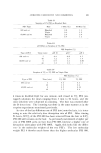
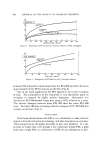
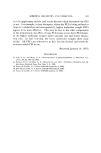
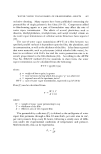
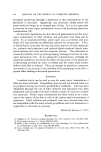
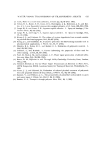
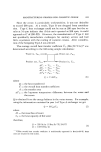
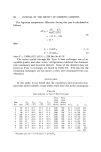
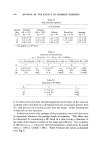
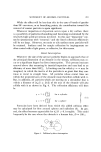
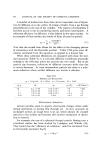
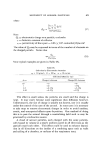
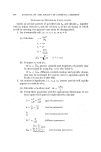
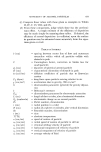
678 JOURNAL OF THE SOCIETY OF COSMETIC CHEMISTS v r (cm/sec) = % (cm/sec) •_ (cm/sec) Ax B (cm) x era) (cm) y (cm) •0 • (dyne/cm sec) = = 0p (g/cma) = 0l (g/cma) = ½½c) -- velocity of fluid stream in axial direction, at radial position r horizontal component of velocity of fluid streamline vertical component of velocity of fluid streamline mean displacement of particle by Brownian motion distance traveled horizontally by particle stopping distance of particle in stream distance traveled vertically by particle geometric standard deviation in •/•p dielectric constant of collector pmmittivity of free space collection efficiency of particles by obstacle collection efficiency of particles due to diffusion collection efficiency of particles due to electrostatic force viscosity of fluid inertial impaction parameter, dimensionless density of particle density of fluid relaxation time of particle (Received November 15, 1971 ) REFERENCES (1) Findeisen, W., Arch. Gesamt. Physiol., 286, 467 (1935). (2) Landahl, H., Bull. Math. Biophys., 12, 43 (1950). (3) Hatch, T. F., and Gross, P., Pulmonary D• position and Retention o[ Inhaled Aerosols, Amer. Ind. Hyg. Assn., Academic Press, New York, N.Y., 1964, pp. 67-8. (4) Fuchs, N. A., The Mechanics o[ Aerosols, The Macmillan Co., New York, N.Y., 1964, p. 112. (5) Whitby, K. T., Calculation of the clean fractional efficiency of low media density filters, ASHREA J., 7, 56-65 (Sept. 1965). (6) Fuchs, N. A., The Mechanics o! Aerosols, The Macmillan Co., New York, N.Y.. 1964, p. 165. (7) lb"d., p. 184. (8) Langmuir, I., Theory of Filtration of Smohes, O.S.R.C. Rep. No. 865 (1942). (9) Ranz, W. E., Tech. Rep. No. 8, I11. Univ. Eng. Exp. Sta., Jan. 1, 1953. (10) Lundgren, D. A., and Whitby, K. T., The effect of particle electrostatic charge on filtra- tion by fibrous filters, Ind. Eng. Chem., Process Des. Develop., 4, 345-9 (1965). (11) Fuchs, N, A., The Mechanics of Aerosols, The Macmillan Co., New York, N.Y., 1964, pp. 192-204.

Notes Properties and Vocabulary of Aggregated States B. ECANOW, Ph.D.,* R. BALAGOT, M.D.,* B. GOLD, Ph.D.,* and C. ECANOW, B.S.** It is a legitimate concern and necessity for the scientific community to help clarify the vocabulary used in discussing heterogenous systems. In this effort we have extended to heterogenous systems the conceptual clari- fications and vocabulary which were developed in our laboratories for the coagulated and the flocculated suspension states (1, 2). The aggregated states of heterogenous systems are the ones which give ditficulty in relat- ing vocabulary to properties. The flocculated state is one in which the particles are aggregated in a network structure with entrapped bulk media. The particles have a rela- tively fixed spacial relationship (geometry) to each other. The particles with their adsorbed surfactant films are not in contact. If one particle moves and the bridges hold, then the whole group moves in that direction (2). The coagulated state is one in which the particles are aggregated in a structure which consists of surface-to-surface contact. The surface con- sists frequently of adsorbed surfactant or adsorbed colloidal material sur- rounding the particles. The adsorbed films form a matrix with little or no entrapped free bulk medium. The matrix of surfactant and water and oil molecules (in oil/water emulsions) can form a structural phase having the properties of a micellar film or liquid crystals or coacervate, etc. Thus, the film matrix in a coagulated system probably incorporates * University of Illinois, 853 S. Wood St., Chicago, Ill. 60612, and Hines V.A. Hospital, Hines, Ill. * Ecanow and Assoc. Consultants, Chicago, Ill. 679
Purchased for the exclusive use of nofirst nolast (unknown)
From: SCC Media Library & Resource Center (library.scconline.org)