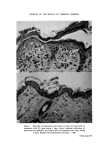
J. Soc. Cosmet. Chem. 24, 473-492 ¸1972 Society of Cosmetic Chemists of Great Britain The effect of soap upon certain aspects of skin biochemistry C. PROTTEY, P. J. HARTOP and T. F. M. FERGUSON* Presented on the !2th April 1972 in Oxford, at the Symposium on 'Skin--Environmental responses and protection', organized by the Society of Cosmetic Chemists of Great Britain. Synopsis--Rats have been TOPICALLY TREATED with SOAP solutions and distinct morpho- logical changes in the skin have been observed histologically. Samples of the treated tissues have been CULTURED in vitro in the presence of specific precursors of DNA and LIPIDS, when it was seen that DNA and PHOSPHOLIPID metabolism was stimulated in mildly irritated cases, but in more severely irritated tissues, which had received greatly exaggerated soap treat- ments compared with routine tests for irritancy or normal user conditions, both of these bio- chemical reactions were greatly diminished. TRIGLYCERIDE synthesis, on the other hand, appeared to increase as the degree of irritation response increased. The most irritant component of the soap was SODIUM LAURATE, and this compound similarly caused the most marked biochemical alterations. The enhanced triglyceride synth.esis, in skin which was severely damaged from exaggerated soap treatment, more than replaced the inhibited phospholipid synthesis: indeed, severely irritated skin was seen to synthesize greatly increased amounts of radioactive lipids compared with the water-treated controls. INTRODUCTION When the surface of the skin is repeatedly treated with soap solu- tions, an irritation response is often seen in the tissue, dependent generally upon the frequency and duration of treatment, the formulation of the soap, and the concentration of the solutions. The irritation response which may develop often involves marked changes in the morphology of the skin, the rate of keratin formation, and in the overall physical properties of the skin. *Unilever Research Laboratory, Colworth House, Sharnbrook, Bedford. 473

474 JOURNAL OF THE SOCIETY OF COSMETIC CHEMISTS This paper describes certain biochemical parameters which are seen to be altered by soap-induced irritation of rat skin, with particular emphasis on glycerolipid metabolism. The soap formulation used here is very mild under typical user con- ditions. The drastic morphological and metabolic changes described are due to grossly exaggerated treatments, and in no way would arise from normal usage in cleansing human skin. MATERIALS AND METHODS Soap treatment The soap was a conventional formulation derived from coconut oil and tallow. 8•o solutions were prepared by homogenizing powdered soap in distilled water (6 ø hardness), and the pH adjusted to 9.8. The solutions were maintained at 37 ø during treatment of the animals, which had been clipped closely on the dorsal surface with electric clippers prior to the initial treat- ment. The solution (0.2 ml) was applied to the shaved area and gently massaged in, and then left for 7.5 min, after which the treatment was re- peated. Excess of soap was then removed from the animals by rinsing with distilled water and wiping with tissues. Control animals received similar treatment, except that distilled water replaced the soap solutions. The frequency of soap treatment in each experiment (either twice--or four times daily) is quoted at the relevant point in the text. Sodium soaps of individual fatty acids were prepared by neutralization of the free acids with sufficient NaOH solution to give final solutions of 0.25M at pH 9.8. Animals All rats were 3-week-old females of the Colworth/Wistar albino strain, fed Spital diet and water ad libitum throughout treatments. Guinea-pigs were 6-week-old albinos ex-Porton, of either sex. Radioactive substrates These were purchased from the Radiochemical Centre, Amersham, Bucks. The specific activity of each added to tissue culture were 5.0 I•Ci ml 4 media for 2-x4C-thymidine, 2-x4C-sodium acetate and U-x•C-glycerol,
Purchased for the exclusive use of nofirst nolast (unknown)
From: SCC Media Library & Resource Center (library.scconline.org)