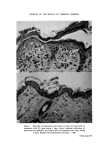
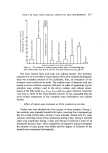
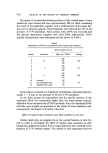
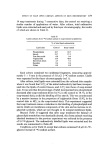
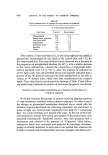
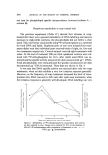
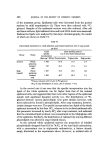
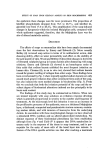
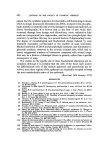
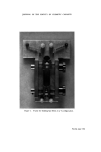
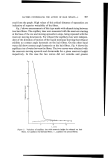
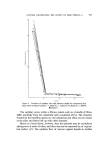
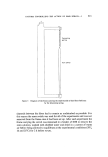
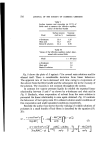
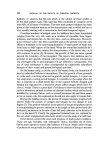
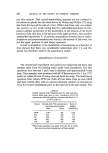
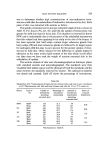
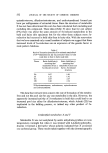
FACTORS CONTROLLING THE ACTION OF HAIR SPRAYS--I 505 ment of contact angle, was used to measure the wettability of hair fibres by various resin solutions. The same technique was also used to measure the CST of the hair fibres. The experimental technique was originally developed by Dyba and Miller (12, 13) for the study of the wettability of textile filaments. Using the frame shown in Fig. 1 two hair fibres were arranged under tension in a vee- shaped configuration with the apex pointing downwards and dipping into a reservoir of the liquid being studied. The frame allowed the fibres to be held in strict alignment and was adjustable so that the angle of the vee could be set to any desired value. The frame itself consisted of a metal plate carrying two pairs of adjust- able jaws mechanically actuated on matched left- and right-hand threads. The two fibres were each secured at one end by the screws at the bottom of the Perspex plate and the free ends were passed between the lower and upper jaws, around the retaining pins, fastened via the tensioning springs to the two upper screws. Each jaw carried a precisely located notch to hold the fibres in the same vertical plane. Freshly shampooed virgin Italian hair was washed thoroughly with distilled water and a single long fibre was cut in half so that the two halves could be arranged in the vee-frame with the cuticles on each half pointing in the same direction. In this way the effect of moving the liquid with or against the scales could be studied. With the liquid reservoir initially adjusted so that the tip of the apex of the vee was just immersed, there was a spontaneous capillary rise up to a certain height. For a given liquid-fibre system this rise depends on the angle between the fibres and the distance separating them at the reservoir level. This latter distance increases with increasing depth of immersion, hr, of the apex of the vee below the reservoir surface. The capillary rises, h, produced for different depths of immersion were measured with a cathetometer. Capillary rise measurements were carried out using a range of AR ethanol/water solutions. A single pair of fibres was used throughout and the angle between them was maintained constant. This precaution was necessary since the capillary rise has been shown (13) to be dependent on both spacing and diameter of the fibres. Surface tension of the solutions was measured with a du Nouy tensiometer and using the correction tables of Harkins and Jordan (14). Similar capillary rise measurements were carried out using ethanol solutions of hair spray resins. The relative humidity and temperature were maintained at 50• and 25øC respectively during all experiments.

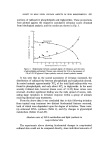
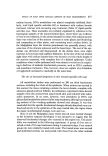
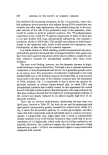
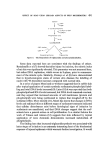
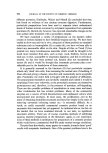
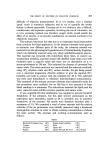
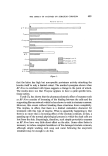
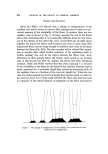
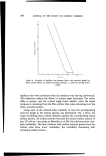
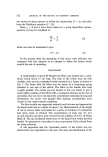
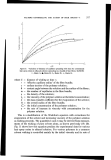
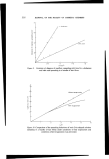
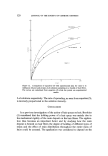
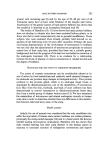
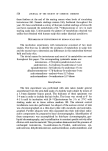
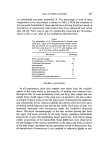
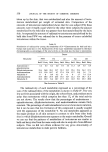
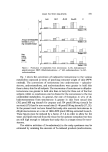
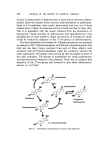
506 JOURNAL OF THE SOCIETY OF COSMETIC CHEMISTS Results and discussion Dyba and Miller (13) showed that a change in configuration of the capillary rise which occurs at narrow fibre spacings can be used as a con- venient measure of the wettability of the fibres. In practice there are two capillary rises as shown in Fig. 2. At large spacings the rise of the liquid about each individual fibre is not noticeably different from the rise about one in the absence of the other (Fig. 2(a)). As the fibres are brought closer together the liquid rise about each increases and even at quite large fibre separations these rises are large enough to reinforce each other in the space between the fibres (Fig. 2(b)). The rises increase until a critical fibre separa- tion is reached after which further reduction of the separation leads to further capillary rise only in the region between the fibres (Fig. 2(c)). Reduction in fibre spacing below the critical value results in an increase only in this second rise with the original rise about each fibre remaining constant. Dyba and Miller showed that the critical spacing is a measure of the wettability of the fibres by the liquid in use, and this distance may be easily measured for a particular liquid-fibre system by measuring both of the capillary rises as a function of the reservoir height (hr). When the two rises are plotted against the reservoir height they become equal at a particu- lar reservoir level. For a fixed angle between the fibres this reservoir level is a measure of the critical distance of separation of the fibres and may be / / Figure 2. The change in configuration of the capillary rise around the two hair fibres in the V-configuration.
Purchased for the exclusive use of nofirst nolast (unknown)
From: SCC Media Library & Resource Center (library.scconline.org)