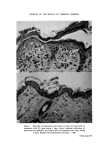
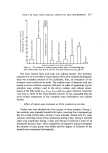
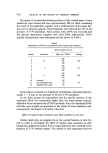
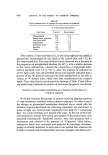
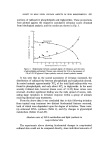
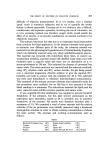
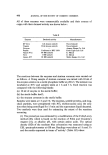
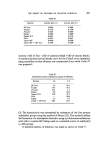
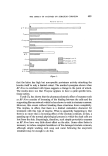
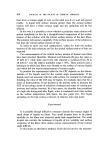
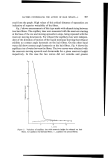
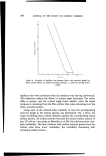
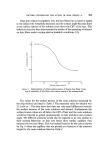
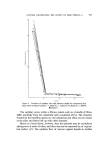
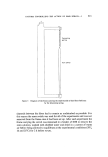
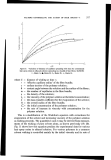
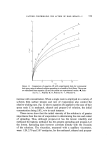
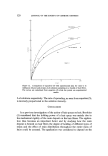
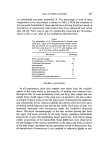
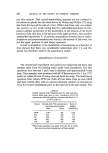
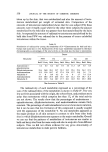
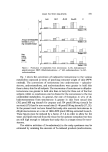
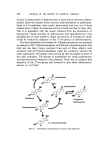
FACTORS CONTROLLING THE ACTION OF HAIR SPRAYS--I 509 Thus pure ethanol completely wets the hair fibres but as water is added to the ethanol the wettability decreases and the contact angle becomes finite as the surface tension of the solution rises above the CST of the hair. This behaviour has also been demonstrated in studies of the spreading of ethanol on hair fibres under varying relative humidity conditions (11). 15 0.5 I I I I 20 25 30 35 40 Surface tension (mN/m) Figure 5. Determination of critical surface tension of human hair fibres. Varia- tion of wettability of hair fibres with surface tension of the wetting liquid. The values for the surface tension of the resin solutions measured by the ring method are listed in Table I. The measured value for ethanol was 21.5 mN m 4. The data show that there are only small differences between the surface tensions of the resin solutions and ethanol. Furthermore the surface tension values are all below the CST of hair and the resin solutions would be expected to spread spontaneously on hair and show zero contact angle. The different solutions would also be expected to be very similar in their wetting behaviour on hair and hence show similar capillary rises between the two hair fibres. This was indeed found to be the case as shown by Fig. 6 where the capillary rises are plotted as a function of the reservoir height for the resin solutions listed in Table I.

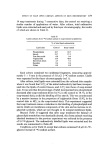
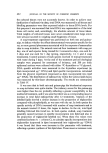
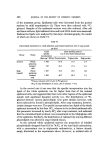
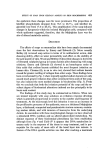
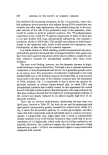
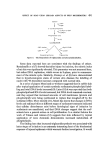
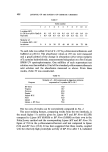
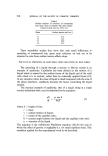
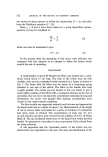
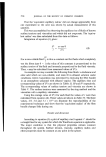
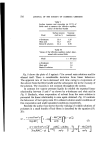
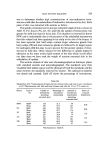
510 JOURNAL OF THE SOCIETY OF COSMETIC CHEMISTS Table I Surface tensions of solutions of commercial hair spray resins in ethanol. The resin concen- tration in each case was 5.0 % w/w Resin Surfacx tension (mN m -•) C 21.2 D 21.4 E 20.8 B 21.3 These wettability studies thus show that only small differences in spreading of commercial hair spray resin solutions on hair are to be expected to arise from surface tension effects alone. THE RATE OF SPREADING OF HAIR SPRAY RESIN SOLUTIONS ON HAIR FIBRES The spreading of a liquid through a porous or fibrous system is an example of capillarity. Capillarity has been defined as the motion of a liquid which is caused by the surface forces of the liquid and of the solid with which it is in contact, rather than by externally applied forces (15). In any situation where the mass of liquid is small compared with the area of the phase interfaces, capillarity becomes the factor controlling the liquid motion. The classical example of capillarity, that of a liquid rising in a single vertical cylindrical tube, may be described by the equation: dS ?r cos 0 d-7 = 4nS (1) where S = height of rise t - time 7 = surface tension of liquid r = radius of the capillary tube 0 = contact angle between the liquid and the capillary tube wall •1 = viscosity of the liquid. This equation is the well-known Washburn equation (16) for the case in which the effect of gravity is negligible (i.e. for small capillary rises). This condition applied for the experimental work to be described.
Purchased for the exclusive use of nofirst nolast (unknown)
From: SCC Media Library & Resource Center (library.scconline.org)