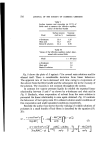
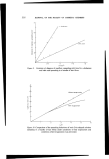
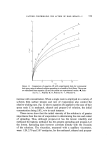
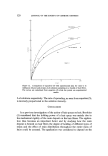
504 JOURNAL OF THE SOCIETY OF COSMETIC CHEMISTS thus show a contact angle of zero on the solid (cos 0 = 1) and will spread readily. A liquid with surface tension greater than the critical surface tension will show a finite contact angle and the spreading will be less efficient. In this way it is possible to show whether a particular resin solution will spread completely on hair by a straightforward comparison of the surface tension of the solution with the critical surface tension of the hair fibres. The solution will spread completely if the surface tension of the solution is less than the critical surface tension of hair. In order to carry out such comparisons, values for both the surface tensions of the resin solutions and for the critical surface tension of hair are required. Two measurements of the critical surface tension of human hair fibres have been reported. Mutchler, Menkart and Schwartz (9) gave the value as 27 mN m 4, while Alter and Cook (10) reported a variation from 34 to 26 mN m 4 over the relative humidity range 1-95•o. These authors used a technique in which hair fibres were floated on the surface of various liquids and which did not require measurement of contact angles. In practice the experimental value for the CST depends on the charac- teristics of the liquids used for the contact angle measurements. If the liquids used can associate with the solid surface, for example by hydrogen bonding, the value of the CST may be higher, for example, than that for a series of hydrocarbons. It was decided in the present study to measure the CST of hair using a series of solutions of ethanol and water of varying pro- portions and surface tensions. In a hair spray, the droplets lose propellant at a high rate during and after flight water is condensed onto their surface as the surface temperature falls below the dew point (11). The liquid spreading on the hair is thus a mixture of ethanol, resin and water. Experimental It is possible though difficult to measure directly the contact angles of small drops of liquids on fibres. Very small droplets have to be placed carefully on the fibres and observed under high magnification. The small droplet size restricts the technique to liquids of low volatility and surface roughness of the fibres often makes precise measurements of the contact angle difficult. In this study an alternative method, which did not involve the measure-

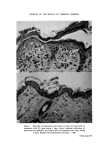
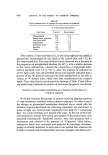
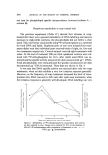
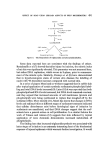
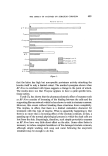
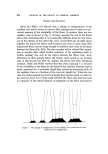
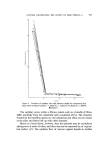
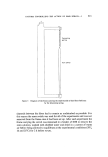
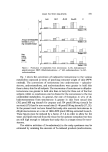
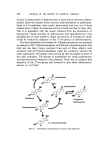
JOURNAL OF THE SOCIETY OF COSMETIC CHEMISTS Figure 1. Frame for holding hair fibres in a V-configuration. Facing page 504
Purchased for the exclusive use of nofirst nolast (unknown)
From: SCC Media Library & Resource Center (library.scconline.org)