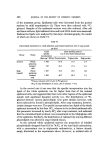
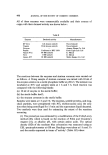
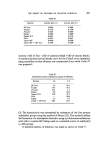
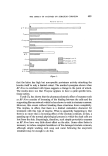
500 JOURNAL OF THE SOCIETY OF COSMETIC CHEMISTS This work does nothing to solve the many practical problems surround- ing the preparation and successful sale of commercial enzyme products, but it does indicate that the varied reports in the literature may be reconciled, i.e. proteolytic enzymes do not cause any immediate or complete breakdown of stratum corneum but they do damage the bonds linking the surface cells to the other skin structures and allow for subsequent easier removal of dead tissue. In addition, there is a strong suggestion that a much more rapid and vigorous effect may be obtained by combining a lipase, which is in itself relatively ineffective, with a proteinase. The indications are, therefore, that enzymatic preparations should be beneficial to the skin by rendering it smoother and cleaner. However, of the many problems associated with enzyme preparations, the outstanding one remains lack of stability. This lack of stability can be overcome by preparing totally dry products, but these products will then have no activity on the skin itself unless an adequate quantity of water is supplied. This leads to cumbersome, aesthetically displeasing dosage forms such as face masks, etc., which can, at best, have a limited sales potential. (Received: 31st March 1972) REFERENCES (1) Fertek, M. U., Horeheld, J., Kolinsky, J. and Levivi, Narodni Podnik, Prague Czecho- slovakia. Perrum. Cosmet. 83 33 (1968). (2) Einbinder, J. M., Walzer, R. A. and Mandl, I. J. Invest. Dermatol. 46 492 (1966). (3) Kligman, A.M. and Christophers, E. Arch. Derrnatol. 88 702 (1964). (4) Bartels, P. H. J. Soc. Cosmet. Chem. 15 485 (1964). (5) Anson, M. L. J. Gen. Physiol. 22 79 (1938). (6) Kunitz, M. J. Gen. Physiol. 30 311 (1947). (7) Turek, B. The Sixth Congress of lnternationaI Federation of Societies of Cosmetic Chemists, Barcelona. September 20th-25th, 1970. (8) Nova!, J. J. and Nickerson, W. J. or. Bacteriol. 77 251 (1959). (9) US Patent 3 409 719. (10) Lowry, O. H., Rosebrough, N.J., Farr, A. L. and Randall, R. J. J. Biol. Chem. 193 265- 275 (1951). (11) Folin, O and Ciocalteu, V. or. Biol. Chem. 73 627 (1927). (12) Boyer, P. D. Am. Chem. Soc. J. 76 4331-4337 (1954).

J. Soc. Costnet. Chem. 24 501-522 (1973) ¸ 1973 Society of Cosmetic Chemists of Great Britain Studies of the factors controlling the action of hair spraysI: The spreading of hair spray resin solutions on hair R. W. RANCE* Synopsis--The importance of SPREADING in the action of HAIR SPRAYS is discussed from the points of view of the WETTABILITY of HAIR FIBRES by hair spray solutions and the rate of spreading of such solutions in bundles of hair fibres. The wettability depends on the magnitude of the surface tension of the solution compared with the critical SURFACE TENSION of the hair fibres, and measurements of both of these quantities showed that for the commonly employed hair spray solvents complete wettability (zero CONTACT ANGLE) invariably occurs, giving rise to spontaneous spreading on the fibre surface. The rate of spreading is shown to depend mainly on the viscosity of the solution, the rate of evaporation of the solvent and the rate of increase in the solution viscosity with concentration due to evaporation. The Washburn equation describing the rate of capillary penetration of liquids into porous systems is shown to be insufficient when dealing with volatile fluids. A new equation which is a modification of the Washburn equation, allowing for the effects of solvent evaporation and increasing solution viscosity with evaporation, is described and shown to be in good agreement with experimental data for various resin solutions spreading in a bundle of human hairs. INTRODUCTION The mode of action of hair sprays has been studied by Brookins (1) who considered the holding power of such products to be due mainly to the mechanical rigidity of the resin deposit formed on the hair fibres. The application of the resin to the hair (i.e. the way in which the resin bridges are formed) was also found to be an important parameter. The * Unilever Research, Isleworth Laboratory, 455 London Road, Isleworth, Middlesex. 501
Purchased for the exclusive use of nofirst nolast (unknown)
From: SCC Media Library & Resource Center (library.scconline.org)