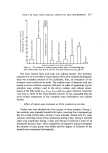
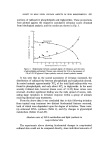
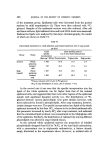
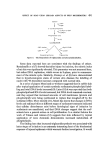
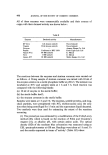
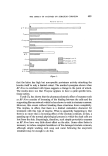
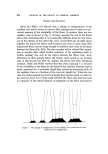
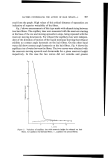
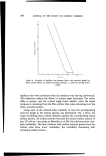
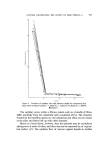
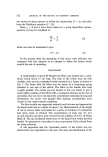
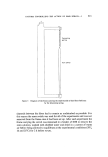
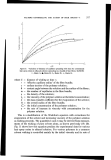
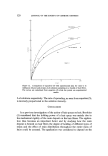
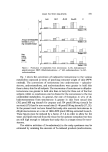
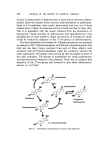
484 JOURNAL OF THE SOCIETY OF COSMETIC CHEMISTS not seen for phospholipid specific incorporations, however (column A x column B). Phosphorus metabolism in soap treated skin The previous experiment (Table IV) showed that whereas in soap- treated skin there was a general stimulation of DNA labelling and massive increases in triglyceride synthesis, the phospholipids did not follow a clear trend. This was further examined by using a•P-orthophosphate as a substrate for both DNA and lipids. Duplicate pairs of rats were treated (four treat- ments daily) such that individual pairs received totals of eight, six, four and two treatments respectively. Control animals received eight treatments with water. At the end of treatment 200 [tm thick epidermal sections were cul- tured with •P-orthophosphate for 24 h, after which total DNA was ex- tracted and the specific activity measured (in dpm incorporated pg-• DNA). Total phospholipids were extracted and the specific incorporation (in dpm incorporated pg-• DNA) measured. These data are shown in Fig. 4. It was seen that DNA specific activity was maximal after only two soap treatments, when rat skin exhibits a very low irritation response generally. However, as the frequency of soap treatment increased the level of incor- poration into DNA was seen to fall, and, after eight soap treatments, when the irritation response is generally well developed, DNA labelling was very _ I I I I I _ 2 4 6 8 Number of soap treatments (Each point represents the mean of two values) Figure 4. Metabolism of a:P-orthophosphate by soap-treated and control rat skin cultured in vitro. Tissues were cultured for 24 h in the presence of 50.0 •tCi ::P-orthophosphate after completion of treatments in vivo. x--x, DNA &--&, phospholipids.

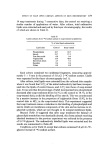
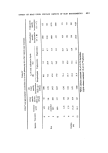
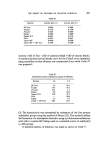
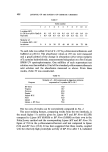
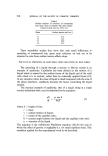
EFFECT OF SOAP UPON CERTAIN ASPECTS OF SKIN BIOCHEMISTRY 485 low indeed. The incorporation of a•P-orthophosphate into total phospho- lipids followed a similar trend, namely, a slight stimulation in labelling after two treatments, which rapidly declined as soap treatments increased, with virtually no phospholipids being synthesized in the rats treated eight times. These results corresponded with those shown in Table IV for the •4C- thymidine and •4C-glycerol experiments except that in the present experi- ment there was a far greater inhibition of phosphorus metabolism after eight soap treatments compared with the metabolism of the carbon- labelled substrates. This suggested that the animals used in the a•P-ortho- phosphate experiment responded more to the soap treatment than in previous experiments. Such variations in irritation response cannot be explained. The individual phospholipid types labelled during the cultures were separated by thin-layer chromatography and the control pattern of activity was compared with that from soap-treated skin. There were no changes in the overall pattern of phospholipids labelled, however, the general propor- tions of radioactivity being: phosphatidylcholine, 60•o phosphatidyl- ethanolamine, 145/o sphingomyelin, 10•o lysophosphatidylcholine, 105/o and phosphatidic acid, 2.5•o. Unidentified material accounted for 3.55/0. Effect of topically applied sodium laurate on lipid and DNA metabolism in rat skin In order to establish whether the irritant component of the soap, sodium laurate, also caused the biochemical changes observed in soap-irritated skin, the following experiment was performed. One rat was treated four times during 1 day with 0.25 M sodium laurate solution, another was treated eight times during 2 days, and a third, control animal, was treated eight times with water. Samples of epidermis were then cultured in the presence of x*C-thymidine or x•C-glycerol and samples of whole skin were examined histologically. Total x'C-labelled lipids were extracted and examined by thin-layer chromatography, the labelling patterns being shown in Table V. The results show a dramatic reversal in the proportion of labelled phos- pholipids and triglycerides. In the water-control epidermis, greater than 80•o of the glycerol incorporated into lipids was located in phospholipids (principally phosphatidylcholine), whereas in the skin irritated by sodium laurate, triglyceride contained 805/0 of the radioactivity, and phospholipids less than 20•o.
Purchased for the exclusive use of nofirst nolast (unknown)
From: SCC Media Library & Resource Center (library.scconline.org)