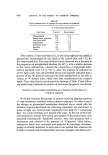
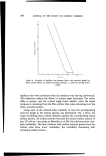
502 JOURNAL OF THE SOCIETY OF COSMETIC CHEMISTS application depends on the wetting properties of the solvent vehicle on hair, and the amount of 'flow-out' of the spray droplets on the hair fibres after impact. This 'flow-out' depends on both the degree to which the droplets wet the hair and the mobility of the droplets after striking the hair fibres. Thus, hair spray consisting of 50•o w/w of alcoholic resin concentrate and 50•o of propellant provides a much wetter spray than one packed with 30•o of alcoholic concentrate and 70•o of propellant. The wet spray wets the hair much faster and more thoroughly than the dry spray. As a result of the lower mobility of the droplets of the dry spray, relatively small bonds or bridges between adjacent or intersecting hair fibres are formed. These sprays are likely to exhibit low holding power. With a wet spray much broader bridges are formed and the degree of hold is increased as a consequence of the much larger area of contact between the resin and the hair fibres. This last point calls for a consideration of the adhesion of the hair spray resins to the fibres. Good wettability of the fibres is essential for close inter- facial contact since the adhesion forces act only over very small distances. The importance of good polymer adhesion to wool in the production of anti-felting properties (2) and in the manufacture of non-woven fabrics (3-5) is already well recognized, and at least one report of the results of actual measurements of adhesion of polymeric binders to wool fibres is to be found (5). To the author's knowledge no such data exist for the adhesion of hair spray resins to hair fibres. Certain properties are required for a polymer to be effective in reducing felting shrinkage of wool. These properties are also those required by a good adhesive, namely that the polymer should readily cover the surface of the wool and should adhere strongly. It is to be expected that these same properties will help promote good hold for a polymer used in a hair spray. However, if the resin cohesion (resin-resin bond) is poor then hold will not necessarily be good in spite of good adhesion. The requirements of a good adhesive have been more fully defined (6, 7) as the ability to wet the adhererid, to be solid at the temperature of usage, and to be sufficiently deformable to minimize stress concentrations during solidification. In the case of a hair spray, deformability of the polymer has the added advantage that the polymer bridges will be less liable to fracture during flexing of the fibres. This condition is essential for lasting hold. If the polymer solution has a contact angle greater than zero only partial wettability results and the tendency to form a large area of interfacial con- tact is reduced. When the contact angle is zero spontaneous spreading of

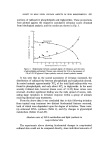
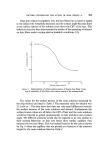
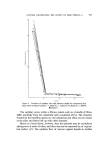
FACTORS CONTROLLING THE ACTION OF HAIR SPRAYS--I 503 the resin solution over the fibre surface takes place and the solution is able to flow into the crevices and around the scale edges on the fibre surface giving very intimate contact. In the present study measurements have been made of the rate of spreading of hair spray resin solutions on hair and of the wettability of hair fibres by such solutions. Spreading is of twofold importance, together with the spray characteristics (particle size and concentration) it controls the distribution of the resin on the hair and hence the number and size of the resin bridges formed, it directly affects the adhesion of the resin since good wetting and spreading are essential for good adhesion. Consideration of the spreading of hair spray resin solutions on hair may be divided into two parts: (1) the wettability of the fibres by the solution and the magnitude of the contact angle formed and (2) the degree of spreading or 'flow-out' of the solution on the fibres. The wettability depends mainly on the surface tension of the solution, while the 'flow-out' depends on the rate of spreading which is controlled by the surface tension and the viscosity of the solution and the rate of evaporation of the solvent. WETTABILITY OF HAIR FIBRES BY HAIR SPRAY RESIN SOLUTIONS The majority of commercial aerosol hair sprays use alcohol as the main solvent and fluorinated hydrocarbons as propellants. Most of the ex- tremely volatile propellant has evaporated by the time the spray droplets strike the hair fibres leaving essentially a solution of resin in alcohol. Small proportions of additives such as perfume and lanolin will also be present if included in the formulation. Generally the low concentrations of these additives will have a negligible effect on the surface tension and hence on the wettability of the solutions. Zisman's concept of critical surface tension (CST) (8) may be usefully applied to fibre surfaces and can be used to explain and predict the spread- ing behaviour of various liquids on both natural and synthetic fibres. The CST is an index of surface energy and its value enables one to predict which liquids will spread on an isolated surface. Measurements of contact angles (0) of liquids on many low-energy surfaces have shown that there is a linear relationship between cos 0 and the surface tension of the liquid. The critical surface tension for the surface was defined as the intercept of the line cos 0 = 1 with the extrapolated straight line plot of cos 0 against surface tension. ^ liquid having a surface tension less than this critical value will
Purchased for the exclusive use of nofirst nolast (unknown)
From: SCC Media Library & Resource Center (library.scconline.org)