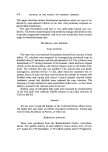
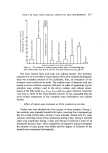
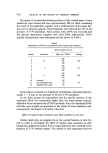
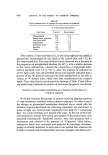
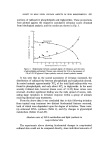
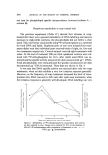
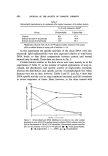
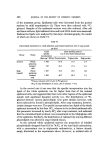
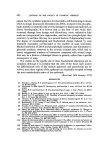
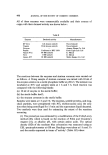
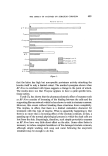
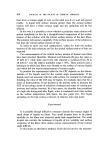
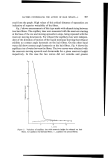
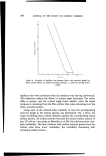
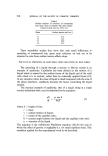
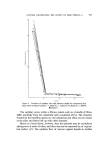
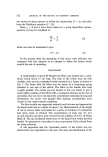
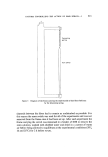
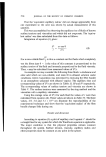
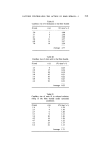
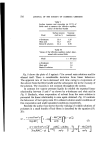
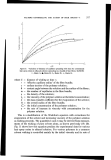
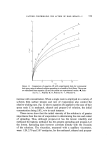
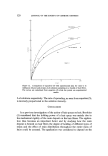
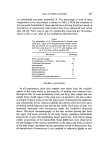
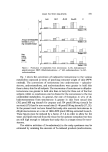
486 JOURNAL OF THE SOCIETY OF COSMETIC CHEMISTS Table V Glycerolipid metabolism in rat epidermis after topical treatment with sodium laurate •o of total radioactive lipids* Group Phospholipids Triglycerides Control 82.1 17.9 Sodium laurate']' (4 treatments) 22.0 78.0 Sodium laurate (8 treatments) 13.9 86.1 *Epidermis cultured with 5.0 •Ci U-x•C-glycerol (after treatment with soap). '•0.25 M sodium laurate in water, pH of solution = 9.8. In this experiment the specific activities of the tissue DNA were also measured: lipid radioactivities were also expressed relative to total tissue DNA levels, so that direct comparisons between control and treated animals may be made. These data are shown in Fig. 5. Certain features similar to the data above were seen, namely as in the experiment of Table IV, as the number of topical applications of soap in- creased, the distribution and specific activity of triglycerides increased, whereas the distribution and specific activity of phospholipids fell. Other features were not so clear, however. Tables I and IV, and Fig. 4 show that DNA specific activity rose as soap treatment increased, and fell sometimes in severe responses of tissue. Here, however, in the skins treated with I 4 8 Number of treotments Glycerolipid and DNA labelling in rat skin in vitro after topical Figure 5. treatment in vivo with 0.25 M sodium laurate solution. DNA cultures were for 24 h in the presence of 5.0 I•Ci 2-x4C-thymidine. Glycerolipid cultures were for 24 h in the presence of 5.0 IxCi U-x4C-glycerol. l--l, Total glycerolipids ß --- O, triglycerides x -- x, DNA lm&, phospholipids.

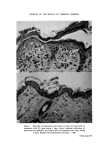
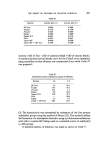
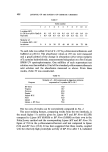
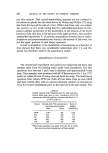
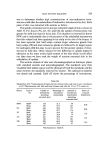
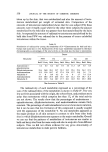
EFFECT OF SOAP UPON CERTAIN ASPECTS OF SKIN BIOCHEMISTRY 487 sodium laurate, DNA metabolism was almost completely inhibited. Simi- larly, total lipid specific activities fell as treatment with sodium laurate increased, whereas with increasing soap treatment (Table IV) lipid specific activities rose. These anomalies are probably explained by reference to the histological samples of the laurate-treated skins, where there was evidence of very severe irritation. In the animal treated four times with sodium laurate there was some loss of the stratum corneum in some places and thickening and compacting in other places, and containing much nuclear debris. In the Malpighian layer the stratum granulosum was generally absent, with some loss of the stratum spinosum and the basal layer. The rest of the epi- dermis was disrupted and disorganized. In the dermis there were slight increases in leucocytes and capillary dilatation. In the skin of the rat treated eight times with sodium Iaurate there was necrosis over the whole length of the sections examined, with complete loss of a defined epidermis. Under conditions where viable epidermal cells were absent it would not be surpris- ing to find loss of anabolic biochemical processes, such as DNA synthesis and membrane formation. This, however, does not explain why formation of triglyceride increased so markedly at the same time. The site of increased lipogenesis in skin treated topically with soap All metabolism studies were performed on 200 [tm thick keratotome sections, including the whole of the epidermis. When sections are excised in this manner the tissue remaining contains the lower dermis, complete with sebaceous glands and hair follicles. In preliminary experiments these dermal samples were also excised from soap-treated skin and cultured with radio- active precursors. In no cases, however, were alterations in DNA and glycerolipid metabolism observed after soap treatment, although correspond- ing sections of the overlying epidermis showed such changes. It was thus concluded that the specific biochemical changes already described were con- fined exclusively to the epidermis of the soap treated skin, the region where the major morphological changes were seen too. Since it was the Malpighian layer which showed most marked changes as the irritation response developed, it was attractive to suggest that the observed biochemical changes also occurred in this region too. This possi- bility was examined in the following experiment. A group of four rats re- ceived a total of 10 soap treatments during 3 consecutive days. Four control group rats were similarly treated with water. The treated areas were excised and epidermal sections cut and pooled with those from the other animals
Purchased for the exclusive use of nofirst nolast (unknown)
From: SCC Media Library & Resource Center (library.scconline.org)