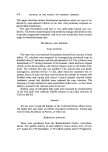
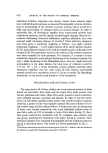
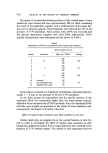
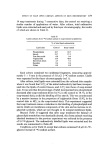
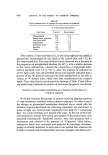
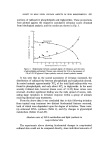
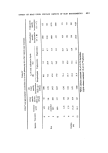
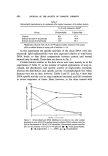
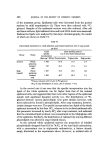
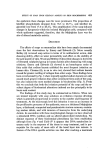
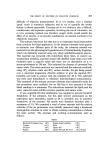
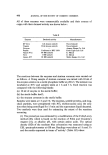
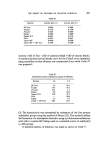
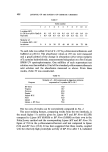
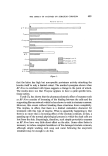
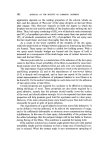
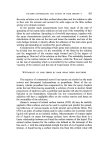
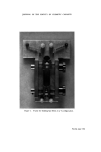
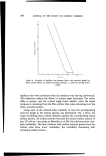
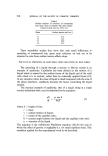
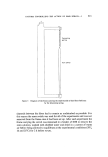
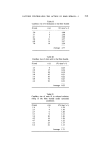
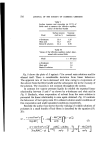
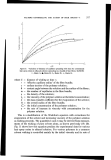
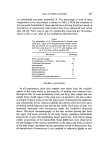
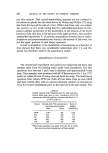
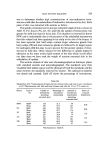
498 JOURNAL OF THE SOCIETY OF COSMETIC CHEMISTS Table V Tube number 1 2 3 4 5 6 7 8 9 10 11 L-cyteine HC1 8X 10⁻²M at pH 6.5 (ml) 0 0.1 0.2 0.3 0.4 0.5 0.6 0.7 0.8 0.9 1.0 HaO (ml) 1 0.9 0.8 0.7 0.6 0.5 0.4 0.3 0.2 0.1 0 Molarity of L-cysteine HCIx 10 -2 in mixture 0 8 16 24 32 40 48 56 64 72 80 To each tube was added 10 ml of 6 x 10-SM p-chloromercuribenzoic acid buffered at pH 6.5. The absorbance values at 255 nm were measured and a graph plotted of the change in absorption (AA) versus molarity of L-cysteine hydrochloride, measurements being taken on a Pye Unicam SP800 UV spectrophotometer. One millilitre of each supernatant test solution was then added to 10 ml of the standardp-chloromercuribenzoic acid solution and the absorbance measured as above. From these results, Table VI was constructed. Table VI Enzyme Molarity of--SH compounds in digestion mixtures expressed as L-cysteine HCIX 10- • BP Novo 13.0 Trypsin 18.7 Prozyme 62.0 Papain 25.5 Papain W.S. 18.3 Ficin 32.0 Lipase 8.0 Lipase q- BP Novo 72.0 The two sets of results can be conveniently compared in Fig. 1. The most striking feature, comparing results from the two methods, is the much higher 1 h activity given by Lipase MY and BP Novo (0.1250) compared to Lipase MY (0.0050) or BP Novo (0.0050) on their own in the Folin/Lowry method and the corresponding Lipase MY and BP Novo 3-h figure of 72.0 in the p-chloromercuribenzoic acid test compared to lipase (8.0) and BP Novo (13.0). It has been suggested that these results, coupled with the relatively high proteolytic activity of BP Novo after 3 h, indicated

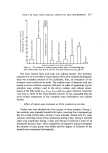
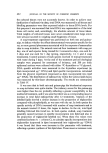
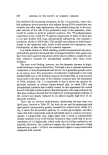
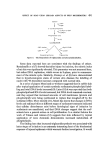
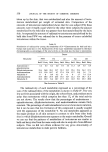
THE EFFECT OF ENZYMES ON STRATUM CORNEUM 499 Relatve activity B P Novo Tryp s/• Prozyma Papain Papa/n Lipase __ f///////////////////////////////////////////A ::::::::::::::::::::::::::::::::::: //////////////////////////////////////A :::::::::::::::::::::::::::::::::::::: :::::::::::::::::::::::::::::::::::::::::::::::::::::::::::::::::::::::::::::::::::: • Proteolysis at • Proteolysis at 3h. ß .:..'• Keratolysis at 3h. Lipase + Figure 1. that the latter has high but non-specific proteinase activity attacking the keratin itself to only a limited extent. The marked synergism shown when BP Novo is combined with lipase suggests a change in the point of attack. The results show too that Prozyme appears to have a quite specific kera- tinase action. Turek (7), has shown that the pharmacodynamic effect of enzymes such as BP Novo consists of loosening of the binding between the cells and the supporting fibrous network which he has shown to exist in stratum corneum. However, this occurs without breaking these structures down completely. This implies, in effect, that there is a distinct cumulative character for treatment with this type of enzyme. What is apparently happening is that there is no more than a loosening effect of the stratum corneum in fact, a speeding up of the normal physiological process in which the dead cells are lost from the skin. Surprisingly, therefore, such simple proteolytic enzymes as BP Novo have very little direct effect on the skin. Some other factor is necessary to induce complete breakdown of the damaged stratum corneum, although simple washing with soap and water following the enzymatic treatment may be enough to do this.
Purchased for the exclusive use of nofirst nolast (unknown)
From: SCC Media Library & Resource Center (library.scconline.org)