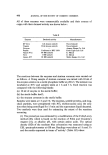
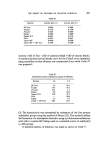
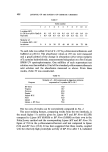
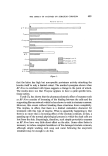
MALE PATTERN BALDNESS 525 greater with increasing age (8) and by the age of 50, 60 per cent of all Caucasian males have at least some baldness of the temples and vertex. Examination of the genetic aspects of male pattern baldness has shown that the condition is inherited as an incomplete dominant trait (9). The studies of Hamilton (10, 11) have shown that male pattern baldness does not develop in subjects who have been castrated before puberty or in those who fail to reach sexual maturity due to gonadal insufficiency. Those subjects who were castrated when already partially bald showed no ex- pansion of the bald areas even 18 years after castration. Perhaps the most convincing demonstration of the involvement of testosterone in baldness was not only that the administration of testosterone propionate to eunuchs caused loss of their scalp hair, provided that there was a suitable genetic background, but that the progress of the hair loss was halted on cessation of the androgenic treatment (10). There is no evidence for a relationship between the levels of plasma or urinary testosterone or related steroids and the degree of baldness. RATIONALE FOR THE STUDY OF ANDROGEN METABOLISM The action of systemic testosterone can be considerably altered at its site of action by local metabolism and relatively small chemical changes in the molecule can produce large changes in biological activity. Thus protein synthesis in the prostate gland, which is an androgen target tissue, is stimulated by dihydrotestosterone, one of the metabolites of testosterone (12). Skin from the chin, forehead, and back of acne sufferers has been demonstrated to convert testosterone to dihydrotestosterone faster than skin from a similar group of subjects without acne (13). We have examined the metabolism of testosterone and related androgenic steroids in human scalp skin in order to determine whether there are differences in this metabo- lism between bald and hairy areas of the scalp. Model systems Initially the use of animals was considered but the only candidates who suffer the equivalent of human male pattern baldness are certain primates, principally the stump-tailed macaque (14) and to a lesser extent the Kenyan wattled starling (Creatophora carunculata). Hamilton (15) has shown that male wattled starlings lose their scalp feathers in the mating season in response to increased secretion of endogenous testosterone and regrow

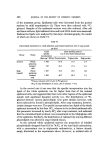
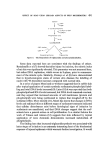
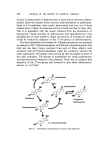
526 JOURNAL OF THE SOCIETY OF COSMETIC CHEMISTS these feathers at the end of the mating season when levels of circulating testosterone fall. Female starlings remain fully leathered throughout the year. We have established a colony of Kenyan wattled starlings at Isleworth and have examined the metabolism of [4-•4C]testosterone in vitro in male starling scalp skin. Unfortunately the pattern of metabolism obtained was unlike that obtained with human scalp skin under identical conditions. METABOLISM OF TESTOSTERONE BY HUMAN SCALP SKIN The incubation experiments with testosterone consisted of two main studies. The first was to identify the products of metabolism in scalp skin and the second was to determine any differences in this metabolism between bald and hairy skin. The trivial names for testosterone and most of its metabolites are used throughout this paper. The corresponding systematic names are: testosterone--17 [3-hydroxyandrost-4-en-3-one androsterone--3a-hydroxy-Sa-androstan-17-one epiandrosterone--3 [3-hydroxy-5 a-androstan- 17-one dihydrotestosterone--17 [3-hydroxy-5 a-androstan-3-one androstenedione--androst-4-ene-3,17-dione andr ostanedione--5 a-androstane- 3,17-dione Identification The first experiment was performed with skin taken (under general anaesthesia) from the semi-bald scalp of a healthy male subject by means of a 3.5-mm diameter biopsy punch. The thickness of these specimens was 3-4 mm in order to include the hair bulbs. The tissue was stored at 0 ø for 4-5 h until its incubation with [4-•4C]testosterone for 5 h at 37øC with shaking under air in tissue culture medium 199. The relevant control incubations were also performed. An aliquot of the acetone extract of skin was chromatographed on a thin-layer plate with standards and autoradio- graphed. Further aliquots were then separated into their individual radio- active components by preparative layer chromatography. Identification of these components was accomplished by thin-layer chromatography, gas- liquid chromatography, and crystallization to constant specific activity after dilution with inactive material. This procedure demonstrated the presence of unchanged testosterone, 5a-androstane-3a, 17 [3-diol, androsterone, epi- androsterone, dihydrotestosterone, androstenedione, androstanedione, and
Purchased for the exclusive use of nofirst nolast (unknown)
From: SCC Media Library & Resource Center (library.scconline.org)