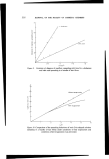
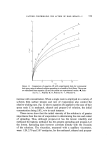
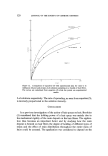
FACTORS CONTROLLING THE ACTION OF HAIR SPRAYS--I 521 wetting properties of the solvent on the hair and the amount of 'flow-out' of the spray droplets landing on the fibres. Brookins found that with dry sprays some coalescence of droplets occurred on the fibres leading to the formation of definite bonding or bridging between adjacent fibres. With a wet spray much more coalescence took place and broader cross links were formed giving greater holding power. The strength of holding was found to be dependent on the much higher area of contact between the resin and the hair junctions. The present study goes further than this previous work of Brookins. Thus the dependence of the hair spray action on the wettability of the hair fibres by the spray droplets has been studied more precisely in terms of surface chemistry concepts and the 'flow-out' of the resin solutions on the hair defined in terms of capillary spreading. The evidence now shows that wettability is less important than 'flow- out'. For conventional hair spray solvents, surface tension values for the solvents are below the critical surface tension of human hair fibres and complete wettability will result. The spreading of hair spray resin solutions in hair has been studied showing that the Washburn equation for capillary spreading cannot be used to describe this process. Corrections must be made to allow for evaporation of the solvent and consequent increase in the viscosity of the solution. A new equation has been derived which allows for these factors and which can be used to predict experimental behaviour. The equation shows that the 'flow-out' is controlled mainly by the initial viscosity of the solution and by the rate of evaporation of the solvent. The importance of adhesion of hair spray resins to the hair fibres is also discussed. This will be the subject of a future communication. (Received: 27th July 1972) REFERENCES (1) Brookins, M. G. The action of hair sprays on hair. J. $oc. Cosmetic Chem. 16 309 (1965). (2) Feldtman, H. D. and McPhee, J. R. The spreading and adhesion of polymers on wool. Text. Res. J. 34 634 (1964). (3) Hearle, J. W. S. and Newton, A. Text. Res. J. 38 488 (1968). (4) Tikhomirov, V. B. Dokl. Akad. Nauk. $SSR 167 207 (1966). (5) Tikhomirov, V. B. and Gusev, V. E. Tech. Text. Ind. USSR I 103 (1966). (6) McBain, J. W. and Hopkins, D. G. J. Phys. Chem. 29 188 (1925). (7) McBain, J. W. and Lee, W. B. Adhesives and adhesion. Ind. Eng. Chem. 19 1005 (1927). (8) Zisman, W. A. Advan. Chem. Ser. 43 1 (1964).

522 JOURNAL OF THE SOCIETY OF COSMETIC CHEMISTS (9) (10) (11) (12) (13) (14) (15) (16) (17) (18) (19) (20) Mutchler, J.P., Menkart, J. and Schwartz, A.M. Rapid estimation of the critical surface tension of fibres. Pesticidal Formulation Res. 86 7 (1969). Alter, H. and Cook, H. The effect of adsorbed water on the critical surface tension of hair. J. Colloid $ci. 29 439 (1969). Rance, R. W. The effect of relative humidity on the spreading of ethanol on human hair fibres. J. Colloid. $ci. 41 588 (1972). Miller, B., Coe, A. B. and Ramachandran, P. N. Liquid rise between filaments in a V-configuration. Text. Res. J. 37 919 (1967). Dyba, R. V. and Miller, B. Evaluation of wettability from capillary rise between filaments. Text. Res. J. 39 962 (1969). Harkins, W. D. and Jordan, H. F. A method for the determination of surface and inter- facial tension from the maximum pull on a ring. J. Amer. Chem. See. 52 1751 (1930). Schwartz, A.M. and Rader, C. A. Recent developments in surface physics of interest to cosmetic science. J. Sec. Cosmetic Chem. 13 245 (1962). Washburn, E. W. The dynamics of capillary flow. Phys. Rev. 17 273 (1921). Minor, F. W., Schwartz, A.M., Buckles, L. C. and Wulkow, E. A. Pathways of capillary migration of liquids in textile assemblies. Am. DyestuffRepr. 49 37 (1960). Minor, F. W. and Schwartz, A.M. The migration of liquids in textile assemblies. Textile Res. J. 29 931 (1959). Rance, R. W. The capillary penetration of volatile liquids into porous systems. L To be published. Rance, R. W. The capillary penetration of volatile liquids into porous systems. II. To be published.
Purchased for the exclusive use of nofirst nolast (unknown)
From: SCC Media Library & Resource Center (library.scconline.org)