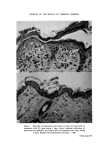
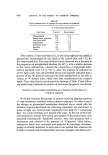
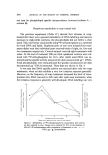
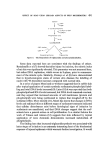
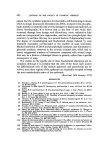
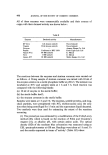
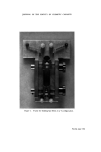
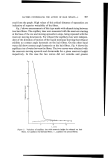
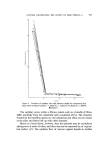
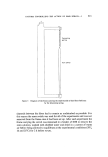
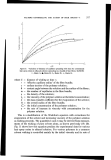
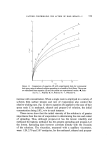
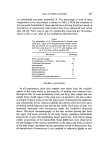
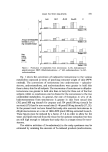
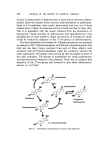
FACTORS CONTROLLING THE ACTION OF HAIR SPRAYS--I Tensioning spring Hair switch Figure 7. Diagram of the frame carrying the small bundle of hair fibres held taut by the tensioning spring. 513 channels between the fibres had to remain as undisturbed as possible. For this reason the same switch was used for all of the experiments and was not removed from the frame once it had been set up. After each experiment the frame carrying the switch was immersed in a beaker of IMS to remove the resin solution, washed with distilled water and dried in a current of warm air before being allowed to equilibrate at the experimental conditions (50•o rh and 25øC) for 2 h before re-use.

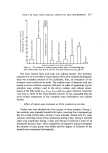
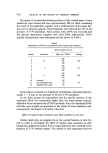
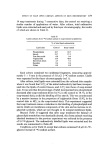
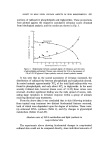
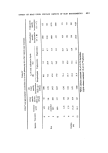
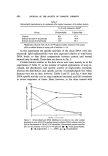
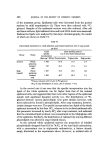
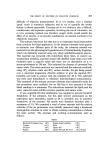
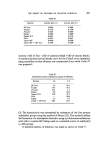
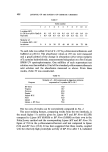
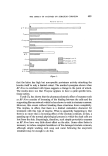
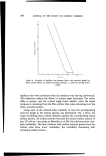
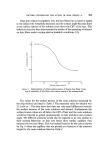
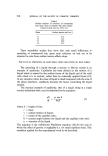
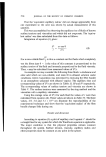
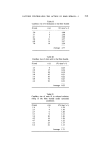
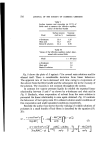
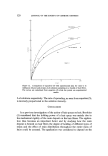
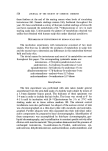
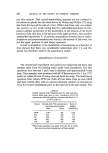
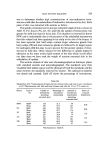
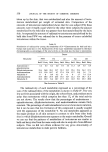
514 JOURNAL OF THE SOCIETY OF COSMETIC CHEMISTS That the 'equivalent capillary radius' did not change appreciably from one experiment to the next was shown by actual measurement of this quantity. This was accomplished by observing the capillary rise of fluids of known surface tensions and viscosities and which did not evaporate. The 'equiva- lent radius' was then calculated from this data as follows. Integration of equation (1) gives: S9. ¾r cos 0 t 211 (4) 8 9. For a non-volatile fluid -- is thus a constant and for fluids which completely t wet the fibres (cos 0 = 1) the value of this constant is proportional to the surface tension of the fluid and inversely proportional to the fluid viscosity. Thus, r may be calculated from measured values of Sg./t. As examples we may consider the following three fluids: n-dodecane and oleic acid which are non-volatile, and resin D in ethanol solution under conditions where evaporation was prevented by enclosing the fibre bundle in an atmosphere saturated with ethanol vapour. The capillary rises and corresponding values of Syt are shown in Tables II, III and IV respectively. The corresponding values of surface tension and viscosity are shown in Table V. The surface tensions were measured by the ring method and the viscosities with a capillary viscometer. Using the average value of S•/t for each fluid the values of r were then calculated from equation (4). These values are shown in Table VI. The three values, 2.9, 3.4 and 3.1 x 10 -a cm illustrate the reproducibility of the experimental technique and show that the 'equivalent radius' of the fibre bundle changes little during use. Results and discussion According to equation (3) a plot of capillary rise S against t ! should be a straight line for any system for which the Washburn equation is applicable. The major condition is that the physical properties remain constant throughout the system. Surface tension, viscosity, capillary radius and other properties must be constant at any point in the system.
Purchased for the exclusive use of nofirst nolast (unknown)
From: SCC Media Library & Resource Center (library.scconline.org)