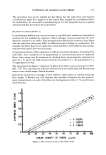
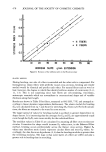
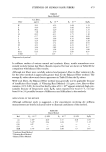
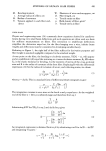
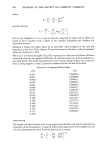
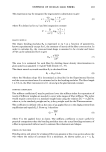
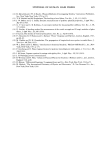
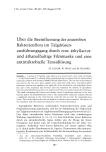
J. Soc. Cosmet. Chem., 29, 469-485 (August 1978) Stiffness of human hair fibers G. V. SCOTT and C. R. ROBBINS Colgate-Palmolive Research Center, 909 River Road, Piscataway, NJ 08854. Received November 3, 1977. Presented at Annual Scientific Meeting, Society of Cosmetic Chemists, December 1977, New York, New York. Synopsis The STIFFNESS of COMPONENT FIBERS is known to be important to the behavior of a fiber mass, but measurements are lacking in the cosmetic literature probably because of experimental difficulties with published methods. Recognizing this, we devised a simple method to compare fibers for stiffness. A fiber with a small weight on each end is draped over a wire and the distance ("D") between the vertical legs is measured. Fibers with a wide range of thicknesses clearly showed that values of"D" relate linearly to cross- sectional areas, as expected of "stiffness." This prompted a theoretical study which yielded equations in terms of"D" for calculating, e.g., elastic bending moduli and shapes of hanging fibers. Empirical and theoretical guides are given for selection of wire diameter and fiber weights. The average elastic modulus for bending fibers, assumed round in cross section, is approximately equal to that for stretch- ing the same fibers. Fiber stiffness is affected by humidity and chemical treatments but is relatively unaf- fected by shampoos. INTRODUCTION The stiffness or resistance to bending of individual fibers unquestionably plays an im- portant role in determining the behavior of any assembly of fibers. Textile literature (1-7) recognizes this importance in attempts to relate fiber stiffness to such fabric properties as flexibility, drape, handle, crease resistance and wear. Although changes in fiber stiffness must likewise affect manageability, body, combing, wave retention and handle of human hair (8, 9), the few hair measurements reported are mainly found in wool research literature (4, 10, 11). Several reasons may account for the lack of hair re- search in this area. Measurement of fiber stiffness has been an experimentally difficult task. Our need for measurements arose during a• investigation of effects on hair produced by polymeriza- tion within the fibers. Appreciable tensile increases were achieved, but we wished to directly measure changes in fiber stiffness. Sophisticated methods, each with appro- priate theory, were reviewed in the textile literature. Many articles depended on deflection of very short fiber segments treated as cantilever beams, either end-loaded (3-5, 7, 12, 13) or center-loaded (2, 6). We tried the end-loading approach with only partial success. A "loop deformation" method (1, 6, 12) was rejected because fiber 469

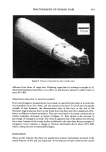
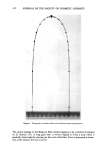
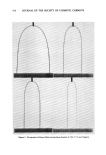
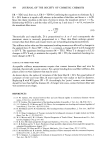
470 JOURNAL OF THE SOCIETY OF COSMETIC CHEMISTS rings had to be very carefully made round, in one plane and small, 1 to 2 cm in diameter. Both beam and loop methods required precise measurement of very small deflections and forces. A dynamic procedure using short lengths of fibers as vibrating reeds (3, 6, 10, 11, 14) seemed experimentally more attractive, but we preferred a static or quasi-static (10) method for relating to hair behavior. No other methods re- viewed offered better prospects for routine screening of hair treatment effects. Changes in fiber strength are conveniently monitored by conventional tensile measure- ments which presumably serve as indirect measures of fiber stiffness. Controversy exists, however, as to the equivalence of elastic moduli calculated from stretching and from bending keratin fibers (3-5, 11). Unlike stretching, fiber bending involves both extension and compression with greatest strains near peripheral points of the fiber cross section. As a consequence, if fiber strength is affected chiefly in outer portions of a fiber, treatment effects may be detected more readily by stiffness than by tensile measurements. Aside from means for estimating stiffness, a question remains as to the extent to which hair fiber stiffness can be altered by practicable hair treatments. Few current hair products of the nondamaging variety can be expected to produce more than superficial effects on stiffness. With a convenient measuring means available, however, perhaps this can be changed. Essential working details of a simple method for measuring hair fiber stiffness were first disclosed in a very brief communication (15). The present paper describes the com- plete method giving information which includes a theoretical basis for equations, ex- perimental data obtained on hair fibers and how these data relate to other measured properties of the same fibers. For easier reading, theoretical equations are derived in the Appendix with appropriate equations brought forward where needed in the text. The Appendix also contains a glossary of symbols used in this paper. EXPERIMENTAL MATERIALS AND METHODS Hair fibers used were from a 15-year-old Caucasian female (H), a 12-year-old Cau- casian female (L) and from purchased South Korean hail: (A. Klugman Inc., New York, New York). Unless otherwise specified, the fibers were equilibrated and measured in a room maintained at 60% RH, 75øF. STIFFNESS DETERMINATION (D) The procedure used for determining stiffness is as follows: weights are attached to each end of a fiber by threading the end through a short length of plastic tubing and insert- ing a tapered metal pin in the tubing to wedge the fiber. The weights of pin plus tubing on each fiber end are equal and known exactly. The fiber is carefully draped over a wire hook and a separately hung guide bar is brought into light contact with the fiber legs to hold the fiber plane 'perpendicular to the optical axis of a horizontal cathetometer. The distance between tile two vertical legs is measured several times by moving the distal end upwards, slidfng the fiber to different contact points on the hook. The average distance in centimeters is'expressed as the stiffness index (D) for that fiber.
Purchased for the exclusive use of nofirst nolast (unknown)
From: SCC Media Library & Resource Center (library.scconline.org)