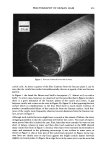
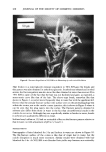
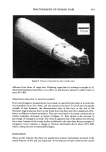
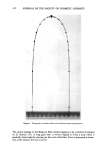
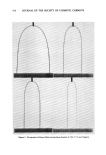
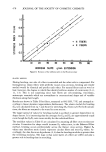
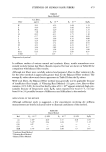
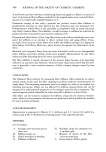
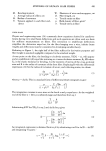
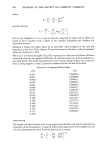
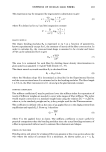
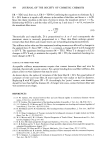
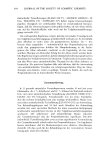
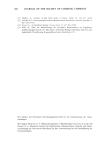
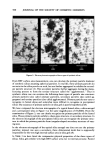
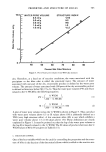
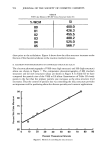
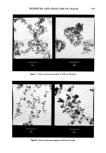
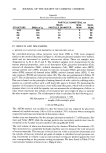
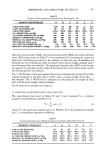
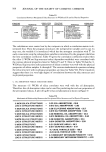
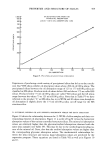
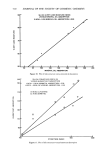
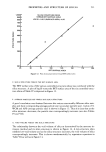
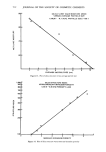
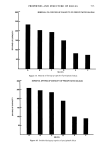
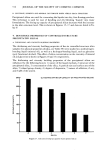
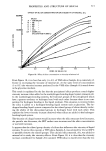
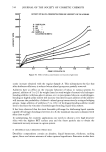
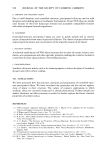
STIFFNESS OF HUMAN HAIR FIBERS 471 For most human hair fibers, a recommended weight of pin and tubing is 0.1 g with a hook wire diameter of 0.75 mm. LINEAR DENSITY DETERMINATION (L) The fiber is measured for length to the nearest millimeter and is weighed to the nearest 0.01 mg using a Roller Smith © 3-mg Precision Balance (Federal Pacific Electric Co., Newark, New Jersey). Results are conveniently expressed as micrograms per cm (L) of fiber. TENSILE DETERMINATION (H) A fiber of 5-cm gauge length is extended at a rate of 0.1 in./min using an Instron © Model TM with Tension Cell A set at 10 g full scale. From the linear portion of the charted trace, the Hookean or elastic slope is estimated as g per mm extension (H) of the 5-cm fiber. RESULTS AND DISCUSSION Although fiber stiffness is important for overall hair performance, no convenient method for measurement of single fibers appeared to be available. Several approaches were tried in an effort to develop an empirical procedure which might be applied for evaluating hair treatment effects. Instron measurement of the work required to draw large hair loops taut between pegs was encouraging but suggested the simpler method described in this paper. A fiber, weighted on each end, is draped over a fine wire and the distance (D) between the vertical legs is measured. The test proved useful on an empirical basis and became more acceptable with development of theory, outlined in the Appendix. The test is referred to below as the "Balanced Fiber" method and the distance between legs as the "Stiffness Index." FIBER SHAPE A fiber was hung in the usual way and photographed. Before theory was developed, at- tempts were made to shape-fit enlargements with simple curves that might empirically characterize the hanging fiber. Our lack of success here is readily explained by the com- plexity of the theoretical equation for fiber shape (Appendix, eq 5). The equation was tested by measuring the enlargement for a D value and calculating values of y at assigned x values. The points coincide with the fiber shape as shown in Figure 1, confirming the theoretical treatment. In another photo, not shown, a pronounced short-length bend just above the vertical part of the fiber had apparently no effect on the otherwise smooth inverted-U shape. A technique of comparing theoretical and photographed fiber shapes may be useful for examining individual fibers for eccentricities. For this purpose, calculations have been simplified by providing computed factors (AppendixmFiber Shape). The distance from the hook to any point along the fiber may also be calculated by applying similar computations to eq 6, Appendix.

472 JOURNAL OF THE SOCIETY OF COSMETIC CHEMISTS Figure 1. Photograph of a balanced fiber with calculated points superimposed The closest analogy to the Balanced Fiber method appears to be a method developed by D. Sinclair (16). A long glass fiber is twisted slightly to form a loop which is gradually drawn tight by moving one free end of the fiber. Force is measured as a func- tion of the distance the end is moved.
Purchased for the exclusive use of nofirst nolast (unknown)
From: SCC Media Library & Resource Center (library.scconline.org)