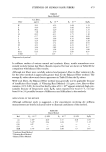
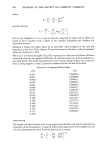
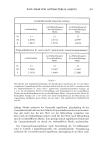
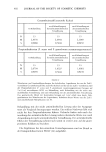
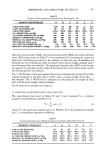
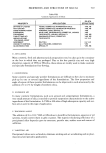
STIFFNESS OF HUMAN HAIR FIBERS 479 Table II Elastic Moduli a Lin. Dens. Fiber /zg/cm EB' 10 -•ø Es' 10 -•ø EB/Es K 99.5 4.23 3.68 1.15 L 94.9 3.54 3.82 0.93 K 89.2 4.29 3.43 1.25 L 71.8 4.25 3.83 1.11 H 69.2 4.11 3.75 1.10 L 67.7 3.35 3.96 0.85 L 54.6 3.60 4.12 0.88 L 52.9 4.69 3.98 1.18 H 52.6 3.74 4.03 0.93 H 42.3 3.23 4.21 0.77 L 34.4 2.89 4.33 0.67 H 31.3 3.58 3.59 1.00 Aver. 63.4 3.79 3.89 0.97 % SD -- 13.9 6.7 -- aExpressed as dynes/cm 2. In stiffness studies of various natural and synthetic fibers, textile researchers occa- sionally include human hair fibers. Results reported for hair are shown in Table III for comparison with balanced fiber results. Although test fibers were carefully selected and prepared, fiber-to-fiber variation in EB for the other methods is appreciably greater than for the Balanced Fiber method. The average Es values show much better agreement in Table III than the EB values. With wool fibers, the Balanced Fiber method may generally not be applicable because of insufficient fiber length. A Vibrating Reed Method (! !) gave a low, fiber-to-fiber variation (12% S.D.) for wool but the EB value of 8 X 10 •ø appears relatively high, pre- sumably because of frequencies used. EB/Es ratios reported for wool (3-5, ! 1) vary from 0.4 to 3.4, possibly because of differences and difficulties in the methods. APPLICATIONS OF THE METHOD Although additional study is suggested, a few experiments involving dry stiffness measurements are briefly indicated below to illustrate usefulness of the method. Table III Elastic Moduli Ref. E8 ' 10 -•ø % S.D. Es ß 10 -•ø % S.D. En/Es (4) 1.95 • 40.9 3.57 16.8 0.55 (11) 5.35 b 22.4 3.68 7.7 1.45 (10) 4.9 b .... (19) -- -- 3.60 -- -- S&R 3.79 c 13.9 3.89 6.7 0.97 Cantilever Beam Method. •Vibrating Reed Method. Balanced Fiber Method.

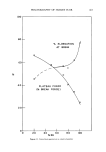
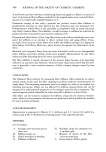
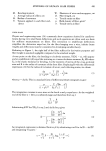
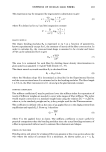
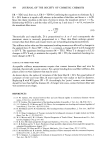
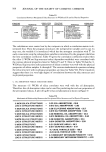
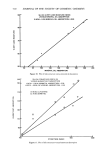
480 JOURNAL OF THE SOCIETY OF COSMETIC CHEMISTS A well known product with hair conditioning claims was applied to fibers in a variety of ways. A decrease in fiber stiffness resulted but the original values were restored follow- ing use of a commercially available shampoo (23). Permanent waving of hair with a personal use product caused fiber stiffness to progressively decrease as time allowed for the reduction step was increased (23). Polymerization within fibers is also generally accomplished with an initial reduction step which weakens fibers. Nevertheless, overall increases in stiffness are achieved by proper selection of monomers and reaction conditions (23). Proximal and distal halves of four long fibers from each of three individuals were com- pared for stiffness in an attempt to detect normal wear and aging effects. Unex- pectedly, distal sections of nine fibers were stiffer and stiffness averaged 2% higher for distal halves of all fibers. Moreover, linear density was greater for distal halves of six fibers. Bleached and untreated fibers from the same individual could not be distinguished when stiffness and linear density results were graphed. Measurement of same fibers before and after bleaching should be more discriminating. Dry fiber stiffness is mainly discussed in the present paper because of its important influence on a person's hair behavior. However other experiments show that wet stiff- ness is generally a more sensitive measure of fiber strength changes caused by hair treatments. CONCLUSIONS The Balanced Fiber method for measuring fiber stiffness offers simplicity in experi- mental setup, avoids need for fiber clamping and allows replicate measurements on single fibers. The measuring instrument may be as simple as a ruler or as complex as a traveling microscope. Fibers are not affected by stiffness measurements and can be measured for other physical properties or for changes caused by fiber treatments. The method appears readily adaptable for other materials in filament or sheet forms. Hair fibers can be routinely compared for stiffness using only the distance measure- ment. However this parameter has theoretical significance which qualifies the method for use in research programs. ACKNOWLEDGEMENT Appreciation is expressed to Messrs. E. J. Gibbons and J. C. Jervert for useful dis- cussions and to Ms. P. Redman for obtaining much of the experimental data. APPENDIX LIST OF SYMBOLS A. Average cross-sectional areaof fiber, cm 2 D. Stiffness index, cm EB. Elastic modulus for bending G. Stiffness coefficient H. Hookean slope for extension of a 5-cm fiber, g/m I. Moment of inertia of the fiber cross-sectional area L. Linear density of fiber,/zg/cm
Purchased for the exclusive use of nofirst nolast (unknown)
From: SCC Media Library & Resource Center (library.scconline.org)