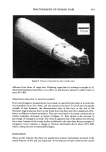
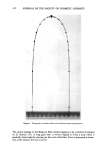
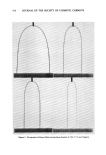
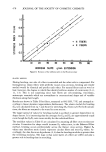
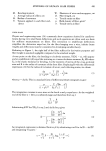
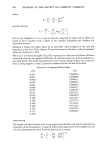
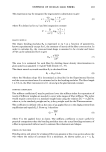
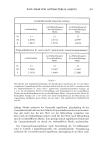
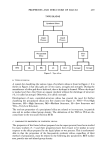
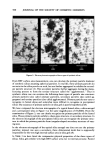
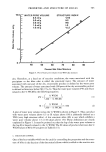
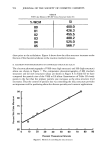
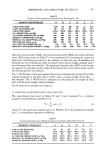
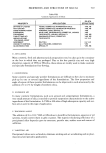
STIFFNESS OF HUMAN HAIR FIBERS 481 M. Bending moment r. Average radius of a fiber, cm R. Radius of curvature T. Tension applied to each fiber end, dynes W. Diameter of wire used assupport, cm Z. Fiber length, cm e. Tensile strain on fiber p. Bulk density of fiber, g/cm a (r. Tensile stress in fiber FIBER SHAPE Physics and engineering texts (24) commonly show equations derived for cantilever beams having very small beam deflections and such equations are often used as a basis for stiffness measurements on fibers. The restriction to small-beam deflections simplifies the derivation steps but, for the fiber hanging over a wire, infinite beam lengths and deflections must be considered in developing suitable theory. Referring to Figure 1, the right half of the fiber suffices for derivation purposes and fiber weight is assumed negligible compared to the attached weight. At any point on the fiber, the bending or clockwise moment, T(D/2 - x), will oppose and at equilibrium will equal the restoring or counterclockwise moment, EB I/R where EB is the elastic modulus for bending, I is the moment of inertia of the cross-sectional area and R is the radius of curvature of the bent fiber. Replacing R with the differential expression (24) for the radius of curvature of an arc, and collecting terms, we obtain - -x dx (1) (1 + p2)a/2 En I where p = dy/dx. This is a standard form of differential which integrates to give (1 + p2)•/= E. I ' (2) The integration constant is zero since at the hook x and p equal zero. At the weighted end of the fiber x = D/2, p is infinitely large and therefore from eq 2 T 8 EB I D • (3) Substituting 8/D • for T/EB I in eq 2 and dy/dx for p gives 4x'/dx D=/ dy = (4) _ _ 4x'/'l An integrated expression is obtained from eq and integrating "by parts." 4 by substituting cos 0 for 4x/D - 4x2/D 2 D D I+F 1og• I + C (5) 1-F

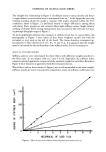
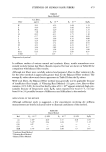
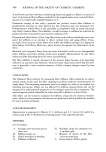
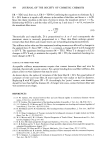
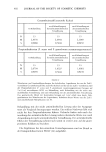
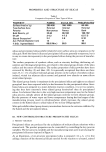
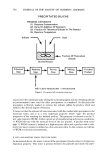
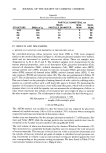
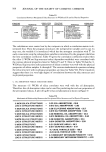
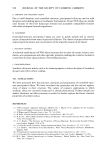
482 JOURNAL OF THE SOCIETY OF COSMETIC CHEMISTS where and the constant -D D X/•+ 1 C - + logo -- For us, the integration of eq 4 was an exercise requiring 40 steps and no effort was made to find a shorter route. Copies of the detailed integration are available for interested persons. Equation 5 defines the shape taken by an ideal fiber when weighted at the ends and hung from a fine wire. Only distance D must be known to calculate y values at assigned values ofx from zero to D/2. When eq 5 is divided through by D, y/D is expressed as a function ofx/D and y/D has a numerical value at each assigned x/D value. A computer print-out of these quantities is provided below. For any D measurements, x and y values along the fiber are readily ob- tained. Using negative x values, points are obtained for the left half of the fiber. Factors •r Computing FiberShape x/D -y/D 0.001 0.000002 0.002 0.000008 0.0025 0.000012 0.004 0.000032 0.005 0.000050 0.008 0.000127 0.010 0.000199 0.025 0.001232 0.050 0.004878 0.100 0.019335 0.200 0.079170 0.300 0.194416 0.400 0.423225 0.450 0.664291 0.475 0.908362 O.5O0 FIBER LENGTH The length z of fiber from the wire to any point along the fiber may also be expressed as a function of the D parameter. Using the differential expression for the length of an arc (25) and substituting the value for dy/dx from eq 4, we obtain az_ 1- (• D2/j dx
Purchased for the exclusive use of nofirst nolast (unknown)
From: SCC Media Library & Resource Center (library.scconline.org)