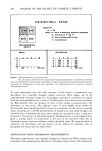
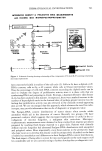
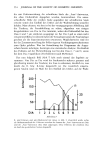
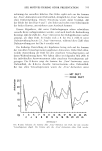
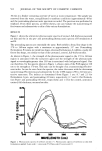
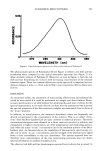
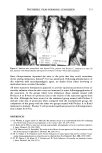
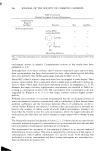
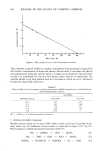
564 JOURNAL OF THE SOCIETY OF COSMETIC CHEMISTS use" situations the sunscreen provides protection over a broader wavelength region than that determined by dilute solution optical absorption investigation. A broadened sun-protective region can be beneficial in designing a UVB-UVA (290 to 320, 320 to 400 nm) regions sunscreen product, where maximum blockage of both the burning rays (290 to 320 nm) and tanning rays (320 to 400 nm) is desired. However in designing a UVB region sunscreen product, where the desire is to block only the burn- ing rays and allow for the tanning rays to penetrate the skin, the observed spectral shift and broadening may be detrimental because a substantial portion of the line shape may fall within the tanning region and thereby minimize the desired effect. The photoacoustic spectral data shown in Figure 1 and the derived sunscreening effec- tiveness indices show that Formulation B is much more substantive to skin and is therefore a more effective postsoaking UVB region sunscreen when compared to Formulation A. In a recent well controlled double-blind clinical study (9) the sunscreening effective- ness and substantivity of commercially a,Jailable sunscreens similar to Formulations A and B were tested under controlled conditions of saltwater swimming at a beach. The result of this study showed that, postswimming, the commercially available product similar to Formulation B provided statistically significant better protection than the commercially available product similar to Formulation A. CONCLUSION The excellent agreement between the sunscreening effectiveness assessments as reported here by the use of photoacoustic spectroscopy and the clinical sunscreening beach study show that one can, in a rapid, simple and direct manner, use the new tech- nique to evaluate undiluted sunscreen formulations in situ and under "in use" situa- tions. ACKNOWLEDGMENTS Special thanks to Drs. J. Mezick, J. Sequeira and M. Augustine (Johnson & Johnson Dermatological Division) for providing the sunscreen formulations and encouraging helpful discussions, Dr. Allan Rosencwaig for his advice and assistance in building the spectrometer and Gilford Instruments Laboratories, Inc., Oberlin, Ohio, for making the photoacoustic cells available to us. REFERENCES (1) N. S. Lucas, The permeability of human epidermis to ultraviolet irradiation, Biochem. J., 25, 57 (1931). (2) W.J. Runge and R. M. Fusaro, Biophysical considerations of light protection, J. Invest. Dermatol., 39, 431 (1962). (3) M. A. Everett, E. Yeargers, R. M. Sayre and R. L. Olson, Penetration of epidermis by ultraviolet rays, Photochem. and Photobid., 5, 535 (1966). (4) A. Rosencwaig, Photoacoustic spectroscopy--a new tool for investigations of solids, Anal' Chem., 47, 592A (1975). (5) A. Rosencwaig, Photoacoustic spectroscopy of solids, Physics Today, 28, 23 (1975). (6) A. Rosencwaig and E. Pines, A photoacoustic study of newborn rat stratum comeurn, B•ochim. Biophys. Acta, 493, 10 (1977). (7) A. Rosencwaig and A. Gersho, Theory of the photoacoustic effect with solids, J. Appl. Physiol., 47, 64 (1976). (8) Gilford Instruments Laboratories, Inc., Oberlin, Ohio. (9) P.M. Catalano and D. D. Fulghum, A water-resistant sunscreen, Clin. Experm. Dermatol., 2, 127 (1977).

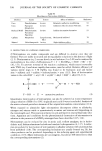
J. Soc. Cosmet. Chem., 29, 565-571 (September 1978) Evaluation of a polymeric film-forming sunscreen preparation in tranquilized hairless mice C. W. STOTT, J. SUSKEVICH and A. H. CAMPBELL Johnson Johnson Research Foundation, New Brunswick, NJ 08903. Received December 15, 1977 Synopsis A method is described for the EVALUATION of SUNSCREEN PREPARATIONS using HAIRLESS MICE. The mice were treated with TRANQUILIZERS to prevent removal of the agents by grooming. Three preparations were evaluated: 5 % p-aminobenzoic acid in absolute ethanol 5 % p-aminobenzoic acid in 55% ethanol with skin moisturizers, and 3.3% octyl dimethyl p-aminobenzoate in a vehicle that forms a polymeric coating on the skin. Each product was evaluated two ways: 1) exposure to fluorescent sun lamps and 2) immersion in water followed by exposure to the sun lamps. All three products provided comparable protection, provided the animals were not immersed in water. Only the product which formed a POLYMERIC FILM provided suitable protection following immersion in water. INTRODUCTION Although the ultimate subject for sunscreen preparations is man, preliminary screen- ing of such preparations in laboratory animals is desirable. Wolska et al. (1) have raised the question of the advisability of producing large areas of hyperpigmentation in human subjects in preliminary screening. Also the variation in the amount of pig- mentation from subject to subject, and perhaps even between sites on the same sub- ject, may tend to increase the difficulty of evaluation of the amount of protection af- forded by different agents. Physical methods (2, 3) in which the absorption characteristics of potential sunscreen agents are measured may be important in preliminary screening, such as the selection of compounds which absorb ultraviolet (UV) irradiation in the desired range and de- termination of the concentration of the agent in the product. The real test of efficacy, however, is the amount of protection afforded in vivo against biological damage during exposure to UV irradiation. A number of laboratory animal species have been used in testing the effects of UV irradiation on normal and treated skin. Most of these, however, require the use of a depilatory or afford a very small area of relatively hair-free skin on which to conduct testing. We have found that the clipped abdominal skin of albino rabbits is markedly sensitive to many of these materials adding an additional impediment to evaluation of 565
Purchased for the exclusive use of nofirst nolast (unknown)
From: SCC Media Library & Resource Center (library.scconline.org)